Press Release 16/04/2014
The population in work fell by 0.5% and the unemployment figure stood at 15.5% in the first quarter of 2014 in the Basque Country
The activity rate remained at 57.2%, but the employment rate fell by three tenths of a percentage point
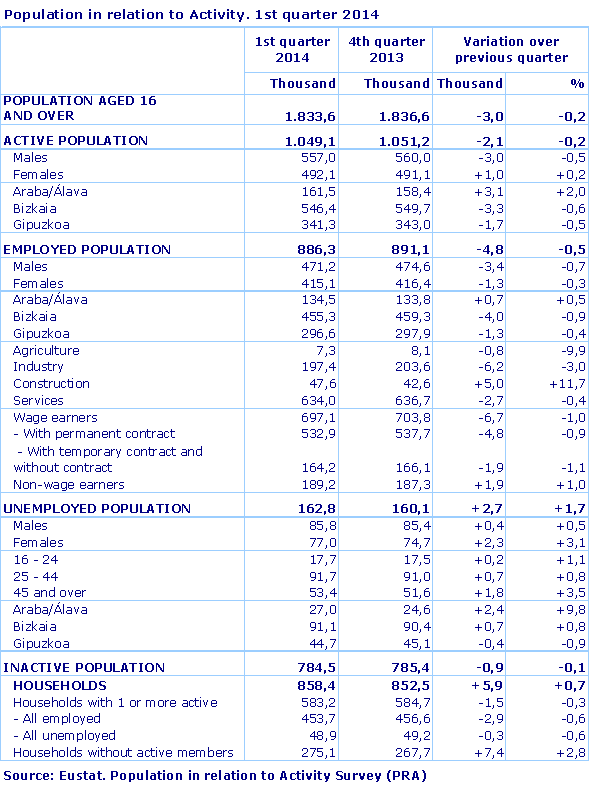
The data from the labour market in the Basque Country from the first quarter of 2014 showed that there were 886,300 people in work, which was a net decrease of 4,800 compared with the previous quarter (-0.5%), according to Eustat data. Furthermore, the unemployment rate of the Basque Country stood at 15.5%, 0.3 percentage points up on the fourth quarter of 2013.
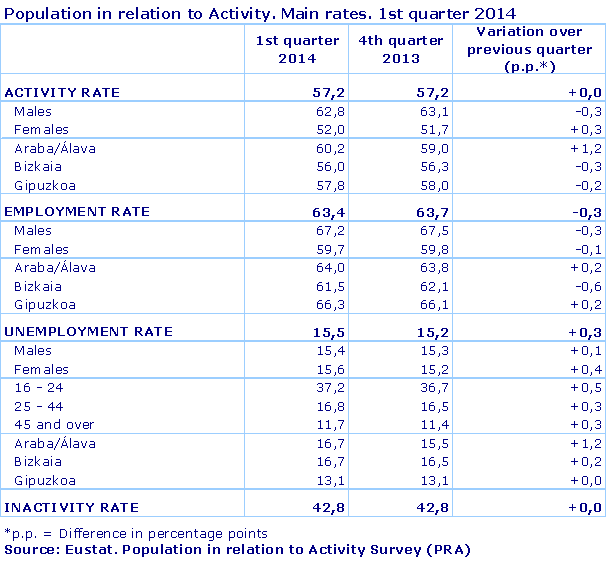
As a result of the evolution in the employed and unemployed population, the activity rate stood at 57.2% in the first quarter of 2014, remaining stable with respect to the previous quarter.
The province that saw the biggest fall in employment was Bizkaia with 4,000 fewer employed, followed by Gipuzkoa with 1,300 fewer, while in Álava the number of individuals in work rose by 700. As far as gender was concerned, the drop in employment affected both men, with 3,400 less in work than in the previous quarter, and women, whose number in work fell by 1,300.
The fall in employment was concentrated in industry and services
The working population was down by 6,200 in industry, by 2,700 in the services sector, by 800 in agriculture, whilst in construction it rose by 5,000.
The employment rate, the percentage of people in work aged 16 to 64 over the total for these ages, was down by 0.3 percentage points compared to the previous quarter, standing at 63.4%. This figure stood at 67.2% for men and 59.7% for women.
By province, the highest employment rate turned out to be that of Gipuzkoa, with 66.3% and an increase of 0.2 percentage point compared to the previous quarter; this was followed by Álava, with a rate of 64% and an increase of 0.2 points; lastly, Bizkaia had the lowest rate, with 61.5% and a fall of 0.6 percentage points on the last quarter.
The number of salaried individuals with a permanent contract fell, and stood at 532,900, whilst those on a temporary contract or without a contract brought the total for this group down to 164,200.
In 5.7% of households all active individuals were unemployed
In the first quarter of 2014 it was estimated that there were 858,400 households in the Basque Country (5,900 more than the previous quarter) a third of which did not have any active individuals. In just over half of households, all of the active individuals were in work, 2,900 families less than the previous quarter; furthermore, households where all active individuals were unemployed stood at 48,900 (5.7% of the total).
The unemployment rate rose from 15.2% to 15.5%
The unemployed population in the Basque country, that is, individuals who are available for work, actively making enquiries and seeking employment, was estimated to be 162,800 in the first quarter of the year, 2,700 up on the previous quarter. The number of unemployed men, 85,800 individuals, increased by 400, whilst the number of unemployed women was up by 2,300, reaching a total of 77,000 in the quarter.
The data for the first quarter of 2014 revealed an unemployment rate of 15.5%, 0.3 points up on the previous quarter. The male unemployment rate rose to 15.4% (0.1 percentage points up) and the female rate was up 0.4 points, reaching 15.6%. The youth unemployment rate continued to be the highest, and stood at 37.2%, affecting 17,700 active young people between the ages of 16 and 24.
By province, the greatest increase in the number of people out of work was in Álava (2,400 individuals) where the unemployment rate stood at 16.7%. In Bizkaia, with 91,100 individuals out of work, the number of unemployed rose by 700, with the unemployment rate standing at 16.7%. In Gipuzkoa, unemployment remained stable with respect to the previous quarter and the unemployment rate stood at 13.1%.
According to EUROSTAT – The Statistical Office of the European Union - in February 2014 the unemployment rate of the European Union-28 stood at 10.6% and that of Spain stood at 25.6%.
Methodological note
As from this quarter of 2014, the results of the Survey on Population in Relation to Activity-PRA carried out by Eustat are calculated using the new Population Projection 2026. Eustat updates the Population Projections every five years and those of 2026 use the 2011 Population and Housing Censuses as a population base. The impact of this change on the fourth quarter of 2013, compared to the data published with the previous 2006 population base, derives from the fall in the population aged 16 and over by 37,600 individuals.
Next May all of the information of the period 2006-2013 will be updated with the new population base.
For further information:
Eustat - Euskal Estatistika Erakundea / Instituto Vasco de Estadística
C/ Donostia-San Sebastián, 1 01010 Vitoria-Gasteiz
Press Service: servicioprensa@eustat.eus Tlf: 945 01 75 62
Further press releases on population in relation to activity survey (PRA)
Databank on population in relation to activity survey (PRA)