Press Release 31/03/2014
56% of people in work and 63% of students in the Basque Country travelled outside of their municipality for work or academic reasons
Among them, 120,000 individuals worked or studied outside of their province and 3,600 did so abroad
In the Basque Country, 628,000 individuals aged 16 or over travelled outside their municipality of residence for work or academic reasons in 2011, according to Eustat data.
For work reasons, more than 500,000 individuals aged 16 or over travelled to another municipality for work (56.3% of the population in work) and 1,600 travelled abroad (0.2%). At provincial level, the highest mobility was registered in Bizkaia, where 64.5% of people in work, worked in a municipality other than the one they resided in; in Gipuzkoa the proportion was 56.7% and in Álava, 28.6%.
By regions, labour mobility was highest in Estribaciones del Gorbea (82.6%), Plentzia/Mungia (79.2%), Valles Alaveses (78.3%), Arratia-Nervión (77.5%), Tolosa (76.2%), Encartaciones (70.3%) and Goierri (70.2%). On the other hand, Llanada Alavesa (20.1%) and La Rioja Alavesa (49%) were the regions with the lowest labour mobility.
At the municipal level, work-related travel was especially predominant in municipalities with a small population, where nine out of ten people worked in a municipality other than the one they resided in. At the opposite extreme, the lowest labour mobility occurred in large municipalities such as Irún, San Sebastián and Vitoria-Gasteiz, along with other medium-sized and industrial municipalities such as Azpeitia, Arrasate/Mondragón and Oñati, and finally, in primarily agricultural municipalities in Álava such as Navaridas, Samaniego and Laguardia.
Furthermore, there were significant differences between capitals. In Vitoria-Gasteiz labour mobility affected 15.9% of its population, in San Sebastián 34.6%, and in Bilbao, 41%.
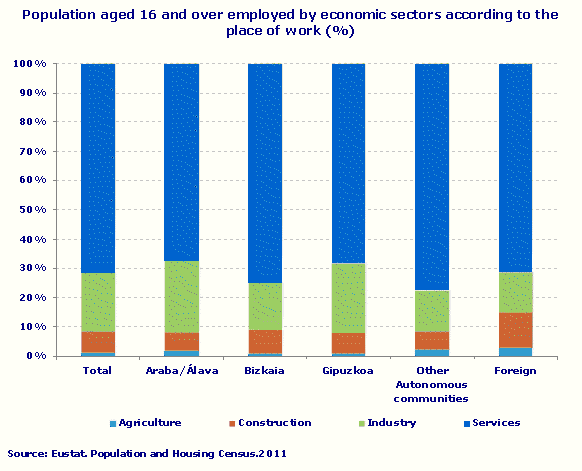
As regards labour mobility between provinces and abroad, this affected 83,000 people in work, or 9.3%, which was 3.6 percentage points higher than in 2001. By economic sectors, the majority of those who travelled for work belonged to the services sector, with an increase of 11.4 percentage points compared to 2001. On the other hand, mobility between provinces and abroad fell by 12.6 percentage points in the industrial sector, going from 32.1% of its working population in 2001, to 19.5% in 2011. Finally, the construction and agriculture sectors showed virtually no variations over the decade: mobility between provinces remained low, at 8% and 2% respectively.
�
Nearly two out of three students aged 16 and over travelled outside of their municipality for academic reasons
According to the 2011 Population and Housing Census of the Basque Country, there were 119,000 individuals aged 16 or over who travelled to another municipality to study (63.2%) and nearly 2,000 who went abroad (1%).
In Bizkaia and Gipuzkoa the proportion of the student population who travelled outside of their municipality was similar - 69.4% in the former, 65.5% in the latter - whilst in Álava the proportion was lower, at 42.7%.
By regions, the highest study-related mobility occurred in Montaña Alavesa, Valles Alaveses, Estribaciones del Gorbea, Arratia Nervión, Plentzia-Mungia, and Rioja Alavesa, where more than 90% of students went to education centres outside of their municipality of residence.
Llanada Alavesa had a particularly low student mobility, as in this region only 33.7% travelled to another municipality to study.
Regarding capitals, mobility for academic reasons was 30.4% in Vitoria-Gasteiz, 33.7% in San Sebastián and 38.7% en Bilbao. These were the municipalities of the Autonomous Community with the lowest academic mobility.
�
In some municipalities with a smaller population size, academic mobility even reached 100% of students, and in 129 municipalities it affected more than 90% of the student population.
Mobility between provinces and abroad for the purpose of study rose by 5.8 percentage points since 2001 and reached a total of 35,700 individuals.
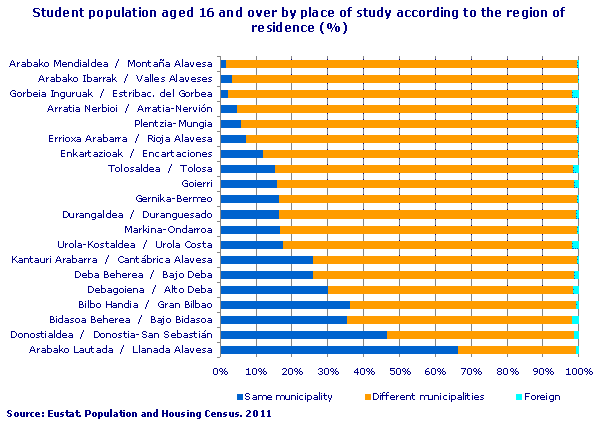
If we consider only the mobility within each province, in Bizkaia it represented 86.6% of total mobility for the purpose of study, 78.6% in Gipuzkoa and 66.7% in Álava.
However, Bizkaia is the province that received the most students, 35%, while Gipuzkoa received 24%, and Álava, 20%. 16% travelled to other Autonomous Communities and 5% went abroad.
For further information:
Eustat - Euskal Estatistika Erakundea / Instituto Vasco de Estadística
C/ Donostia-San Sebastián, 1 01010 Vitoria-Gasteiz
Press Service: servicioprensa@eustat.eus Tlf: 945 01 75 62
Further press releases on the CPV2011 of the Basque Country
Databank on the CPV2011 of the Basque Country