Press Release 21/02/2014
The population of the Basque Country will decrease by more than 100,000 people between 2013 and 2026
In addition to the negative migration balance, there is an increased number of deaths and a fall in the number of births
It is estimated that on 1 January 2026 there will be 2,077,000 inhabitants in the Basque Country, 1,004,000 of which will be men (48.3%) and the remainder, 1,073,000 (51.7%), women, according to Eustat Demographic Projections for 2026. This amounts to a little over 101,000 people fewer than in 2013, with an average annual variation of -0.3%. The greatest year-on-year falls will occur at the end of this decade, with rates of -0.4%, later slowing down towards a rate of -0.3% at the end of the projection period.
Population pyramids of the Basque Country 2013-2026.
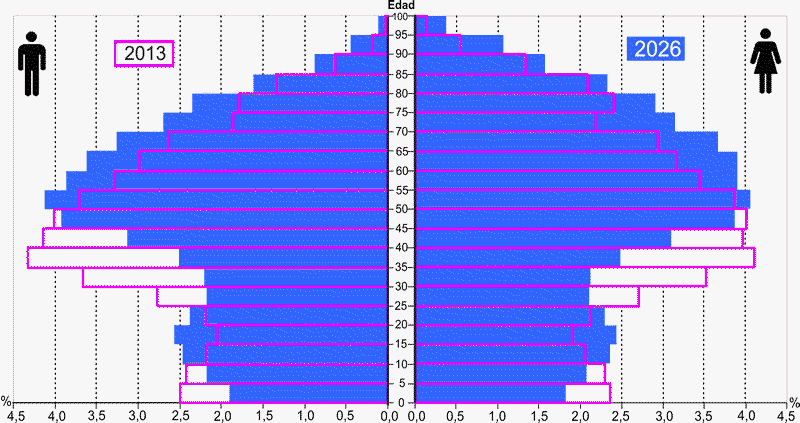
Source: EUSTAT. Demographic Projections 2026. Population on 1 January
A population decrease is predicted in the three provinces, although in differing degrees: Álava will lose slightly more than 6,000 inhabitants, while the population decline in Gipuzkoa will be of about 31,000 people, and in Bizkaia, 65,000. These differences will continue the trend of the most recent five-year periods in the Basque Country as a whole, which have seen a progressive rise in the population weight of Álava at the expense of Bizkaia. It is predicted that in 2026, 15.1% of the population will live in Álava, (1.5 percentage points more than in 2001), 52.3% in Bizkaia (1.5 points less) and 32.6% in Gipuzkoa.
Both components of demographic growth will see negative balances: the natural component (births minus deaths) and the migratory component (immigrations minus emigrations). Natural growth will have increasingly negative balances due to the increase in deaths and the steep decline in births. Regarding the migratory balance, it is estimated that it will be -50,000 inhabitants, a figure similar to that of the natural decline.
The process of population ageing will continue
The population under 20, which represented 17.8% of the Basque Country in 2013, will retain the same weight in 2026, but its number will drop by 18,000 people.
It is estimated that the population of 20 to 64 year-olds will lose 195,000 people, or 15%, over these 13 years, as a result of the decreases of 95,000 from the 20-34 age group and 141,000 from the 35-49 age group, and the increase of over 41,000 in the 50-64 age group.
The population of 65 and over could increase by over 110,000 people, meaning that its weight would reach 26.5% in 2026 - nearly 7 points more than in 2013. Of this total, 32,000 people would belong to the group of 85 and over, which will come to make up 4.6% of the total.
The fertility rate will recover, but the number of births will fall
The number of births in the Basque Country will drop by 21,200 in 2010 to 15,000 in 2025, as the predicted recovery of the fertility rate, reaching up to 1.5 children per mother, will not compensate for the fall in the number of women of fertile age: the reduction of the feminine population between 25 and 39, the primary ages for reproduction, could reach 41% of the initial value.
Life expectancy will continue its upward trajectory
Life expectancy at birth will reach 82.6 years for men and 88.4 years for women in 2025, compared to 79.1 and 85.6 years, respectively, in 2010. The difference in life expectancy at birth between women and men will change from 6.5 years in 2010 to 5.8 in 2026.
The migratory balance will contribute to the fall in population
In 2015 the number of people entering the Basque Country will fall by 18,000 and those coming from abroad will only make up 10% of them - less than 2,000 per year. At the end of the projection period, immigrations are predicted to be above 22,000 and those from abroad to rise to 40% of them - a little under 9,000. Emigrations will show a decreasing trend throughout the projection period, falling from 27,000 in 2012 to 22,000 in 2025.
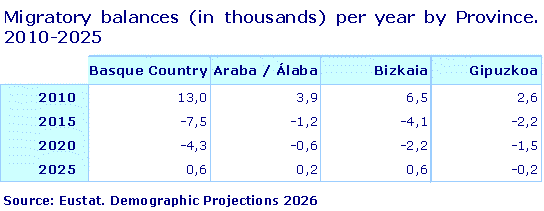
It is estimated that the migratory balance will fluctuate between 2010 and 2025, with positive balances at the beginning of the period; negative balances of about -7,500 per year around 2015, and positive balances, although very slight, at the end of the period.
The migratory balance, which should be negative from the beginning, will be concentrated in the last five-year period of this decade, from 2016 to 2020, when there will be losses of up to 32,000 people of the estimated loss of 52,000 before 2025.
�
In the last two decades of the last century, Álava had positive migratory balances, but the negative balances of Bizkaia and Gipuzkoa were so high that the total population fell, even though there was a positive population growth rate.
The situation changed in the year 2000 when there was a significant increase in immigration, with positive balances for Bizkaia and Gipuzkoa as well; this situation, with increasingly lower balances, continued until 2013. As from this year negative migratory balances are predicted in Gipuzkoa, which is predicted to lose 19,000 people. Bizkaia will return to positive balances in the last two years of the prediction period, meaning that the loss of population through the migratory balance (-25,000 people) will be less than what would correspond to its weight across the Basque Country as a whole. Álava will have negative balances until the last year of the projection, but they will be small and over the whole period they will amount to a reduction of 9,000 people in the population of the province.
The first decade of this century has seen a steady increase in the migratory exchanges between provinces, going from an average of 4,000 in the three-year period 2000-2002, to a little over 5,000 per year from 2010. Part of this increase is related to the foreign population which is characterised by a greater residential mobility.
Nevertheless, despite this increase, the total volume of internal movements is low and its impact on the demographic evolution of the provinces is not very significant, as the internal migratory balances are small. It is estimated that this situation will continue during the projection years, and that the internal migratory balance of the Basque Country will only bring 1,200 people to Álava and 1,000 to Gipuzkoa, at the expense of Bizkaia, which could lose 2,200.
For further information:
Eustat - Euskal Estatistika Erakundea / Instituto Vasco de Estadística
C/ Donostia-San Sebastián, 1 01010 Vitoria-Gasteiz
Press Service: servicioprensa@eustat.eus Tlf: 945 01 75 62
Reports on Demographic Projections, 2026
Databank on Demographic Projections, 2026