Press Release 11/02/2014
The average income of families in the Basque Country exceeded 42,000 euros in 2011
62.5% of families received an income below the Basque Country average
The average family income in the Basque Country in 2011 stood at 42,192 euros, according to the Personal and Family Income Statistics produced by Eustat in collaboration with the Provincial Councils of Álava, Bizkaia and Gipuzkoa. The average income for families overall in the Basque Country exactly corresponded to 2.1 times the average personal income.
The total family income is obtained as an aggregation of the personal incomes of all adult members of the family. As is similar to the case with personal income, Gipuzkoa was the province with the highest family income, 43,589 euros, followed by Álava with 41,727 euros and, lastly, Bizkaia with 41,476 euros.
The average income of families in the Basque Country fell by 1.3% between 2009 and 2011. By province, Álava showed the smallest drop, at 0.7%, followed by Gipuzkoa, where family income fell by 0.8%, and Bizkaia, which had the largest downturn of 1.7%.
�
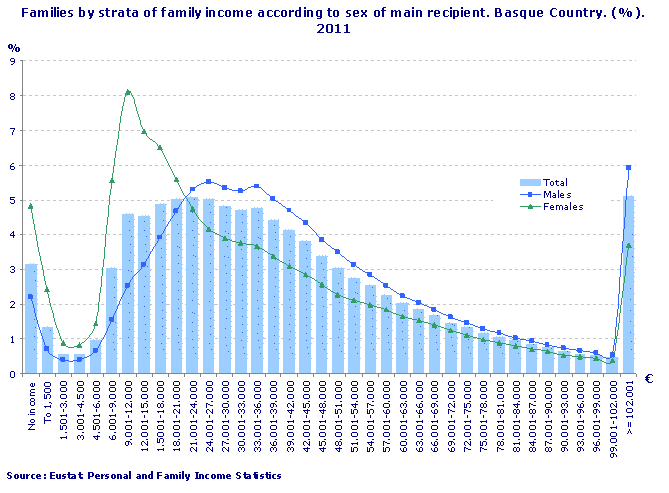
62.5% of families received an income below the Basque Country average or did not receive any income, three percentage points more than the figure for personal income. 3.2% of families did not receive any type of income in 2011. On the other hand, almost 9% of families, specifically 76,329, had an income above twice the average, that is, just over 84,000 euros. In turn, half of families in the Basque Country had an income below 34,104 euros.
Where the main receiver of the family was a male, the families had an average income of 46,513 euros, with the majority of families being concentrated in the intermediate and high strata, whereas if the main receiver was a woman the average income stood at 34,717 euros and was concentrated in the lowest income strata.
Therefore, we may speak of a “gender gap” in family income, due to the existence of inequalities regarding family income depending on whether the main receiver was male or female.
Donostia-San Sebastián was the capital with the highest family income, followed by Vitoria-Gasteiz and Bilbao
Donostia-San Sebastián, with 48,741 euros, was the capital with the highest family income, followed by Vitoria-Gasteiz, with 42,054 euros and Bilbao, with 41,920 euros.
The municipality in the Basque Country with the highest family income was the municipality of Laukiz, located in Bizkaia, with 93,161 euros; in Álava it was Arrazua-Ubarrundia, with 70,355 euros, and in Gipuzkoa it was Arama, with 62,275 euros. On the other hand, those with the lowest family incomes were Elvillar/Bilar in Álava, with 25,826 euros, Karrantza Harana/Valle de Carranza in Bizkaia, with 28,030 euros and Pasaia in Gipuzkoa, with 33,249 euros.
In turn, the gap between the municipalities with the highest and the lowest family incomes exceeded 67,335 euros. In the highest extreme was Laukiz, with 22,806 euros more than the next municipality following it in the list, and the lowest, Elvillar/Bilar, with almost 126 euros less than the municipality preceding it.
At regional level there were also differences between the 20 regions that make up the Basque Country. Of these, 8 obtained family incomes above the average of the Basque Country, amongst which the following stood out: Estribaciones del Gorbea in Álava (51,482 euros), Plentzia-Mungia in Bizkaia (49,421 euros) and Urola Costa in Gipuzkoa (44,960 euros). On the other hand, the 12 remaining regions had family incomes below the average, amongst which the following stood out: Encartaciones in Bizkaia, with 35,443 euros, and Montaña Alavesa and Rioja Alavesa, with 35,196 and 31,793 euros, respectively.
For further information:
Eustat - Euskal Estatistika Erakundea / Instituto Vasco de Estadística
C/ Donostia-San Sebastián, 1 01010 Vitoria-Gasteiz
Press Service: servicioprensa@eustat.eus Tlf: 945 01 75 62
Further press releases on Family and Personal Income of the Basque Country
Database on Family and Personal Income of the Basque Country