Press Release 17/01/2014
The number of people in work remained stable and the unemployment rate reached 15.3% due to an increase in the active population in the fourth quarter of 2013 in the Basque Country
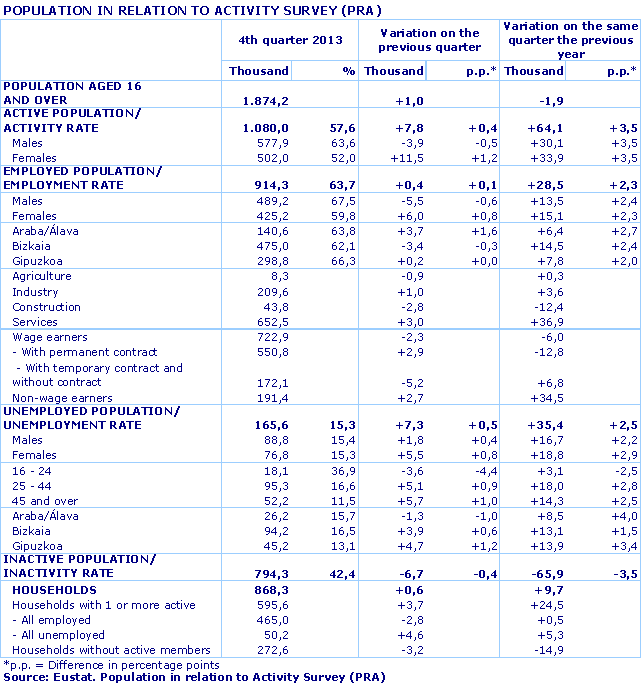
The active population grew by 7,800 individuals, placing the activity rate at 57.6%
The data from the labour market in the Basque Country from the fourth quarter of 2013 showed that there were 914,300 individuals in work, which was a slight increase compared with the previous quarter (400 more jobs), according to Eustat data. Furthermore, the unemployment rate for the Basque Country stood at 15.3%, half a percentage point up on the third quarter of 2013.
As a consequence of the evolution in the population in work and unemployed, the activity rate stood at 57.6% in the fourth quarter, four tenths higher than the previous quarter, following the increase in the active population by 7,800 individuals.
The increase in employment affected above all women, with 6,000 more in work than the previous quarter, whilst the number of men in work fell by 5,500. The province with the greatest increase was Álava, with 3,700 more employed; in Gipuzkoa employment remained stable with 200 more, while in Bizkaia the number of people in work decreased by 3,400.
The population in work grew in the service sector and in industry whilst it fell in construction and agriculture
Employment figures were up by 3,000 in the service sector, followed by industry with 1,000; on the other hand, 2,800 jobs were lost in construction and 900 in agriculture.
The employment rate, the percentage of individuals in work between the ages of 16 and 64, stood at 63.7%, one tenth of a percentage point up on the previous quarter. This figure stood at 67.5% for men and 59.8% for women.
By province, the highest employment rate turned out to be that of Gipuzkoa, with 66.3%, remaining at the same level compared to the previous quarter; this was followed by Álava, with 63.8%, 1.6 percentage points up; lastly, Bizkaia had the lowest rate, with 62.1% and a fall of 0.3 points in the last quarter.
The number of salaried individuals fell by 2,300, with the number of salaried individuals on a permanent contract increasing by 2,900, and the number of salaried individuals on a temporary contract (including those without a contract) falling by 5,200. The number of self-employed individuals increased by 2,700 with respect to the previous quarter and stood at 191,400.
In the fourth quarter of 2013 it was estimated that there were 868,300 households in the Basque Country, a third of which did not have any active individuals. In just over five out of every ten households, all of the active individuals were in work, 2,800 families down on the previous quarter; moreover, there were 50,200 households where all active individuals were unemployed (5.8% of the total), 4,600 up on the previous quarter.
The unemployment rate rose from 14.8% to 15.3%
The unemployed population in the Basque country, that is, individuals who are available for work, actively making enquiries and seeking employment, was estimated to be 165,600 in the fourth quarter of the year, 7,300 up on the previous quarter. The number of unemployed men, 88,800 individuals, increased by 1,800, and the number of unemployed women increased by 5,500 in the fourth quarter, and stood at a total of 76,800.
The data for the fourth quarter of 2013 revealed an unemployment rate of 15.3%, five tenths of a percentage point more than the previous quarter. The male unemployment rate rose to 15.4% (0.4 percentage points up) and the female rate stood at 15.3% (0.8% percentage points up). The youth unemployment rate continued to be the highest, and stood at 36.9%, affecting 18,100 active young people between the ages of 16 and 24, having decreased by 3,600 in this quarter.
By provinces, the greatest increase was in Gipuzkoa (+4,700 individuals), where the unemployment rate reached 13.1%. In Bizkaia, with 94,200 individuals out of work, unemployment rose by 3,900 with the unemployment rate standing at 16.5%. In Álava, the unemployment rate fell to15.7%, with 1,300 fewer individuals out of work with respect to the previous quarter.
According to EUROSTAT –The Statistical Office of the European Union-, in November 2013 the unemployment rate of the European Union-28 stood at 10.9% and that of Spain stood at 26.7%.
As a result of the 64,100 new active individuals, 35,400 people were added to the employment figures over the last year in the Basque Country, despite 28,500 more people being in work
The unemployment rate in the last year was up by 2.5 percentage points (from 12.8% to 15.3%), with 35,400 individuals being added to the unemployment figures of the Basque Country compared to the data from the fourth quarter of 2012. By province, over the last twelve months the unemployment figure increased by 4 percentage points in Álava, 3.4 points in Gipuzkoa and 1.5 points in Bizkaia.
For further information:
Eustat - Euskal Estatistika Erakundea / Instituto Vasco de Estadística
C/ Donostia-San Sebastián, 1 01010 Vitoria-Gasteiz
Press Service: servicioprensa@eustat.eus Tlf: 945 01 75 62
Further press releases on population in relation to activity survey (PRA)
Databank on population in relation to activity survey (PRA)