Press Release 19/12/2013
17.3% of Basque companies performed innovation in 2012. This figure stood at 36.2% for companies with 10 or more employees
Technological innovation expenditure was down 3.4% on 2011
The percentage of companies in the Basque Country carrying out innovation –technological or not- in 2012 was 17.3%, based on Eustat data. Taking into account companies with 10 or more employees only, the percentage of innovating companies was 36.2%, 1.6 percentage points less than in 2011.
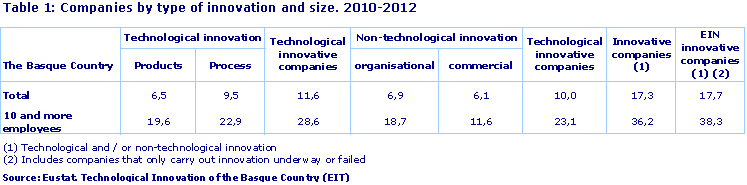
The number of companies with technological innovation in the 2010-2012 period represented 11.6% of the total in the Basque Country, which was a drop of 0.7 percentage points in relation to the previous period. This percentage was equivalent to 19,466 companies. Technological innovation is considered to be innovation carried out by companies that are able to introduce a new or appreciably improved product into the market, be it goods or services related (6.5% of the total in 2012), or those which implement, within their own establishment, a new or appreciably improved process, (9.5% of the total).
These percentages, however, rise to 28.6% if only companies with 10 or more employees are taken into account, which is a loss of 2.1 percentage points on the data from the previous year. In this size of company, 19.6% were product innovators and 22.9% process innovators.
Expenditure invested by Basque companies in technological innovation activities accounted for 4% of GDP
Spending implemented by Basque companies on technological innovation activities stood at 2,583.7 million euros in 2012, following a drop of 3.4% with regards to the previous year. This expenditure represented 4.0% of GDP.
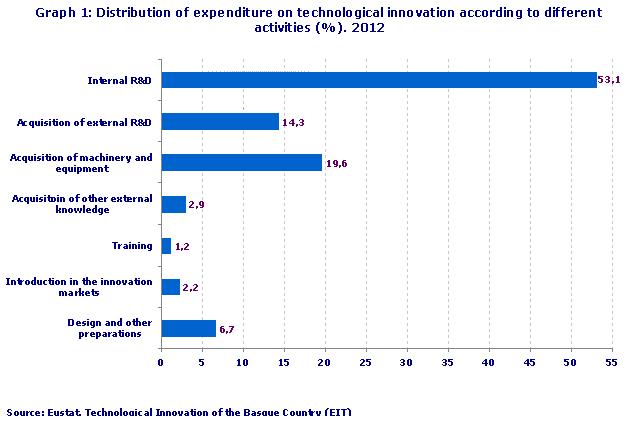
Amongst the main activities necessary for technological innovation, particular mention should be made of spending on internal R&D, which accounted for 53.1% of the total; the acquisition of machinery and equipment, 19.6%; and the acquisition of external R&D, 14.3%, with the remaining activities accounting for 13.0% of spending.
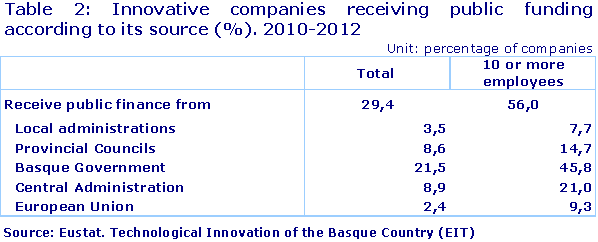
29.4% of companies with technological innovation received public funding
If we look at where this support came from, it is worth mentioning that the Basque Government provided 21.5% of the total for these companies. In the case of companies of 10 or more employees, 56.0% received support, with the Basque Government being the provider of funds to the greatest number of companies, specifically 45.8% of companies of this size that spent on innovation.
�
83.9% of innovating companies felt that innovation had positive effects
80.5% thought that innovation had positive effects on their products (goods or services), 58.3%, on their internal processes, 37.9% on employment and 31.4% believed that there were other positive effects, such as a lesser impact on the environment or an improvement in the health of their employees.
In innovating companies of 10 or more employees, 92.8% felt that innovation had positive effects, whilst the rest of the previously mentioned percentages regarding this size of company accounted for 85.1%, 71.8%, 55.2% and 48.8%, respectively.
Just over half of companies felt that there were factors that hindered technological innovation
Specifically, 60.5% considered that certain factors existed that made technological innovation difficult. Amongst these factors, the economic ones stand out. These companies highlighted economic risks, which they considered excessive (43.0%), increased costs involved in carrying out innovation (46.5%) and the lack of funding sources (45.9%). Amongst companies with 10 or more employees, the percentage of those that thought there were factors that made innovation difficult rose to 70.1%, with the same hindrances highlighted.
Non-technological innovation (11.6%) is composed of organisational innovation or innovation related to marketing. Organisational innovation consists of the implementation of new organisational methods in the internal functioning of the company, and was carried out by 6.9% of Basque companies, whilst marketing innovation is the implementation of new commercial strategies or concepts that are significantly different to previous ones and that have not been used before, which was the case in 6.1% of all companies in the Basque Country. Non-technological innovation stood at 23.1% in companies with 10 or more employees, and was obtained by carrying out organisational innovation, 18.7%, and marketing innovation, 11.6%.
For further information:
Eustat - Euskal Estatistika Erakundea / Instituto Vasco de Estadística
C/ Donostia-San Sebastián, 1 01010 Vitoria-Gasteiz
Press Service: servicioprensa@eustat.eus Tlf: 945 01 75 62
Further press releases on the Technological Innovation of the Basque Country (EIT) Survey
Databank on the Technological Innovation of the Basque Country (EIT)Survey