Press Release 16/12/2013
Three out of every four buildings built between 2001 and 2011 are accessible
In the last decade there has been a breakthrough in the accessibility of buildings intended for housing
According to the Population and Housing Censuses in 2011, prepared by Eustat, 28% of the buildings in the Basque Country are accessible, i.e. providing direct lift access, either at the main or a secondary entrance, with no steps or if there are any, a ramp that allows people with mobility limitations to overcome them without difficulty and in addition, a large enough entrance without obstacles in order to manoeuvre a wheelchair.
With regards to this statistic, in the buildings built between 2001 and 2011, the proportion rose to 75.4%, more than double the number built between the 1991 and 2001 (30.4%).
By province, Álava has the highest proportion of buildings with accessible housing, 33.5%, followed by Gipuzkoa, with 28% and Bizkaia, with 26.7%. In turn, continuing with provinces, Vitoria-Gasteiz is without doubt the capital of the three provinces with better accessibility in its buildings (41.7%), probably due to a higher volume of recent construction in the city, followed by Bilbao (29.9%), and finally Donostia/San Sebastián (27.7%).
By municipality, it is in Alto Deba where the highest proportion of buildings with accessible housing are found (46.7%). In contrast, the region of Montaña Alavesa has the lowest proportion (10.5%).
Half of the buildings of the Basque Country were built in the last 40 years
As to the year of construction of the buildings in the Basque Country, 52.5% were built from 1971, 16.5% in the 1960s, 11% in the 1950s and 20% before 1950.
13.3% of the buildings of the Basque Country have been built in this century. This average is exceeded in Álava, with 20%, compared to just over 11% in Bizkaia and Gipuzkoa. Furthermore, in Llanada Alavesa the proportion increased to 26% and exceeded the 40% in the municipalities of Alegría-Dulantzi, Irura, Ziortza-Bolibar, Etxebarri, Larraul y Ribera Baja/Erribera Beitia. However, in Montaña Alavesa and in Markina-Ondarroa, the proportion did not reach 10% as with 105 other municipalities, with minimums in Baños de Ebro/Mañueta y Mendata (1%).
More than 9 out of every 10 buildings have telephone lines installed in the Basque Country
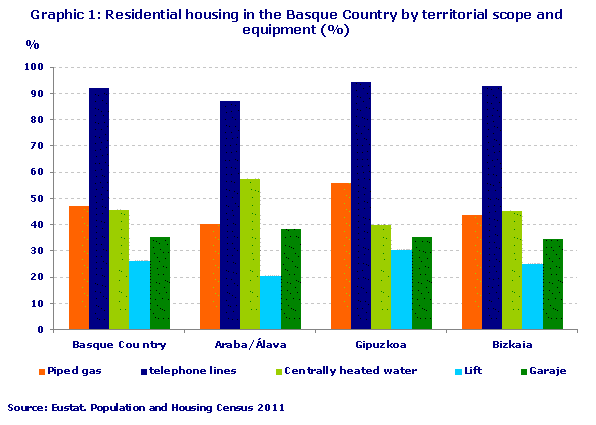
In relation to the equipment available in the buildings in the Basque Country, 92.2% possess a telephone line, nearly half have gas supplied via a pipe (46.9%) and central hot water (45.9%), more than a third have a garage (35.6%) and 26% have a lift.
By province, Gipuzkoa has the highest percentage of residential buildings with piped gas (55.8%) telephone lines (94.3%) and lifts (30%) and it is in Álava where the highest proportion of buildings with central hot water (57.4%) and garages (38.5%), are found.
Less than 1% of the residential buildings of the Basque Country have an unpaved path of access to the building, or lack a path
With regard to the quality of the public thoroughfare leading to the building, more than 99% of residential buildings in the Basque Country have paved pathway access and a further 7.2% are in pedestrian areas; 1% have access to the building via stairs or steps and 1.2% have access via a ramp.
Bizkaia is where the highest proportion of buildings with unpaved paths are found, just over 1%, in pedestrian areas 8.6%, and with access via stairs or steps, 1.5%. Gipuzkoa, perhaps due to its orography, has the largest percentage of buildings with access via a ramp, 1.8%.
For further information:
Eustat - Euskal Estatistika Erakundea / Instituto Vasco de Estadística
C/ Donostia-San Sebastián, 1 01010 Vitoria-Gasteiz
Press Service: servicioprensa@eustat.eus Tlf: 945 01 75 62
Further press releases on the CPV2011 of the Basque Country
Databank on the CPV2011 of the Basque Country