Press Release 20/11/2013
The life expectancy of men and women in the Basque Country continues to increase
Fertility is still low and third children have almost disappeared, while the marriage rate is down
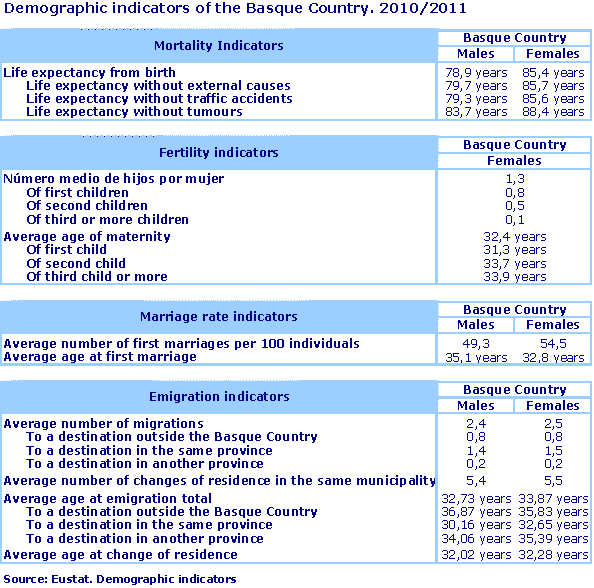
According to Eustat data, the results of the Demographic Indicators predict that a male newborn in the Basque Country will live almost 79 years and have a 49% probability of getting married. If the newborn were female, her life expectancy would be prolonged to 85.4 years, her probability of marriage would be slightly higher than 54% and she would have only one child. In both cases, they would change their place of residence 8 times in their lifetime.
Both men and women in the Basque Country have experienced a constant increase in their life expectancy. Compared to the indicators observed 35 years ago (a life expectancy of 69.6 years for men and 76.9 years for women in 1975), life expectancy has increased 8.5 years for women and 9.3 years for men. Men have gained 3.2 more months of life per year, reaching 78.9 years, while women enjoy 2.9 more months per year, reaching 85.4 years. The gap between the life expectancy of the two sexes has narrowed to 6.6 years, from a maximum of 8.7 years difference 20 years earlier.
In any case, very few developed countries can take pride in having such a high life expectancy, particularly for women. The life expectancy for women was identical to that of Spain, and higher than for Germany and the European Union in general (83.2 years), although it was still slightly lower than in France (85.7 years). The life expectancy of men also exceeded that of the European Union (77.4) and Germany (78.4) but was one year lower than in Spain (79.4 years).
Tumours are the main threat to the years of life expectancy. If tumours are completely eliminated, men will prolong their lives almost 5 years and women 3 years. However, external causes of death are less detrimental, taking 9 months from the lives of men and only 3 months from women. Among the external causes of death, if traffic accidents alone are taken into account, the reduction is 4 months for men and only 2 months for women.
Fertility continues to be at low levels
Fertility in the Basque Country was at low levels compared to the fertility registered in other surrounding countries. In 2011, the average number of children was 1.3, a long way from the average of 2.7 children obtained in 1975 and the 2.1 required for generation replacement. The lowest rate was in Bizkaia (1.26), whereas Álava had 1.42 children per woman and Gipuzkoa was in between, with 1.39 children. At the international level, the fertility rate was similar to the levels in Germany (1.36 children) but lower than the European average (1.57) and at a great distance from France (2 children).
�
On the basis of the data, it was predicted that women would have an average of 0.76 first children, assuming that a quarter of women would have none; 0.5 second children; and scarcely one in every ten women would give birth to a third child. In this sense, the drop in fertility in the third child or more range was 90% compared to 1975.
The average age for maternity was quite similar to other countries (32 years), 3.8 years later than in 1975. There was a great concentration of births at around that age.
Drop in the marriage rate
In the conditions of 2011, the percentage of single men who would end up being married was 49.3% and that of single women stood at 54.5%, meaning a large drop compared to 2005 rates, which were 53.8% and 58.5%, respectively. From the other point of view, the data show that half of the men would remain single, as well as 45% of the women. That was far from the situation 35 years earlier, when practically everyone got married.
An analysis of the marriage rate showed that the age for marriage continued to be delayed. The average age for the first marriage was 35.1 years for men (8.4 years later than in 1975) and 32.8 years for women (8.6 years later than in 1975).
As in the case of the fertility rate, a considerable number of marriages took place at specific ages. 48.1% of the marriages of men took place at age 30 to 36, and 52.8% of the marriages of women at age 28 to 34.
On average, an inhabitant of the Basque Country will emigrate 2.5 times in their lives
Normally, emigration is intra-provincial. In other words, the municipality of destination is in the same province as the municipality of origin. Such is the case of more than half of the migrations (1.4 out of a total of 2.4 for men and 1.5 out of a total of 2.5 for women). However, the average citizen only migrated 0.8 times to destinations outside of the Basque Country (a third of the total number of emigrations). Migrations between provinces barely accounted for 8% of the total.
By province, there was quite a pronounced difference between Bizkaia and Gipuzkoa, on the one hand, and Álava, on the other. Whereas Álava had almost 1.9 migrations for both sexes, Gipuzkoa had a rate of 2.3 and Bizkaia had 2.8 movements. These differences were due to intra-provincial mobility, because Gipuzkoa had 1.3 movements of this type and Bizkaia exceeded 1.7, whereas Álava scarcely had 0.7. This was due to the characteristics of settlement in Álava, where the weight of Vitoria-Gasteiz predominated. The rates in all other types of mobility were very similar.
On the other hand, as the distance covered by the emigrants increases, so does their age. Thus, on average, the men who moved within the three provinces were the youngest, of age 30.1, while the women were 32.7. The oldest were those who emigrated outside of the Basque Country: of these, the male emigrants were age 36.9 and the women age 35.8.
With regards to transfers within the same municipality, the population of Álava shows the highest mobility rate, with 6.4 movements on average. Those who moved the least were the residents of Gipuzkoa, for the opposite reasons as the intra-provincial emigration: many movements in Álava took place within the geographical boundaries of Vitoria-Gasteiz.
If the number of migrations are added to changes of address, residents of the Basque Country will change their place of residence around 8 times during their lives, either within their municipality or outside of it.
For further information:
Eustat - Euskal Estatistika Erakundea / Instituto Vasco de Estadística
C/ Donostia-San Sebastián, 1 01010 Vitoria-Gasteiz
Press Service: servicioprensa@eustat.eus Tlf: 945 01 75 62