Press Release 04/10/2013
In 2011 one in every four Basque Country residents had been born outside of the autonomous region
The average age of individuals born abroad stood at 34.2 and the average age of the population born in other Autonomous Regions was a lot higher, 61.4
28.7% of the population resident in the Basque Country were born outside of the Autonomous Region and, within this collective, almost one in three, 29%, corresponded to individuals who had been born abroad, according to data prepared by EUSTAT relative to the 2011 Population and Housing Censuses.
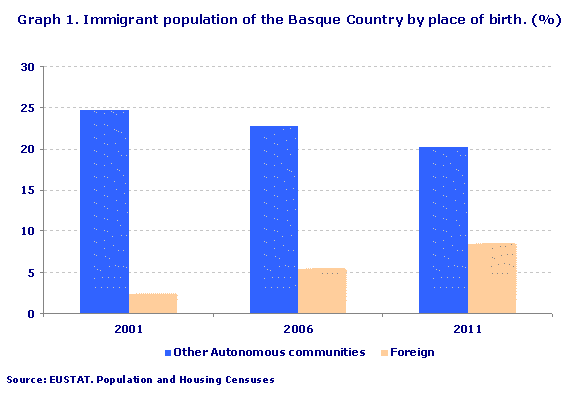
The percentage of individuals born outside of the Basque Country has remained stable over the last ten years, although changes have been produced in their origins. In the last decade the population resident in the Basque Country born abroad has increased by six percentage points, at a rate of three percentage points per five-year period, whereas on the other hand the population resident in the Basque Country born in the rest of Spain has fallen by a little over four percentage points, going from 24.7% to 20.3%.
�
The countries that provided the highest number of individuals born abroad to the Basque Country were, in order: Columbia (9.0%), Morocco (9.4%), Romania (8.7%), Bolivia (6.6%) and Ecuador (5.1%).
By Autonomous Region of birth, the highest number of individuals in the Basque Country originated from Castilla y León, 8.4% of the population, followed by Extremadura (2.6%) and Galicia (2.1%). By contrast, individuals born in the Balearic Islands only accounted for 0.03%.
Regarding the average age of the population born outside of the Basque Country, a notable difference was observed according to place; thus, the average age of individuals born abroad was 34.2, whereas for the population born in other Autonomous Regions it was much higher, 61.4.
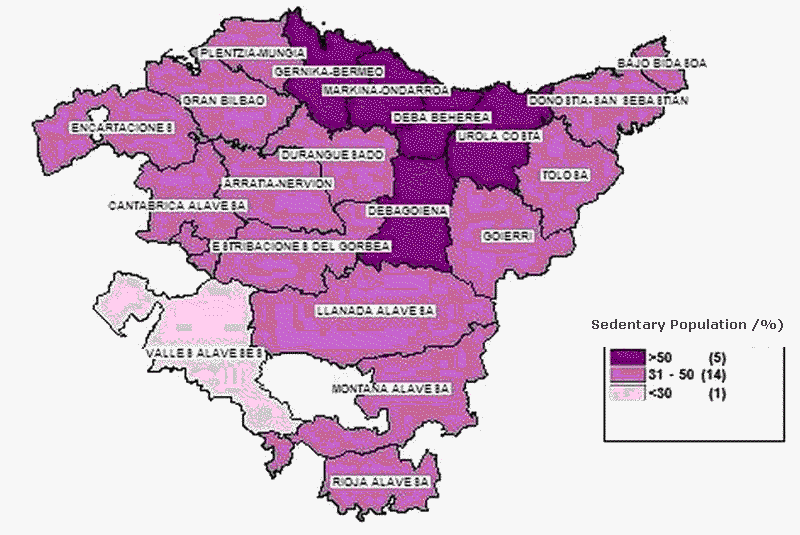
Graphic 2: Sedentary Population of the Basque Country by regions (%). 2011
Source: EUSTAT. Population and Housing Census 2011
Two out of every five individuals continued to live in the municipality where they were born
44.3% of the population of the Basque Country, almost half, resided in their municipality of birth, known as sedentary population. 31.6% lived in a different municipality to that where they were born, but within the Autonomous Region, that is, the internal migrant population, and the remaining 24.1% originated from another Autonomous Region or from abroad.
�
Taking into consideration territorial scope, Bizkaia was the province with the least sedentary population, 42.9%, against 44.3% for Álava and 47.3% for Gipuzkoa. In the case of internal migration Bizkaia particularly stood out, with 34.3% of the migrant population originating from other municipalities in the Basque Country. For its part, Álava was the province with most individuals born outside of the Basque Country, 33%.
In the regional sphere, Markina-Ondarroa (55.8%), Alto Deba (54%) and Urola Costa (53.2%) stood out as the regions with the highest proportion of sedentary population. In turn, Rioja Alavesa (42.9%), Llanada Alavesa (35.4%) and Valles Alaveses (31.7%) presented the highest percentages of immigrant population. Finally, in comparative terms, a greater number of individuals originating from other municipalities of the Basque Country resided in the regions of Plentzia-Mungia (57.3%) and Estribaciones del Gorbea (53%), even exceeding the proportion of sedentary population.
Almost half a million individuals arrived in their municipality of residence after 2000
In 2011 a total of 491,685 individuals resided in a municipality in which they arrived during the first decade of this century. Of these 291,474, that is, close to 60%, previously lived in another municipality of the Basque Country and had moved within its interior. Almost 20% had come directly from abroad and the remainder, around 20%, originated from other Autonomous Regions.
Within the last group of migrant individuals special mention should be made of the weight of the Autonomous Regions of Castilla y León, which provided 18,110 individuals, Madrid (12,266, Cantabria (11,988), Catalonia (8,707), Navarra (8,441) and La Rioja (6,099). In contrast, just 280 individuals originated from Ceuta y Melilla and under 2,000 came from the Region of Murcia and the Balearic Islands.
It is to be assumed that, to a certain degree, the Autonomous Regions of Madrid and Catalonia constitute a midway point for population movements, in particular of foreigners, in the sense that not only people from Madrid and Catalonia come from them, but populations from other geographic origins.
For further information:
Eustat - Euskal Estatistika Erakundea / Instituto Vasco de Estadística
C/ Donostia-San Sebastián, 1 01010 Vitoria-Gasteiz
Press Service: servicioprensa@eustat.eus Tlf: 945 01 75 62
Further press releases on the CPV2011 of the Basque Country
Databank on the CPV2011 of the Basque Country