Press Release 03/09/2013
The housing stock in the Basque Country grew at a rate of 14,000 units per year between 2001 and 2011
The five-year period 2001-2006 accounted for over 70% of the increase in the number of dwellings registered over the last decade
On the 1st of November 2011, the housing stock in the Basque Country stood at 1,020,131 dwellings, according to data prepared by Eustat. Over half of the dwellings were located in Bizkaia, 530,335, accounting for 52% of the total. Gipuzkoa, with 33,260 dwellings, represented 32.7%, whilst the remaining 15.3%, 122,466 dwellings, corresponded to Álava.
Compared to 2001, there were 141,515 more dwellings, which was growth of 16.1%, or 14,152 more per year.
This evolution shows two different five-year periods: the first, between 2001 and 2006, when growth reached 11.7%, 102,429 more dwellings; the second, 2006-2011, with growth limited to 4%, 39,086 additional dwellings. Put another way, the first five years saw 72.4% of the increase experienced over the decade.
Almost half (46.4%) of growth in the Basque Country overall from 2001 occurred in Bizkaia, just under a third (29.5%) in Gipuzkoa and the remaining quarter (24.1%) in Álava, this last example clearly above its population weight.
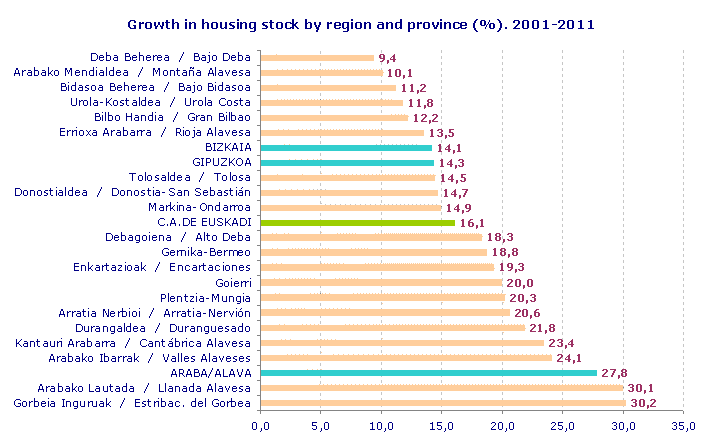
In this way, the most notable increase was registered in Álava, with 27,8% more dwellings since 2001, double that of Gipuzkoa and Bizkaia, where it stood at 14%.
The three provinces reveal a drastic deceleration in the most recent five-year period. In the 2001-2006 period Bizkaia increased its housing stock by 10.7%, three times more than the following five years, when it grew by 3.1%. In Gipuzkoa and Álava the deceleration was lower: Gipuzkoa went from 10.1% in the first half to 3.9% in the second and Álava, with significantly higher figures, went from 19.2% to 7.2%, two-and-a-half times less in both cases.
On a regional level, the inequalities are noteworthy, with four regions in Álava standing out in terms of growth over the last ten years: Estribaciones del Gorbea (30.2%), Llanada Alavesa (30.1%), Valles Alaveses (24.1%) and Cantábrica Alavesa (23.4%). Three regions in Bizkaia also had growth of over 20%: Duranguesado (21.8%), Arratia-Nervión (20.6%) y Plentzia-Mungia (20.3%), and one region in Gipuzkoa, Goierri, was situated just above this figure. At the other extreme, with the lowest growth, were Bajo Deba (9.4%), Montaña Alavesa (10.1%), Bajo Bidasoa (11.2%), Urola Costa (11.8%) and Gran Bilbao (12.2%).
�
Vitoria-Gasteiz was the capital that most increased its number of dwellings in throughout the period, with an increase nearing 30%
Vitoria-Gasteiz was the capital with the most growth, 28.9%, over the last ten years (25,116 more dwellings), followed by San Sebastián, with 15.4% (11,966 more), and Bilbao, with 9.6% (13,988 additional dwellings). At the same time, it is in this last capital where the slowdown in recent years has been more noticeable: in the first five-year period it grew by 6.9% whilst in the second it scarcely reached 2.5%, close to three times less. In San Sebastián it went from 9.4% in the first period to 5.6% in the second, and in Vitoria-Gasteiz from 17.6% to 9.6%.
In municipal terms, 13 municipalities experienced increases of over 50% in their housing stock. Two of them, Larraul and Alegria-Dulantzi, practically duplicated their initial volume (98.1% and 95.3%, respectively). The remaining municipalities implicated are five municipalities from Guipuzkoa: Irura (73.1%), Aia (56%), Mendaro (55.3%), Olaberria (52.7%) and Gaztelu (51%); three from Álava: Iruña de Oca (63.4%), Ribera Baja (57.4%) and Urkabustaiz (50.9%); and three from Bizkaia: Etxebarri (70.5%), Maruri-Jatabe (53.8%) and Munitibar-Arbatzegi-Gerrikaitz (51.6%). Except for the case of Etxebarri, these were small municipalities, with housing stock under 1,000 dwellings.
�
11.4% of the total number of dwellings were empty and 4.1% were used as second homes
If family housing stock is considered from the usage point of view, 84.5% of dwellings were destined towards a primary home and the remaining 15.5% was used as second homes (4.1%) or were empty (11.4%).
The proportion of housing not classified as primary dwellings returned to 2001 figures, after reaching a maximum in 2006. In 2001 14.9% of dwellings were not main dwellings; in 2006 this figure increased by more than two percentage points, standing at 17.5%, to then see a reduction in 2011 to the 15.5% already indicated.
At a provincial level, Gipuzkoa had the highest number of non-main dwellings, 17%, a proportion very similar to Álava, 16.7%. For its part, in Bizkaia the percentage was limited to 14.3%.
In terms of regions, three stood out in Álava with a high number of non-primary dwellings: Rioja Alavesa and Valles Alaveses, both with 44.9%, and Montaña Alavesa, with 44.6%.
In almost half of Basque municipalities one in every four dwellings was not the primary dwelling. In twelve of them the proportion exceeded 50%, with Leza (69%), La Bastida/Bastida (66.3%), Añana (63.4%) and Sukarrieta (63.4%) standing out.
In the capitals the phenomena of non-primary dwellings affected Vitoria-Gasteiz (11.7%) and Bilbao (11.2%) almost equally, whereas in San Sebastián it stood at 16.7%.
The average Basque family home was 39.7 years old, had a useable floor space of 86.9 m2, 4.9 rooms and 1.3 bathrooms.
The average age of the family housing stock in the Basque Country was 39.7, standing at 33 in Álava, 40.3 in Gipuzkoa and 41.4 in Bizkaia.
Regarding average useable floor space, Álava presented the largest family dwellings with 91.9 m2 of space, followed by Gipuzkoa with 86.9 m2 and Bizkaia with 85.5 m2, meaning an average useable floor space of 86.9 m2 for the Basque Country overall.
In terms of the number of rooms, three quarters of Basque family dwellings had 4 or 5 rooms (bedrooms, living room and kitchen) and, on average, 1.3 bathrooms. Less than one in a hundred dwellings, 0.8%, did not have a bathroom.
68.4% of family dwellings had a lift in the building, which was an increase of 4.9 percentage points compared to 2006.
Over half of family dwellings, 54.4%, were located in buildings of over ten units and 7.4% corresponded to dwellings in buildings of over forty units. On the other hand, one out of every ten dwellings, 10.5%, were in buildings of one or two units.
�
The presence of gas supplied via pipes to dwellings increased to over 50%.
Half of dwellings in the Basque Country (54.4%) had gas supplied by pipes and over three quarters of these (76.6%) formed part of buildings with natural gas or propane supplies.
If we take into account the last available reference, relative to 1996, the presence of gas supplied via pipes has doubled over the last 15 years, as then it only reached 26% of dwellings. The greatest increase was in Bizkaia, 34 percentage points, where the proportion stood at 49.3%. The highest percentage was observed in Gipuzkoa, 61%, with growth of 23.7 points, whereas Álava, with a somewhat lower percentage (57.8%), was up by 15.8 percentage points, given that its original level was higher.
Furthermore, gas pipelines have extended throughout the Basque Country in such a way that in Gipuzkoa 82.1% of dwellings are situated in buildings with this service, 79.1% in Álava and 72.5% in Bizkaia, with positive variations in all cases and around 10 percentage points compared to 2001.
Additionally, in five existing regions, the increase in this facility has exceeded 20 percentage points: Arratia-Nervión (21.7), Estribaciones del Gorbea (24.2), Rioja Alavesa (27.5), Tolosa (30.5) and Markina-Ondarroa (44.5), although in three cases - Estribaciones del Gorbea, Rioja Alavesa and Markina-Ondarroa - no building had a gas supply on the initial date.
On the contrary, three regions in Gipuzkoa with a general presence of gas pipelines for domestic use - over 80% of dwellings - have stabilised or seen a sharp slowdown in the increase of this service over the last decade: Bajo Bidasoa (-3.5 points), Alto Deba (-2 points) and Goierri (-1 tenth).
For further information:
Eustat - Euskal Estatistika Erakundea / Instituto Vasco de Estadística
C/ Donostia-San Sebastián, 1 01010 Vitoria-Gasteiz
Press Service: servicioprensa@eustat.eus Tlf: 945 01 75 62
Further press releases on the CPV2011 of the Basque Country
Databank on the CPV2011 of the Basque Country