Press Release 19/06/2013
Confidence in institutions amongst the Basque population is lower than the pass level
The network of relatives and friends of the Basques is large (22 people on average), but very homogeneous
The confidence of the population of the Basque Country in people in general reports a score of 5.8 out of 10 and reaches the highest level with regards the networks of relatives and friends (7) and the lowest level, lower than the "pass level", with regards to institutions (4.5), according to the Survey on Social Capital carried out by Eustat.
With regards to confidence in the various professions, we observe clear gradation between the most reliable, doctors (with an average score of 7.1) and the least reliable, politicians (with an average score of 2.2). Scientists (6.8) and teachers (6.8) approach the levels of confidence afforded to doctors whilst shopkeepers (5.8), police officers (5.7), civil servants (5.3) and journalists (5) also score higher than the "pass level" in 2012. However, businessmen and women (4.8), judges (4.7), priests (4.3) and the military (3.9) fail to achieve the "pass level" in terms of citizen confidence.
With regards networks of relatives and friends, the Basque population reports an average of 22.2 individuals, taking in the broader circle of family and friends, in 2012. The network of friends is homogeneous, that is, almost two thirds of individuals only have friends who share the same religious beliefs, nationality, social position or political tendencies.
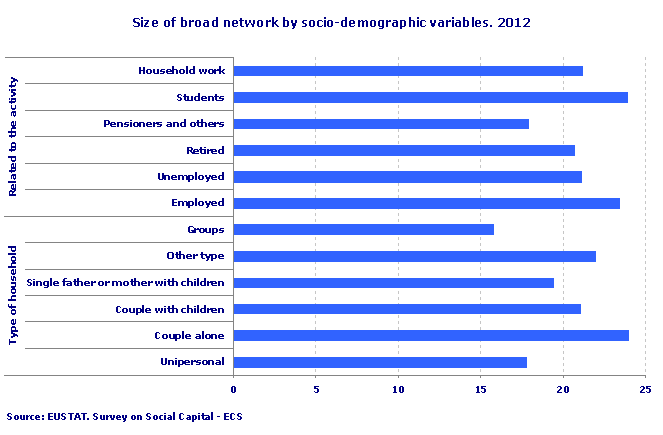
Furthermore, attention should be drawn to the fact that the close network reports an average value of 10.6 people in 2012. The variables of aid afforded and received and access to the three types of aid (financial, health-related and emotional) have bearing on the size of the network. In this sense, aid afforded entails an average score of 3.3 in 2012, whilst aid received reports a score of only 1.9, marked out of 10 in each case.
The socio-economic variables that have the greatest negative impact on the size of the network of friends continue to be the type of family and the relationship with the activity. Thus, couples report networks that on average take in 24 family members and friends, whilst single individuals report networks of 18.7. Individuals who do not live in families, but rather reside in collective establishments report networks of a little over 15 people in 2012.
Bearing in mind the relationship with activity, pensioners report networks of 17.9 family members and friends in 2012, whilst students report networks of, on average, 24 relatives and friends for the same year.
The homogeneity of the network of friends registers the greatest levels of differences in scores in terms of the variables of age and place of birth. Logically, those born in another country present lower levels of homogeneity with average scores of 4.5 points, whilst, at the other end of the scale, those aged 65 or over report the most homogeneous networks of friends with an average score of 8 for 2012.
Social participation largely remains electoral participation with a very small presence of activities within associations
Social participation of the basque population mainly entails electoral participation, with a small presence of activities in associations (0.4 out of 10 in 2012). Thus, the Basque population continues to report high electoral participation, with an average score of 7.2, which translates to 3 out of 4 people voting in the last elections. Basques also remain interested in socio-political matters (5.5); however, their social and political participation is scant (1.2).
With regards to information on public affairs, the Basque population hold themselves to be no more than moderately informed (5.3), in spite of the abundance of information sources at various territorial levels (7.2 on average) and the widespread use of the media (6.7).
The population reports greater levels of being informed with regards to events that are closer in nature, preferentially relating to their neighbourhood or area, their municipality or their Autonomous Region (more than a third feel that they are highly informed), whilst they hold that they are less informed with regards to Spain (only 24.2% feel that they are highly informed) and, in particular, Europe (only 20% feel that they have a great deal of information).
For further information:
Eustat - Euskal Estatistika Erakundea / Instituto Vasco de Estadística
C/ Donostia-San Sebastián, 1 01010 Vitoria-Gasteiz
Press Service: servicioprensa@eustat.eus Tlf: 945 01 75 62
Further press releases relating to the Survey on social capital
Database of the Survey on social capital