Press Release 30/04/2013
Almost 20% of the Basque population was over the age of 64 according to the 2011 Population Census
The number of foreign residents stood at 7.3%, almost six percentage up on the previous census in 2001
The 2011 Population and Housing Census in the Basque Country produced by Eustat shows that 19.8% of the population was aged 65 or over. This percentage exceeded the number in Spain by more than two percentage points and in Europe only Germany and Italy were above the Basque figures. Castilla-La Mancha, Galicia, Principado de Asturias and Aragón were the Autonomous Regions with the highest numbers.
The situation was very different 30 years ago. In 1981 the percentage of individuals over the age of 65 was lower than that for Spain overall: 9.2% against 11.2%. In that year only the Canary Islands had a lower proportion.
This dynamic was much more acute amongst the population aged 85 or over, given that the proportion went from 0.5% in 1981 to 2.8% in 2011; that is, the population resident in the Autonomous Region has multiplied by 5 over the last 30 years. In Spain it has multiplied by four in this period.
Graphic 2. Population pyramids. 1981 and 2011
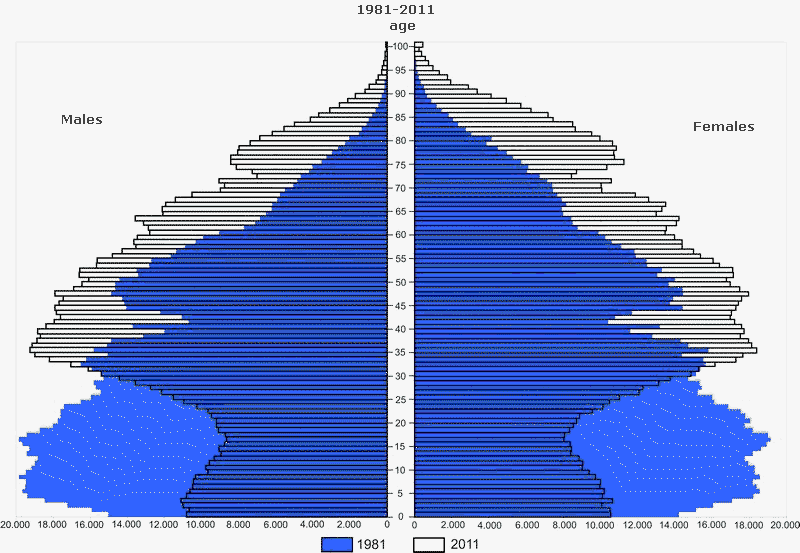
Source: EUSTAT. Population and Housing Censuses, 1981 and 2011
The proportion of residents between the ages of 20 and 64, the bulk of the population of working age, fell by 2 points between 2001 and 2011 , going from 64.9% to 62.6% respectively, whereas in 1981 this age group represented 52.6% of the population. The number of under-20s has been reduced by almost a half in the last 30 years, going from 732,242 individuals of this age in 1981 to 383,424 in 2011, although in 2006 it reached its lowest figure with 351,349.
Bizkaia was the only province that had a higher proportion of individuals aged 65 or over compared to the Basque Country as a whole (20.3%), whereas Álava had the lowest (18%) and Gipuzkoa the closest to the average (19.7%). By regions, the variation in weighting of this age group was greater, given that it went from 14.5% in Plentzia-Mungia and 15% in Estribaciones del Gorbea to 26.6% in the region of Montaña Alavesa. The region saw this percentage reach 29.1% in 2001. The drop in the percentage of older people between 2001 and 2011 also took place in another six regions, with the case of Valles Alaveses particularly standing out, going from 24.6% to 20.6%. Other regions to experience large declines were Rioja Alavesa (from 22.8% to 19.9%) and Estribaciones del Gorbea (from 17.1% to 15%). This process was not due to the fall in the absolute number of individuals aged 65, which in some cases has risen, rather the greater rise in the population of other age groups.
In the Basque Country there were 17 municipalities where the population aged 65 and over exceeded 25%, but they were small, representing just 0.5% of the total population. Ten years ago this figure stood at 47, also small municipalities, with their resident populations accounting for 1.3% of the total for the Autonomous Region.
If we look at the municipal level, it can be observed that in four municipalities, three of them in Álava, the population aged 65 and over surpassed 30%: Lagrán (37.8%), Valle de Arana (36.9%), Elantxobe (31.8%) and Añana (30.8%). At the other extreme, there were three municipalities, two of them in Álava, which had a percentage below 10%: Elburgo (8.4%), Irura (9.2%) and Alegria-Dulantzi (9.3%).
In the Basque Country residents from Latin American countries predominated
In the Basque Country, 7.3% of the population were foreign nationals, almost six points more than the previous census, where foreigners accounted for just 1.5%. This number was lower than that for Spain, where it stood at 11.2%.
By provinces, Álava continued to be the province with the highest population of foreign nationals, 9.9% of its total population, easily above Bizkaia, with 6.8%, and Gipuzkoa, with 6.7%. However, the disparity by municipality was much greater, with four municipalities that practically doubled the percentage for the Autonomous Region: Samaniego, Izurtza, Berriatua and Ordizia, whereas there were another four that scarcely had foreign nationals: Mutiloa, Elduain, Gaztelu and Kripan.
Residents of the Basque Country from Latin American countries made up 43.3% of foreign residents, whilst in Spain they hardly exceeded 29%. In this group, South American countries accounted for the majority: Columbia, Bolivia, Ecuador and Brazil, which made up 24.8% of the total number of foreigners and 57% of Latin Americans.
In contrast, Europeans resident in the Basque Country represented 26.3% compared to almost 43.9% in Spain. Romanians were particularly present in this group, representing almost 11% of the total number of foreigners, whereas in Spain they represented 15.2%; despite this, Romanians represented 41.5% of Europeans. The Portuguese, although lower in number than Romanians, had a significantly higher weighting in the Basque Country than in Spain, accounting for 20.3% and 5.3% of Europeans, respectively.
Nationals from African countries in the Basque Country stood at levels similar to Spain, 23.1% and 20.2%, respectively, but it is noteworthy that in Spain Moroccans accounted for 72.8% of all of these residents and in the Basque Country they stood at under 49%. The second most numerous African nationality in the Autonomous Region was Algeria, with 16.4%, compared to 5.6% in Spain.
For further information:
Eustat - Euskal Estatistika Erakundea / Instituto Vasco de Estadística
C/ Donostia-San Sebastián, 1 01010 Vitoria-Gasteiz
Press Service: servicioprensa@eustat.eus Tlf: 945 01 75 62
Further press releases on the CPV2011 of the Basque Country
Databank on the CPV2011 of the Basque Country