Press Release 02/28/2013
DEMOGRAFIC SURVEY OF THE BASQUE COUNTRY (ED) 2011
Women born between 1951 and 1970 did not achieve generational replacement
The average age of emancipated children went from 26.7 in 1990 to 31 in 2011
Women born in the second half of the 50s were the last generation to achieve generational replacement, that is, they had an average of 2.1 children, according to data obtained by Eustat. The total fertility rate of subsequent generations of women descended to 1.4 children for women born between 1966 and 1970, the last in terms of those whose fertility cycle can be considered complete.
In almost all European countries a general decrease has been observed in the total fertility rate of women born from 1950, where it has not reached the generational replacement of generations born at the end of the 60s, except in countries with very ambitious family policies, such as the Scandinavian countries. Amongst the countries with lower indices Germany is worth mentioning, which showed a total fertility rate in women born in 1968 of 1.4 children; this was somewhat higher in Italy (1.5), Austria (1.6), Greece and Portugal (1.7), as well as some Eastern European countries.
Graph 1: Total fertility rate and average maternity age of generations from 1905 to 1990
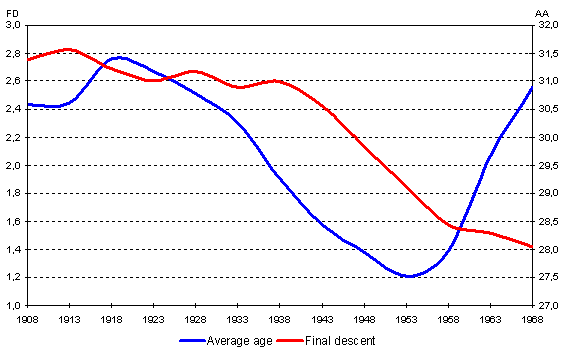
Source: EUSTAT. Demographic Survey of the Basque Country, 2011
The average age of maternity for the last generations was similar to that of the oldest, those that were aged 75 and over, but for this last case it was due to the third and subsequent children representing almost 50% of the total, whereas amongst women aged between 40 and 50 in 2011 third or subsequent children scarcely accounted for 10%. In the most recent generations, the average age at the birth of the most recent child was around 29 and in the oldest scarcely 27.
The total fertility rate of the generations of women under the age of 40 in 2011 does not appear as though it is going to recuperate, given that the number of children that they hope to have over their lives, according to what they have stated, scarcely reaches an average of 1.6, with those born between 1991 and 1995 standing out for predicting that they would only have an average of 1.3 children.
The intensity of fertility within married couples has declined more dramatically, with couples who married before 1960 having an average of almost 3 children, whilst the number for those married between 1986 and 1990 was scarcely 1.5. It should be added that births outside marriage greatly increased: from 5% in women who in 2011 were aged 70 or over to 18% in those who were between the ages of 35 and 40 in 2011.
The marriage rate of the generations was down
Amongst men, the lowest percentage of unmarried men (5%) was observed in those born between 1926 and 1930; amongst women it was in the generations born in the Civil War years. From then on this percentage has increased, reaching 25% in males and 17% in women, in the last generations whose marriage cycle can be considered complete, that is, those born from 1966 to 1970.
This does not mean that the number of unmarried couples has diminished, given that from the generations born between 1966 and 1970 who live as a couple, 12% do so in civil partnerships, whereas this figure for those born 20 years previously does not reach 1.5%. It is also worth mentioning that the fertility of civil partnerships is quite low, given that in 2011 only 48% had children, with the average number of children standing at less than 1.
The average age of marriage for men has increased from 29.2 since the generations born in the Civil war to 30.5 in those born between 1966 and 1970; but these average ages were already given in those generations born before 1936. Amongst women, the average age at marriage revealed its highest level for those born between 1966 and 1970, 28.1, which was one year older than those who were born five years before: in previous generations, the average age at marriage of women did not exceed 26.6.
In the last twenty years, the average age of children who have left the family home has constantly increased, standing at 31 in 2011 when in 1990 it scarcely reached 6.7. Traditionally, the main reason for emancipation of young people was marriage; in the 90s 65% did so for this reason and in the previous decade this figure stood at 77%, but in the first decade of this century there were other reasons for children leaving home, such as the formation of a civil partnership, which stood at 55%.
For further information:
Euskal Estatistika-Erakundea / Basque Statistics Institute
C/ Donostia-San Sebastián, 1 01010 Vitoria-Gasteiz
Tel:+34-945-01 75 00 Fax:+34-945-01 75 01 E-mail: eustat@eustat.eus
Contact: Martín González Hernández
Tel:+34-945-01 75 49 Fax:+34-945-01 75 01