Press release 03/05/2013
The number of deaths in the Basque Country increased by 2.5% in 2011
In one decade the average life expectancy increased by 3.4 years for men and by 1.8 years for women
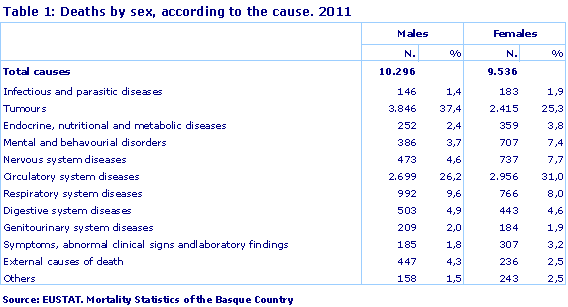
The number of deaths in the Basque Country rose to 19,832 in 2011, an increase of 2.5% compared to 2010, according to Eustat data. By sex, there were 10,296 male deaths and 9,536 female deaths. Broken down by month, January was the month with the highest number of deaths (1,938), whilst July registered the lowest number (1,498).
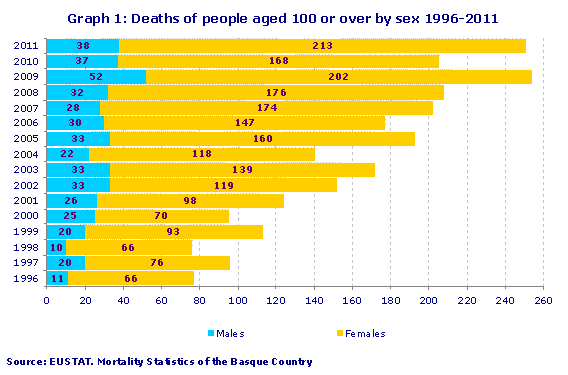
In 2011, 251 people over the age of 100 died, of which 85% were women. The number of deaths of amongst centenarians has gradually increased in recent years, reaching its height in 2009 when 254 deaths were registered within this group.
The average age of women who died in 2010 was 81.7, whilst the average age of men was 74.8
The average age of people who died in 2011 was 78.1 years of age, a figure that stood at 75.3 in 2001, which is to say that the average age has risen by 2.8 years over the course of the last ten years.
�
By sex, the average age at death amongst men in 2011 was 74.8 years of age, whilst the average age amongst women stood at 81.7. In 2001, the average ages were 71.4 and 79.9, respectively. Thus, over the course of the last 10 years, the average lifespan of men has increased by 3.4 years, and that of women, by 1.8 years.
The rate of natural increase was positive, as there were 1,348 more births than deaths. By territory, positive balances were registered in Álava and Gipuzkoa, where the population rose by 910 and 763, respectively. By contrast, in Bizkaia, the number of deaths was greater than the number of births (-325).
As regards child mortality, there were 2.6 child deaths for every 1000 births. Mortality amongst newborns, occurring within the first 28 days of life, produced 36 deaths: 12 of these deaths were during the first 24 hours and another 10 in the first week. Within deaths amongst children below the age of 1, girls accounted for 70% of the total.
60.1% of deaths were the result of tumours and diseases of the circulatory system
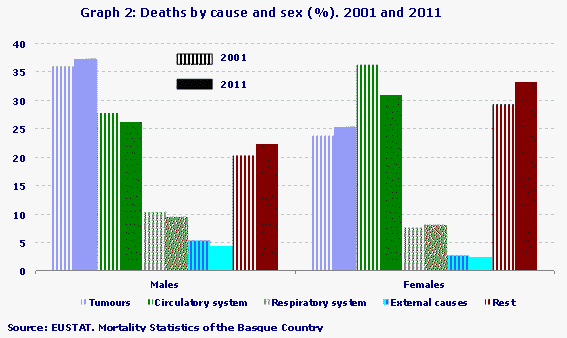
31.6% of the deaths that occurred in 2011 (6,261 deaths) were the result of tumours, followed by deaths resulting from diseases of the circulatory system, which accounted for 28.5% of the total (5,655 deaths) and, at a distant third, by deaths resulting from respiratory diseases, which accounted for 8.9% of the total (1,758 deaths). The prevalence of these three groups of illnesses that were responsible for the highest number of deaths has varied over the course of the last 10 years. Whilst deaths from tumours and respiratory diseases increased by 14% and 7%, respectively, those resulting from cardiovascular diseases dropped by 2%.
The cause of death continued to vary according to sex: amongst men, tumours caused more deaths than diseases of the circulatory system, whilst amongst women, the main cause of death was cardiovascular disease, followed by tumours.
Furthermore, the cause of death varied in accordance with age. Amongst those aged under one, the most frequent causes of death were illnesses originating in the perinatal period and congenital malformations; amongst those aged up to 40, the majority of deaths were attributable to external causes, including accidents and suicides; amongst those aged between 40 and 80, tumours were the highest cause of death, whilst amongst those aged 80 years or over, diseases of the circulatory system were the most frequent cause of death.
�
The number of deaths caused by heart attacks dropped by 28% in the last decade
Within the circulatory diseases group, attention should be drawn to the fact that the number of deaths resulting from heart attacks have gradually fallen. In 2001 861 people died and in 2011 the number stood at 623, which was a decrease of 28%.
Alzheimer's disease caused 661 deaths in 2011
The groups of illnesses that cause death showing the highest increase over the course of the last decade were mental disorders and diseases affecting the nervous system. Over the course of the last ten years, deaths resulting from dementia increased by 61% (1,093 deaths in 2011) and, within degenerative diseases, deaths attributable to Alzheimer’s disease increased by 74% (661 deaths in 2011).
Within deaths caused by dementia and Alzheimer’s disease, the majority of deaths entailed women: in 2011, female deaths attributable to these causes accounted for 65% and 72% of the totals, respectively.
Deaths due to traffic accidents continued to fall and suicides were the main external cause of death
The fall in the deaths attributable to traffic accidents in the 2001-2011 decade proved so extensive (69%) that in 2011, accidental falls and suicide were the main external causes of death. In fact, deaths caused by traffic accidents stood at 75 compared to 125 due to accidental falls and 172 due to suicide. Specifically, the number of suicides increased by 31% compared to 131 in 2010.
Within external causes of death, there was a higher incidence of male deaths in comparison to female deaths. Considering the main causes within this group, accidental falls and suicide, these were responsible for the deaths of 93 women and 204 men.
For further information:
Basque Statistics Office
C/ Donostia-San Sebastián, 1 01010 Vitoria-Gasteiz
Tel: +34-945-01 75 00 Fax:+34-945-01 75 01 E-mail: eustat@eustat.eus
Contact: Martín González Hernández
Tel:+34-945-01 75 49 Fax:+34-945-01 75 01
Further press releases on MORTALITY STATISTICS of the Basque Country
Databank on the Mortality Statistics of the Basque Country