Press release dated 01/30/2013
Total expenditure on social protection in theBasque country amounted to 24.5% of GDP
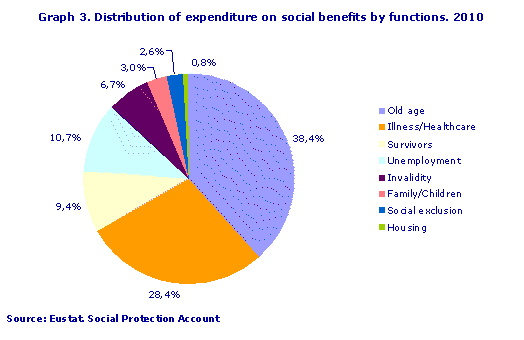
Expenditure on Old Age represented 38.4% of total payments
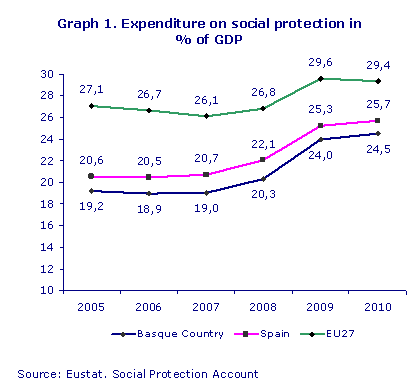
Expenditure on social protection reached 24.5% of GDP in the Basque country in 2010, according to Eustat data and following the European System of Integrated Social Protection Statistics (SEEPROS). This figure places the Basque country below the EU average which was 29.4% for this year. Nevertheless, between 2005 and 2010 threre was a reduction in this differential, falling from 7.9 percentage points in 2005 to 4.8 points in 2010.
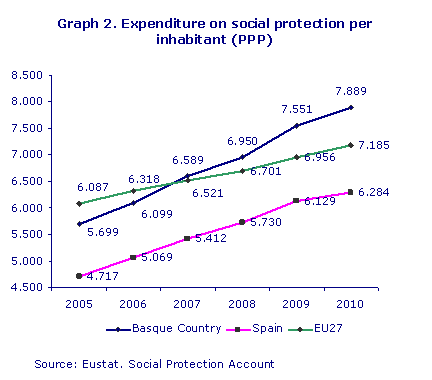
On the other hand, another benchmark indicator, expenditure per person, shows that in 2010 the expenditure on social protection per inhabitant in the Basque country, measured in Purchasing Power Standards (PPS), was 7,889. This was 9.7% above the European average, which was first exceeded in 2007, and 24.5% above the Spanish average.
The total amount of resources dedicated to social protection in the Basque country reached 15,970.6 million euros in 2010, 3.7% higher than the previous year. Excluding administration costs, the value of social provisions stood at 15,653.6 million euros in 2010, which was an annual increase of 7.8%, at a cumulative rate, since 2000.
�
An analysis of the expenditure on social provisions by functions shows that most spending is concentrated in two functions: "Old Age" and "Illness/Healthcare". Spending on Old Age includes pensions and care allowances for housing and home assistance, and reached 6.0042 billion euros, 38.4% of total provisions. Spending on Illness/Healthcare, which includes benefits for temporary disability and health benefits, was 4,443 billion euros in 2010, 28.4% of the total.
�
Spending on Unemployment, which in addition to unemployment benefits includes spending on training for employment, has become the third most important function. In 2010 it amounted to 10.7% of total social provisions spending, standing at 12,693 euros per registered unemployed person. The greatest increase in this function occurred in 2009, when it increased by 59.3% with respect to 2008.
Spending on provisions corresponding to "Housing" and "Social Exclusion" reached 526.2 million, amounting to 3.4% of total provisions; it is the expenditure that has increased the most, 10.6% up on 2009. The other functions that have increased the most are Old Age, by 6.5%, and Family, by 5.7%, with respect to 2009.
The Illness/Healthcare function dropped by 0.4% with respect to 2009, due to the reduction in cash benefits for temporary disability, whilst spending on healthcare benefits in kind has remained unchanged since 2009.
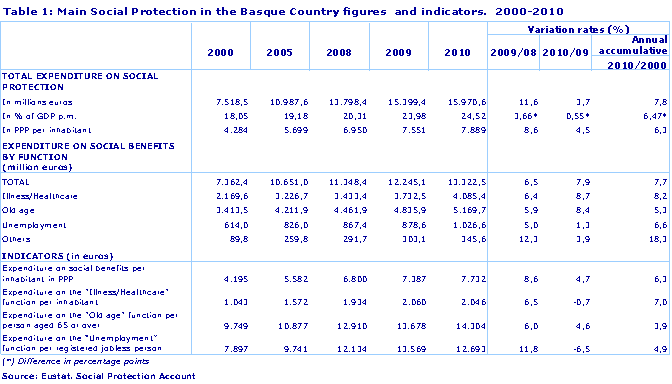
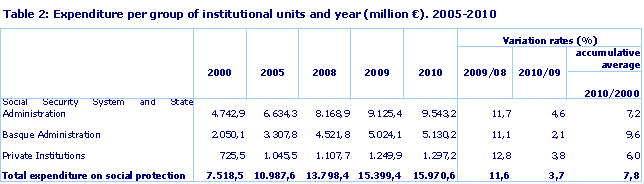
With regard to the institutional units that implement the expenditure on social protection, in 2010 the Social Security System and State Administration spent 59.8% of the total, the Basque Administration 32.1%, and Private Institutions accounted for the remaining 8.1%. In 2010, it is the expenditure incurred by the Social Security System and State Administration that registered the highest growth rate, 4.6% above the previous year, while over the period 2000-2020, the expenditure incurred by the Basque Administration shows the greatest increase in the cumulative annual rate, 9.6%.
�
For more information on the Social Protection Account, see the methodological note:
http://www.eustat.eus/document/datos/Nota%20met_SEEPROS08_i.pdf
For further information:
Basque Statistics Office
C/ Donostia-San Sebastián, 1 01010 Vitoria-Gasteiz
Tlf:+34-945-01 75 00 Fax:+34-945-01 75 01 E-mail: eustat@eustat.es
Contact: Jose Javier Aramburu
Tel:+34-945-01 75 06 Fax:+34-945-01 75 01
Further press releases on the Social Protection Account of the Basque Country
Social Protection Account of the Basque Country Databank