Press release 11/28/2012
Exports from the Basque Country decreased by 9.7% in the third quarter of 2012
There was a drop in imports of 3.9% over the same period.
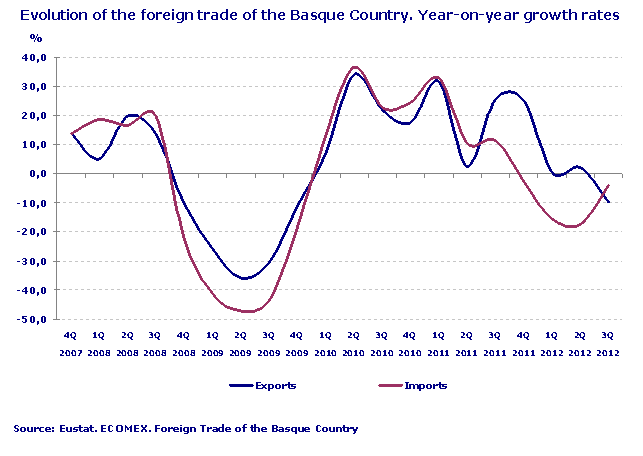
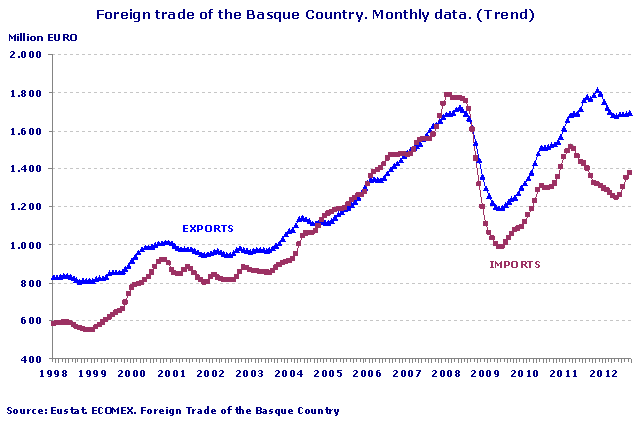
Exports from the Basque Country posted a nominal decrease of 9.7% in the third quarter of 2012, according to EUSTAT data. They totalled 4,752 million euros compared to 5,263 million the previous year. This decline in exports in the third quarter translates into an accumulated rate of -2.6% in the first nine months of 2012.
Total imports to the Basque Country also experienced a nominal decrease of 3.9% in the third quarter of this year, and totalled 3,985 million euros. If only non-energy imports are considered, for the same period there was a higher decrease (-9.9%), valued at 2,419 million euros. The total for the first nine months of the year was negative and stood at -12.5% with regards to the same period of the previous year, a decrease that saw a reduction of -8.9% in non-energy imports.
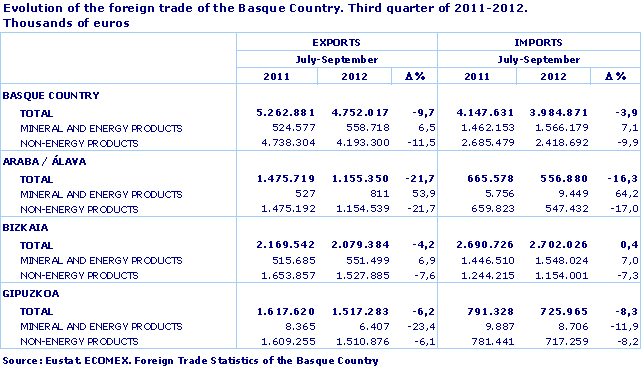
The net balance of exports less imports for the third quarter was positive and showed a surplus of 767 million euros, with a coverage rate of exports over imports of 119.3%. If imported and exported energy products are excluded, the non-energy trade balance registered a large surplus of 1,775 million, which nevertheless supposed 278 million less than the third quarter of 2011. The non-energy coverage rate, in the period under consideration, went from 176.4% in 2011 to 173.4% in 2012.
�
Exports in the third quarter of 2012 destined for the European Union were down by 18.6% compared to the same period of 2011. Amongst these, due to their volume and year-on-year decreases, those destined for France (-9.4%), Germany (-16.4%), Italy (-34.7%), and Belgium (-47.4%) all stood out. The only country amongst those of greatest volume to register a positive rate was the United Kingdom (1.8%). Outside the EU-27, special mention should be made of exports to the United States, (24.0%), Mexico (40.5%), Venezuela (48.5%) and Turkey (3.3%). The decreases registered in exports to China (-41.1%) and to a lesser degree to Brazil (-1.2%) were also noteworthy.
Imports from the European Union were down by 2.5%, with those from Germany (7.4%) and France (12.7%) standing out for their importance and year-on-year falls, whereas those coming from Italy (3.5%), the Netherlands (50.5%), the United Kingdom (38.1%) and Belgium (8.2%) increased. From the rest of the world, the highest growth was recorded in imports originating from Russia (34.1%), Mexico (414.1%), Iraq (100.9%) and Venezuela (1,866.4%), and the greatest decreases in imports from the United States (-29.25%) and China (-13.5%). It is worth mentioning the case of imports from Iran, which went from 560 to 4 million euros (-99.3%).
By customs duty groups, and in relation to exports, special mention should be made of growth in Mineral Products (6.5%) and Electrical Material (8.0%), which were the most dynamic amongst the largest groups. The rest of the largest sections obtained different results, going from the static position of Metals & Manufactured (0%) to decreases for Transport Material (-22.6%) and for Plastics & Rubber (-45.2%).
�
Analysing imports, those of Mineral products particularly stood out, growing 7.1% and accounting for 39.3% of our imports. There was also light growth in Electrical Material(0.9%) but the rest of the largest sections experience decreases that were more or less pronounced, particularly for Plastics & Rubber ,which was down by 32.2%, Chemical Products, down 15.9%, Metals & Manufactured, down by 6.7% and Transport Material, down by 3.8%.
The largest decline in exports took place in Álava. This decrease stood at 21.7% in the third quarter of 2012, being registered above all amongst the most important customs duty groups: Transport Material (-37.1%), Metals & Manufactured (-4.2%) and Plastics & Rubber (-56.4%); on the other hand, exports were up forElectrical Material (36.0%). Of imports to Álava, which registered a decrease of 16.3%, those of Metals & Manufactured (-29.1%) and Electrical Material (-3.5%) stood out amongst the most important customs duty sections.
For further information:
Basque Statistics Office
C/ Donostia-San Sebastián, 1 01010 Vitoria-Gasteiz
Tel: +34-945-01 75 00 Fax:+34-945-01 75 01 E-mail: eustat@eustat.eus
Contact: Patxi Garrido
Tel+34-945-01 75 13 Fax:+34-945-01 75 01
Further press releases on Foreign Trade Statistics of the Basque Country
Database on Foreign Trade Statistics of the Basque Country