Press Release 18/10/2012
In 2011 the migratory balance for the Basque Country continued to be positive and rose by 15%
As in the previous year, there was a positive migratory balance between the Basque Country and the other Autonomous Regions
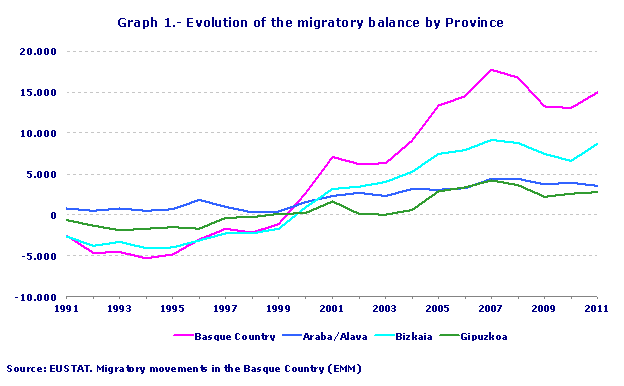
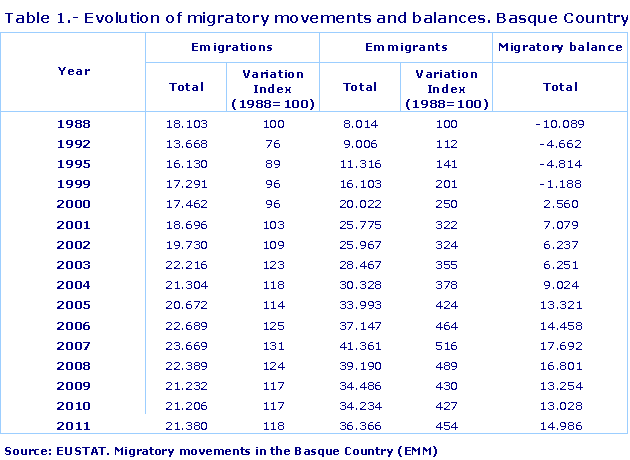
2011 is the twelfth consecutive year in which a positive migratory balance was posted for the Basque Country. Specifically, 14,986 more people came to the Basque Country than left. This figure is 15% above that of 2010, according to data provided by Eustat.
By provinces, Bizkaia, which gained 8,333 people, had the highest migratory balance in absolute figures and was up 27% compared to 2010. Gipuzkoa, which gained 2,949 people, saw its balance increase by 15%. For its part, Álava gained 3,704 people, which represented a decrease of 5% with regards to 2010. By capitals, Vitoria-Gasteiz and Bilbao had positive balances of 2,857 and 2,625 people, respectively, whilst Donostia-San Sebastián posted a slightly negative balance of 385.
In relation to movements produced between the Basque Country and the other Autonomous Regions, in 2011 there was a positive balance of 6,297 people, of which 92.4% were of foreign nationality. It was the fourth consecutive year since Eustat started publishing these statistics in which there were more immigrations to the Basque Country from other Autonomous Regions than emigrations from it, with its migratory balance increasing by 70.8%.
�
The migratory balance for people coming from overseas was positive, standing at 8,689 people. However, it was down by 653 (-7%) in absolute numbers with respect to the previous year.
On the other hand, 9.2% of the Basque population changed their place of residence in 2011, with the mobility being within the Basque Country in 71% of the occasions, while the mobility was extra-community in the other cases.
In total, 198,972 changes of habitual places of residency were recorded in the Basque Country:
- From this figure, 92,447 were changes of address within the same municipality.
- Intra-community mobility, in other words, where the origin and destination are different municipalities of the Basque Country, stood at 48,779 movements.
- There were also 36,366 extra-community or external immigrations, which are those that have their origin outside the Autonomous Region and where the destination is the Basque Country. Of these immigrations, 12,708 came from abroad.
- Finally, there were 21,380 cases of external or extra-community emigration, in other words, residential variations originating in a municipality of the Autonomous Region and with the destination outside it, 4,019 of which were to destinations abroad.
�
Basque geographical mobility is on a much smaller scale if compared to the other Autonomous Regions
In 2011 external or extra-community geographical mobility, which involved 26.6 per thousand inhabitants of the Basque Country (Álava 32.9‰, Bizkaia 27.3‰ and Gipuzkoa 22.5‰), was relatively small if compared to the other autonomous communities, where 40 per thousand inhabitants moved on average.
With the exception of the Autonomous Region of Galicia, the other Autonomous Regions contributed more population to the Basque Country than they received from it.
The Autonomous Regions that attracted the emigrants from the Basque Country were as follows: Madrid, Castilla y León, Cantabria, Catalonia, Navarra and Andalusia. Between them they received 66% of the people who left our Region for other Autonomous Regions.
In 2011 immigrations of foreign nationals stood at 20,863, 679 (3.4%) more than the previous year, and accounted for 57% of the total entries into our Community. Emigrations of foreigners stood at 5873, 239 more than in 2010.
In 2011, 9,636 foreign immigrants were recorded as moving to the Basque Country from other Autonomous Regions. More than half, 5,349 people, originated from Madrid, Catalonia, Comunidad Valenciana and Andalusia. On the other hand, emigrations of foreign nationals to other Autonomous Communities stood at 3.820, which was 65% of the total of emigrations of foreigners, with the remainder moving to other countries.
The average age of the emigrants (35.7 years old) was higher than that of the immigrants (32.1 years old). If the gender variable of the population in question is taken into account, 53% of immigrants were men and 47% women, whilst the difference between the sexes was lower in the case of emigrants: 52% men and 48% women.
For further information:
Basque Statistics Office
C/ Donostia-San Sebastián, 1 01010 Vitoria-Gasteiz
Tel:+34-945-01 75 00 Fax:+34-945-01 75 01 E-mail: eustat@eustat.es
Contact: Martín González Hernández
Tel:+34-945-01 75 49 Fax:+34-945-01 75 01
Online press releases about migratory movements in the Basque Country
Databank on migratory movements in the Basque Country