Press Release 11.07.12
One in six people had to prolong the working day nearly every day
Just over one in three individuals in work had a flexible finish time
17.4% of the population in work nearly always, and a similar percentage, sometimes, had to dedicate more hours to work than those established or planned, according to data provided by Eustat. This situation, the prolongation of timetables: always or sometimes affected close to 60% of employers and self-employed workers. This was also the case for 29.6% of salaried workers in the private sector and 28.2% in the public sector.
A flexible timetable for finishing work, another supplementary solution for improving reconciliation, was enjoyed by one in three people in work (36.1%), although lower for women (32.6%) than for men (39.1%).
As regards working from home, 8.1% worked sporadically from home and 5.3% at least half of the time. In general terms, just over one in eight employed people worked occasionally or with greater frequency from home.
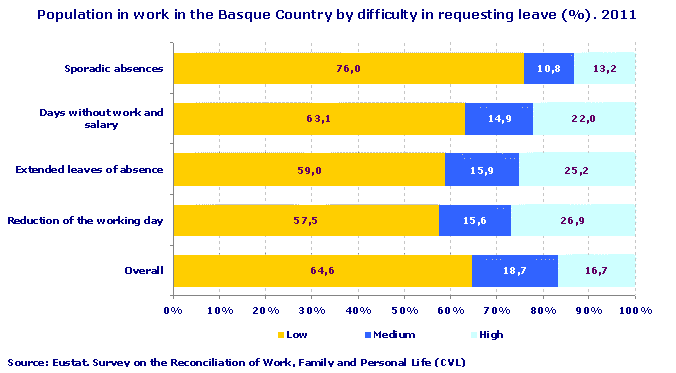
76% of people in work did not experience difficulty in taking time off for personal reasons
Within the various methods that could make the conciliation of work, family and personal life easier, short-term leave was within reach of the large majority of the population in work, followed by the possibility of requesting unpaid days, possible for 63.1% of the working collective. Furthermore, almost 60% stated that they experienced little difficulty in obtaining extended leaves of absence or a reduction in working hours.
�
In general, there were no noticeable differences between the sexes, with the exception that according to their responses, women experienced less difficulty when requesting a reduction of working hours (61.3% stated that they could obtain a reduction without much difficulty) than men (54.3%); on the other hand, obtaining permission for sporadic absences was slightly more difficult for working women (26.6%) when compared to working men (21.7%). Age, likely to be associated with length of service, reduced difficulties in accessing the cited reconciliation measures.
Members of cooperatives and individuals on the public sector payroll had their leave requests granted with less difficulty than other professionals. On the other hand, employers and the self-employed said that they were presented with greater limitations. Half of self-employed individuals saw taking an extended leave of absence or a reduction in working hours as very problematic; taking a day off was problematic for 43.9% and 21.8% considered it difficult to be absent sporadically. For employers, close to 45% responded that they had many problems in taking extended leave or a reduction in working hours; 39% in taking a day off and 19.3% in being absent sporadically.
One in four people in work believed that requesting extended leave or a reduction in working hours for family reasons would seriously affect their professional trajectory
The fear that requesting leave or reduced hours would affect career options was at similar levels amongst men and women, although it appeared more prevalent amongst young people. Notwithstanding, maternity could create promotion inequalities for one in five working women, whilst just 5.9% of men were of the opinion that paternity could seriously affect them. Nevertheless, one in six employed men believed that it would be highly detrimental to them to request paternity leave.
Half of employed people in Gipuzkoa preferred working in a small company, 51.9% in the private sector and 15.9% preferred being self-employed
Gipuzkoa displayed a specific profile with respect to work preferences: half of the employed population in this province preferred working in a small company, 51.9% in the private sector and 15.9% preferred being self-employed. This profile contrasts with that of the employed population in Álava: 67.7% would choose a large company, 69.2% preferred the private sector and only 13.4% preferred managing their own business.
Those from Bizkaia, although closer to the profile of Álava, were positioned between the two other provinces: 60.2% preferred large companies, 62.6% preferred the public sector and around one in seven (15.9%) preferred having an independent business.
Clear differences can be seen in working preferences according to sex: 67.4% of employed women wished to work in the public sector, whilst this percentage falls to 51.5% in the case of men. In turn, only 12.3% of women in paid work preferred being self-employed, compared to 18.3% of men.
One in every five men dedicated 3 or more hours to caring for dependent relatives compared with 41.1% of women
In relation to people dependent on the working population of the Basque Country, 86% of them were aged 65 or above, 74% were women and 30% lived in the same dwelling as the individual in work.
�
Where it proved necessary to care for dependent relatives, up to 41.1% of women in work dedicated 3 or more hours per day, a percentage that falls to 19.6% in the case of men.
With regards to the care for these dependents in households where both partners or spouses worked and when this fell outside working hours, in half of the cases it was other relatives without earnings who mainly took care of them and in 23.9% of cases it was both partners who took charge of this care; however, in 6.2% of cases it was only the women who cared for dependents, whilst on no occasion did men undertake this care on their own.
For further information:
Basque Statistics Office
C/ Donostia-San Sebastián, 1 01010 Vitoria-Gasteiz
Tel: +34-945-01 75 00 Fax:+34-945-01 75 01 E-mail: eustat@eustat.eus
Contact: Pilar Martínez Rollón
Tel:+34-945-01 75 31 Fax:+34-945-01 75 01
Further press releases on Survey on the Reconciliation of Work, Family and Personal Life (CVL)