Press Release 09.07.12
One in every seven men dedicated the same time as women to looking after their children
Half of working women with children dedicated 5 hours or more per day to looking after their sons and daughters
Half of women in work with children under the age of 15 (48.8%), as well as time spent in paid work, dedicated 5 hours or more per day to looking after their sons and daughters, according to the Survey on the Reconciliation of Work, Family and Personal Life carried out by Eustat. In turn, almost half of men in work (49%) dedicated 2 hours or less to looking after their children. However, one in seven (13.5%) dedicated the same amount of time as women. As a whole, whilst men dedicated 2.8 hours per day to looking after children, women dedicated 4.7.
The distribution of domestic tasks amongst employed men and women in the Basque Country was even more imbalanced: nine out of ten men (90.8%) dedicated 2 hours or less, whilst a third of women (32.2%) dedicated 3 hours or more.
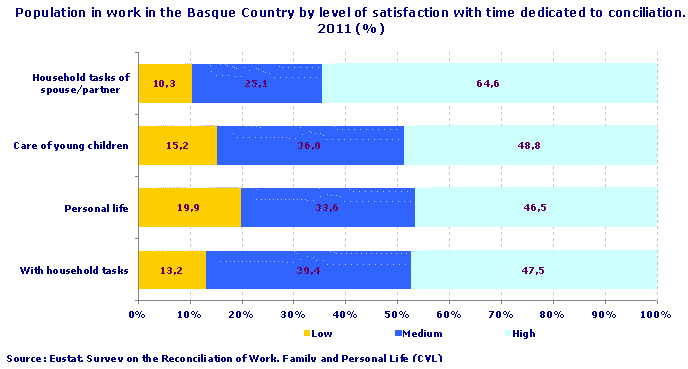
The inequality of responsibilities assumed had a cost in the level of satisfaction with time available for personal life, leisure and studies, given that just over one in five women (22.2%) said they were unsatisfied, compared to less than one in five men (17.9%). This low satisfaction was concentrated in the ages during which the family is being formed, between 35 and 44, and afterwards diminished.
�
This uneven distribution of functions also shows that a significant percentage of women in work, more than one in six, were very unsatisfied with the collaboration of their spouses or partners in domestic tasks. A large majority of men in work (81.2%), on the other hand, were very satisfied with the housework done by their partners.
However, it is worth mentioning that working women expressed a considerably greater satisfaction from looking after their children (55.2% expressed high satisfaction), including household tasks (49.3% also expressed high satisfaction), than employed men, which in the first case dropped to 43.2% and in the second to 45.9%.
One in 4 people in work in the Basque Country stated that they have great difficulty combining work with looking after children and with personal activities
One in 3 people in work in the Basque Country, 26.7%, stated that they have a lot of difficulty combining work with looking after children and with personal activities. This high degree of difficulty was reproduced in 25.6% of people in work where it concerned attending to dependent relatives. In turn, for 23.3% of people in work the time dedicated to remunerated work also made it highly difficult for them to carry out administrative tasks and nearly one in five, 19.2%, stated that it was only with great difficulty that they could carry out domestic tasks.
Employers and self-employed workers experienced a considerably greater degree of impediments than the rest of the employed population when attempting to reconcile work and family life. Thus, 28.9% of the first group and 36.3% of the second group confessed to experiencing great difficulty in looking after young children and for around a third it was also very difficult to dedicate time to personal activities or to help with domestic tasks.
Overall the level of difficulty that the population in work in the Basque Country had in combining paid work and personal and family life was 3.8 points, out of a maximum of 10, where 10 would indicate that conciliation is completely impossible. Bizkaia was situated within the average, Álava showed the least level of difficulty with 2.9 points, whilst Gipuzkoa showed the highest, with a score of 4.2.
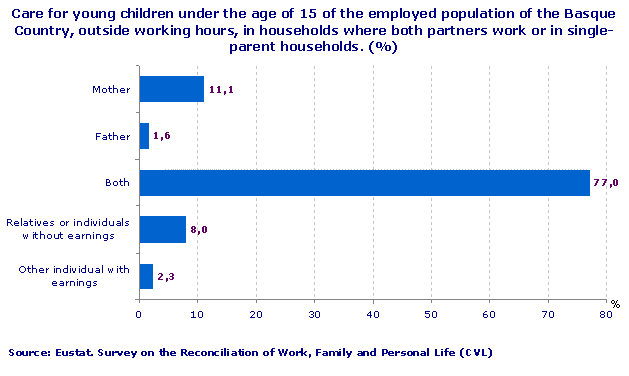
Outside of working hours, just 1.6% of children were looked after mainly by their fathers compared with 11.1% that were looked after by their mothers
In households where both partners worked, or in single-parent households, when looking after children was outside the working hours of the father or mother, in 77% of occasions it was both of them who took responsibility for this care; however, the father took responsibility in just 1.6% of these cases, whereas this figure rose to 11.1% for occasions when the mother took responsibility.
In these same households, and in relation to looking after young children during working hours and outside school hours, in 52.2% of cases it was relatives or individuals without earnings who mainly took care of looking after children, in 22.4% of cases it was both partners who looked after children and in 14.4% of cases the care rested upon other individuals with earnings.
For further information:
Basque Statistics Office
C/ Donostia-San Sebastián, 1 01010 Vitoria-Gasteiz
Tel: +34-945-01 75 00 Fax:+34-945-01 75 01 E-mail: eustat@eustat.eus
Contact: Pilar Martínez Rollón
Tel:+34-945-01 75 31 Fax:+34-945-01 75 01
Further press releases on Survey on the Reconciliation of Work, Family and Personal Life (CVL)