Press release 06.06.12
The digital press recovered the top positions in the list of most-visited websites in 2012
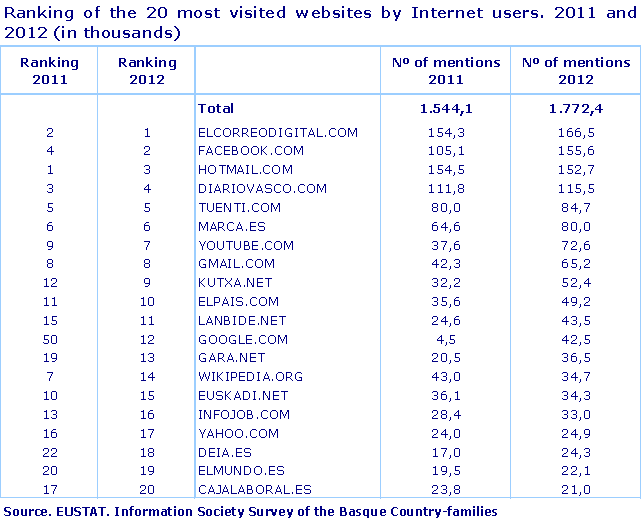
The social networks were consolidated in the top positions, with “facebook.com” and “tuenti.com” occupying the second and fifth positions, respectively
Those who habitually use the Internet in the Basque Country leant, in the first place, towards the sites offered by the communication media, followed by those related to social networks, e-mail platforms, institutions, electronic banking and leisure and travel, according to Eustat data referring to the year 2012.
The most visited website in 2012 is “elcorreodigital.com”, with 9.4% of individuals who use the Internet frequenting this site, a total of 166,500 visits. The second position in the ranking was occupied by the social network “facebook.com”, which climbed two places compared to 2011 with a total of 155,600 visits (8.8%). In turn, the e-mail platform “hotmail.com”, the leader in 2011, is relegated to third position with 152,700 visits (8.6%).
The majority of the communications media gained positions in comparison with the same period of 2011. Amongst the most cited media are “diariovasco.com”, with a percentage of 6.5%, “marca.es” with 4.5%, “elpais.com” with 2.8% of the total, “gara.net” with 2.1% and “deia.es” with 1.4% of the total visits.
Furthermore, the consolidation of the site “tuenti.com” is particularly noteworthy, maintaining itself in fifth position with a total of 84.700 visits, capturing 4.8% of the share. In the same vein, the site “youtube.com” continued to climb in the classification, standing in seventh position with a total of 72,600 visits, which was 35,000 visits more than the same period of 2011. It is also worth mentioning the eruption of “google.com” amongst the most visited pages, as well as a search engine, which climbed thirty-eight places to occupy 12th position.
Electronic banking and institutional pages maintained their positions in the list of most-visited websites in 2012
Amongst the most cited sites were those offered by banking entibies and their clients: “kutxa.net”, with a percentage of 3% of visits, occupied ninth place; ‘’cajalaboral.es” received 1,2% of visits and “bbk.es” 1% of the total.
The website of the Basque Government, “euskadi.eus”, with 1.9% of total visits, had a figure of 34,100 visits, occupying fifteenth position in the ranking. In this sense, it is worth mentioning the consolidation within the first 50 positions of the sites related to the Basque public administration, such as “gipuzkoa.net”, “bizkaia.net”, “alava.net” and “osakidetza-svs.org”.
�
Almost 97% of Internet users in the Basque Country use “Google” as a search engine
In regards to search engines, Google is the preference of Internet users in the Basque Country, with other search engines having been displaced. 96.6% of this collective, standing at more than 1,079,000 Internet users aged 15 and over, use Google as a reference, against 1.8% who use Yahoo and the remaining 1.6% who use other search engines. The number of individuals who use Google as a search engine rose by more than 16,000 individuals in 2012.
93% of children had access to a computer in their dwelling against 72% of the population aged 15 and over
The introduction of the new information and communications technologies amongst the population between the ages of 6 and 14 was very high. Thus, in the first quarter of 2012, 92.9% had a computer in their dwelling, against the 71.8% corresponding to the population aged 15 and over.
As far as Internet access was concerned just over 152,000 children, 88.8%, had access to this service in their dwelling, which was an increase of 2.8 points compared to the same period in 2011. This percentage was more than 20 points above that recorded for the population aged 15 and over with Internet access (66.9%).
�
With regards to the use of new technology by the infant population, 66.2% of minors between the ages of 6 and 14, a total of 113,400 individuals, used the Internet in the last three months, compared to 57.6% of those over 14 years of age. These figures reveal that the percentage of Internet users has remained constant with regards to 2011. By sex, the differences in Internet usage are scarcely significant amongst minors in this same age range.
Minors who use the Internet opted, mainly, for activities relating to leisure (72.2%), followed by e-mail (55.6%), searches in libraries and documents (54.4%), and chats and conversations (51.3%).
Donostia-San Sebastián, with a percentage of 62.1%, stood at the head of the Basque capitals in terms of population who used the Internet
In the analysis by capitals, Donostia-San Sebastián, with 62.1% of individuals aged 15 and over who were Internet users, stood in first place, followed by Vitoria Gasteiz, with a percentage of 59.3%, whilst Bilbao was displaced to third position, with 54.3% of the population connected to the Internet.
The Lumber of men who used the Internet exceeded that of women in the three Basque capitals. The greatest gender-gap was in Bilbao (9.1 percentage points), with the percentage of men standing at 59.2% and that of women standing at 50.1%. In Donostia-San Sebastián the difference was also notable (7.7 points): 66.2% of men compared to 58.5% of women; finally, in Vitoria-Gasteiz, this gender-gap was reduced (6.7 points), with men representing 62.7% and women representing 56% of Internet users.
As regards regions, Plentzia-Mungia (61.3%) in Bizkaia, Urola Costa (62.8%) in Gipuzkoa and la Llanada Alavesa (59.3%) in Álava were the areas with the greatest percentage of population who used the Internet in the three provinces.
On the other hand, Bajo Deba (57.6%) in Gipuzkoa, Gernika-Bermeo (52.4%) in Bizkaia, and Montaña Alavesa (48.5%) in Álava were, in this order, the regions that registered the lowest percentages of Internet users in their respective Provinces.
The region of Urola Costa in Gipuzkoa, with 62.8% of the population who were Internet users, offered the highest percentage in the Basque Country as a whole. On the contrary, the population residing in la Montaña Alavesa, in Álava, recorded the lowest figure, with 48.5% of the population being Internet users.
Gipuzkoa showed the greatest balance amongst regions, whilst the greatest differences were in Álava. Therefore, 48.5% of the population in Montaña Alavesa were Internet users, 10.8 points less than the population who used the Internet in Llanada Alavesa (59.3%).
For further information:
Basque Statistics Office
C/ Donostia-San Sebastián, 1 01010 Vitoria-Gasteiz
Tel:+34-945-01 75 00 Fax:+34-945-01 75 01 E-mail: eustat@eustat.eus
Contact: Pilar Martínez Rollón
Tel:+34-945-01 75 31 Fax:+34-945-01 75 01
Further press releases on Information Society Survey of the Basque Country - Families
Databank on Information Society Survey of the Basque Country - Families