Press release 28.05.12
The Basque Country is one of the communities with the greatest proportion of older people
The Basque Country recorded the highest population figure
The population of the Basque Country on the 1st of January 2011 stood at 2,174,033 individuals, according to Eustat data. It is the highest figure in the history of the community and there are 4995 inhabitants more than one year ago.
This growth was concentrated in Gipuzkoa, with 2583 more inhabitants and Álava, with 1714 more, given that Bizkaia only rose by 698 inhabitants. These differences are due to the fact that six municipalities that lost the most population were in Bizkaia, with Bilbao particularly standing out with 1331 fewer inhabitants, followed by Getxo with 436 fewer; however, the territorial balance was positive given that other municipalities gained population, such as Barakaldo and Etxebarri, up by 552 and 474, respectively.
Population growth in Álava was due in large part to the evolution of the capital, which grew by 978 inhabitants, followed, far behind, by Alegría-Dulantzi and Llodio, up by 108 and 100 individuals, respectively. The case of Gipuzkoa is distinct because Donostia-San Sebastián was down by 68 individuals and it was the other municipalities of the territory that grew in population, amongst which Errenteria stands out, with 439 more inhabitants.
In 17 municipalities of the Basque Country more than a quarter of the population was 65 or over
The Basque Country, with 19.5%, exceeded the proportion of the population aged 65 or over in Spain by over 2 percentage points. Castilla y León, Galicia, Principado de Asturias and Aragón are the Autonomous Communities that had higher proportions. If compared with Europe, only Germany and Italy exceed the Basque figures.
103 municipalities exceed the percentage of the Basque Country total, whilst 148 present the same or a lower percentage. Amongst those that exceed it are Bilbao, Donostia-San Sebastián and Barakaldo, which account for 30% of the population of the Community.
There was quite a lot of disparity between the municipalities regarding the percentage of people 65 and over, where it went from 8.7% in Elburgo/Burgelu to 37.8% in Lagrán. In the Community there were just 3 municipalities that had a percentage below 10%, Alegría-Dulantzi, Irura and those already mentioned, which had a combined percentage that stood at 5.155 103 municipalities exceed the percentage of the Basque Country total, whilst 148 present the same or a lower percentage.
The high proportion of older people in all of the municipalities in the region of Montaña Alavesa caused its figure to exceed 27%, whilst in the regions with the next-highest percentage, Markina-Ondarroa, Bajo Deba and Gernika-Bermeo, the number of people 65 and over stood at below 22%.
�
Graphic 1. Percentage of people 65 years or over by municipality
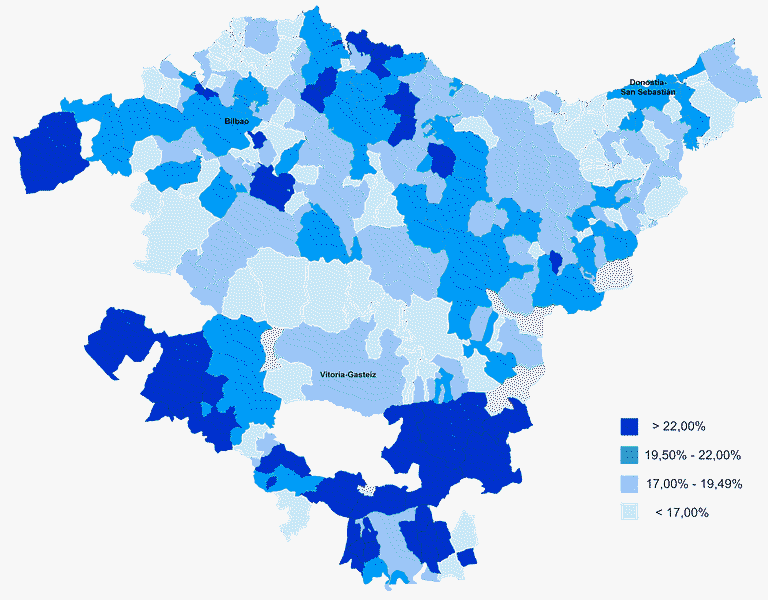
Source: EUSTAT. Municipal Inhabitants Statistics. 1st of January 2011
In the Autonomous Community of the Basque Country there was a ratio of 1.4 people 65 and over for each person below the age of 16, exceeding that of Spain as a whole, which had a ratio of 1.1. The municipalities that exceeded the ratio of 1.4 stood at 81, with extreme cases such as Lagrán, which had a ratio of 9 to 1. Harana/Valle de Arana had a ratio of 6 to 1. Elantxobe, Añana and Moreda de Álava/Moreda Araba had more than 3 older people for each person below the age of 16. In the opposite extreme there were Irura, Alegría-Dulantzi, Elburgo/Burgelu, Altzo y Larraul which had more than 2 young people up to the age of 15 for each person aged 65 and over.
As can be seen, population distribution by age was most extreme in the municipalities of Álava, due above all to its small size and the fact that any demographic phenomena, such as migration, unbalances this distribution.
For further information:
Basque Statistics Office
C/ Donostia-San Sebastián, 1 01010 Vitoria-Gasteiz
Tel:+34-945-01 75 00 Fax:+34-945-01 75 01 E-mail: eustat@eustat.es
Contact: Martín González Hernández
Tel:+34-945-01 75 49 Fax:+34-945-01 75 01
Further press releases on Municipal Inhabitants Statistics of the Basque Country