Press release 21.05.12
The average weekly expenditure of Basque families on food products stood at €100 in the 2006-2010 period
The economic crisis of the last two years of the period did not produce significant changes in consumer patterns
The weekly consumption of food products of families in the Basque Country stood at around €100 in the 2006-2010 period, in accordance with the Family Expenditure Statistics that Eustat has been carrying out since 2006, in collaboration with the National Statistics Institute.
According to this Surrey, just 10 products accounted for half of the weekly shopping basket, amongst which cooked meats and bread each accounted for 8% of the total, fresh fish 7%, bovine meat 6%, yoghurts, poultry meat, crustaceans and molluscs and other bakery products 3% and cheese, 2%. Amongst these was a non-food product, cigarettes, which accounted for a weekly expenditure of just over €6.
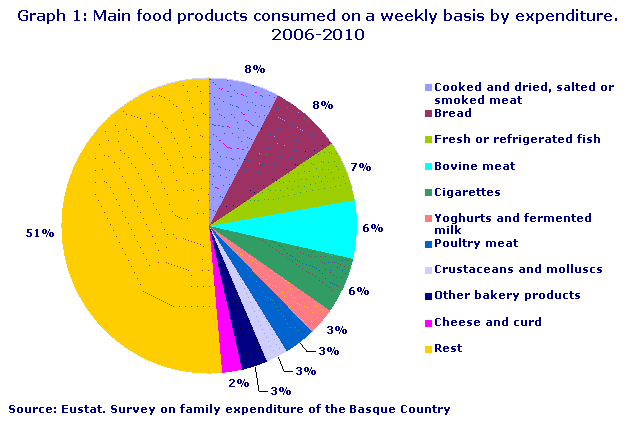
Analysing in euros and aggregating similar products, it can be seen that expenditure stood at €17 for meat, €10 for bread and similar, €9 on fish and seafood and €5.5 on milk products, not including the aforementioned consumption of tobacco.
The consumption of physical quantities does not exactly correspond to the described model, because unit prices of the various products are normally very different to one another. For this reason, taking into account the quantities, only three of the previously indicated products are still visible in the shopping basket: bread, yoghurts and cigarettes.
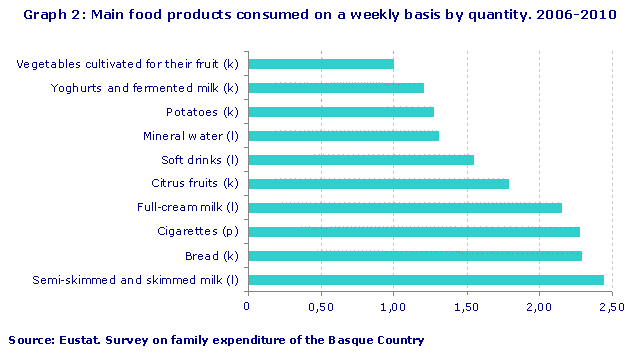
In these terms, the most consumed product turns out to be milk, either in its semi-skimmed and skimmed form (the most frequent, with close to 2.5 litres per week) or full-cream milk, with just over 2 litres. Weekly bread consumption stood at just under 2.5 kg. Tobacco consumption continued to be amongst the first positions, measured in packets of 20, so that weekly family consumption stood at 45 cigarettes.
Amongst those products not highlighted by expenditure in euros but which appeared in the shopping basket in large quantities were citrus fruits (almost 2 kg), soft drinks and mineral water (almost 3 l. for both), potatoes and vegetables (over 1kg.).
The data provided by Eustat show that the crisis did not affect overall consumption to any great extent, at least during the first two years, given that, in both cases, the weekly figure stood at around €100.
However, some changes can be seen that are worthy of a mention: consumption of bovine meat fell by 14% in quantity and 12% in euros; equally, wine consumption was down by 12% in quantity and 7% in euros. On the other hand, the consumption of poultry meat was up 15% in quantity and 12% in euros. The consumption of cigarettes fell by 6% in quantity but in euros it rose by 17%, due to the price increase.
Up to now the aforementioned changes have referred to the average family consumption of food products, but there is also another way of looking at it: if there are families that have stopped purchasing certain products or if they have acquired others with greater frequency: this is what has been denominated the proportion of consumer families in the month.
In this sense we can see that there are few families that stopped consuming food products due to, or in the crisis years. Amongst the most frequent, only wine consumption fell significantly (from 50% to 47%, 3 percentage points). On the other hand, the proportion of consumer families increased in the majority of cases, standing at more than 7 points in prepared fruit and fruit conserves, ovine and caprine meat, frozen vegetables, trimmings, offal and other inferior meat cuts, other milk-based products and other edible meats.
As a result of the fact that not all families habitually purchase products, the Statistics on Family Expenditure also provides information on how much families that have done a specific shop in the month consume. Therefore it can be observed that families that purchased rice (50% of the total) acquired just over half a kilo, against 280 grams for families as a whole, be they consumers of the product or not.
On the other hand, if we refer to bread, given that it is habitually consumed by almost all families (98%), there was hardly any difference between its average (2.35 kg.) and the overall family average (2.30 kg.).
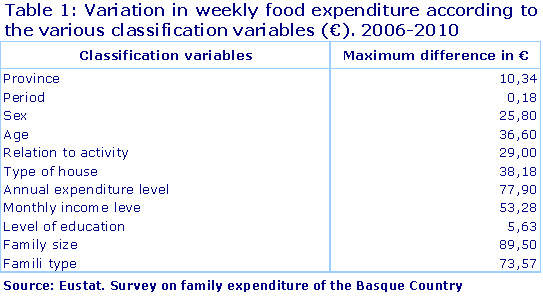
Amongst the variables of analysis used in the survey, that which most conditioned family consumption was family size, because consumption of families consisting of one person stood at €50, whereas when they consisted of four or more members it stood at €140, which indicates that all individuals in the family participated in family consumption of food products, something that did not happen with other types of consumption.
The second most important variable is the annual family expenditure level, where families with lower annual expenditure consumed €64 in food per week and those with higher annual expenditure consumed €141 in food per week.
Leaving to one side family type, which, being related to the presence or absence of offspring in the dwelling has a lot to do with family size, the second most important variable is the monthly income level: it is observed that the expenditure on food of a family with a low income level (€72) was just over half of that corresponding to another family with a high level (€125).
Amongst the remaining variables it is worth pointing out the differences caused by the type of house (large €125, small €87), the relation to activity of the main provider (in work €103, unemployed, student, housework and others €75) or sex of the same, which provoked a difference in expenditure on food of €25 where the main provider was a man.
Finally it should be pointed out that there were no great differences between provinces: Álava and Bizkaia had a very similar weekly expenditure level for food products (€96), with Gipuzkoa standing at €10 above this level.
The overall differences are merely a pale reflection of what occurs when a more detailed analysis is carried out. For example, we can draw attention to the fact that the consumption of baby food varied between €0.10 in families of couples without children and €1 for couples with children. In the same vein, the consumption of crustaceans and molluscs varied between €1.8 per week for low-income families and €3.4 for those with higher incomes. Contrary to what was expected is the fact that families in Álava consumed 1 kg of potatoes per week, whereas those in Gipuzcoa and Bizcaia consumed 1.3 kg.
As regards the periodic payments and monthly bills paid by Basque families, it is worth mentioning those linked to expenditure on the main dwelling, with rent topping the list followed by communal expenditures, electricity, fixed telephone, gas, Internet and insurance.
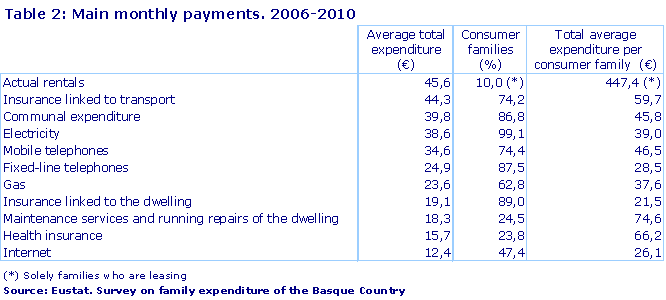
The adjoined table demonstrates how expenditure on electricity was practically universal, showing the average total for all families and the average per consumer family to be the same. In relation to leasing of the main dwelling, the average expenditure for 10% of families who stated that they were leasing, including privately, via social welfare and obsolescent contracts, as well as payments made by lodgers in family homes for the use of a room or rooms, stood at €447.
On a more anecdotal note it is worth mentioning that Basque families paid an average of €12 per month for the Internet, but that half of them, who effectively had Internet, paid an average of €26.
Another important monthly expenditure group is linked to education, which affected family percentages that varied between 4% (Intermediate-level professional training) and 16% (University). For these families, the monthly expenditure ranged between €7 for intermediate Professional Training and €77 for University, with this figure standing at €23 for Compulsory Secondary Education.
For further information:
Basque Statistics Office
C/ Donostia-San Sebastián, 1 01010 Vitoria-Gasteiz
Tel:+34-945-01 75 00 Fax:+34-945-01 75 01 E-mail: eustat@eustat.eus
Contact: Enrique Morán Aláez
Tel:+34-945-01 75 35 Fax:+34-945-01 75 01