Press release 27.04.12
The average income of the Basque Country stood at around 20,000 euros per year
The average personal income of the Basque Country grew 13% between 2006 and 2009
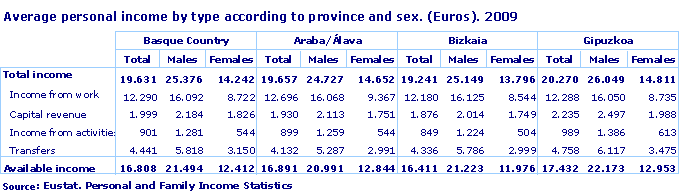
According to the Personal and Family Income Statistics of the Basque Country produced by Eustat, in collaboration with the Provincial Councils of Álava, Bizkaia and Gipuzkoa, the average personal income of residents in the Basque Country in 2009 stood at 19,631 euros for the population aged 18 or over, 13% up on three years before. Gipuzkoa was the province with the highest personal income, 20,270 euros, followed by Álava with 19,657 euros and, lastly, Bizkaia with 19,241 euros. If we analyse the evolution by province since 2006, Gipuzkoa had the best performance with the income of its population increasing by 15.9%; followed by Álava, where it grew by 14.4% and finally Bizkaia, with a rise of 11%.
Taking into account disposable income, equivalent to total income less income tax and social contributions by the worker, various differences can be seen between the three provinces. Disposable income for the Basque Country as a whole stood at 16,808 euros, for Gipuzkoa it reached 17,432 euros, 16,891 for Álava and 16,411 for Bizkaia.
The municipality in the Basque Country with the highest average personal income was Laukiz, with 29,128 euros, located in Bizkaia. In Álava the municipality with the highest personal income was Arrazua-Ubarrundia, with 27,608 euros, and in the province of Gipuzkoa that with the highest personal income was Mutiloa, with 24,804 euros. On the other hand, those with the lowest personal incomes were Lantziego in Álava, with 12,668 euros, Errezil in Gipuzkoa, with 15,129 euros and Lanestosa in Bizkaia, with 11,958 euros.
The average personal income in the capitals of the three provinces exceeded the average for the Basque Country. In first place was Donostia-San Sebastián, with 23,054 euros, followed by Bilbao, with 20,081 euros and, lastly, Vitoria-Gasteiz, with 19,980 euros.
14% of the population aged 18 and over did not receive any type of income in 2009
Regarding the distribution of income amongst the population, more than 1,585,000 individuals aged 18 and over received some type of income, that is, 86.1%, whilst 13.9% of the population did not receive any type of income during 2009. Furthermore, 59.7% of individuals received an income below the Basque Country average or did not receive any income, whilst 11.5% had an income that was double the average, that is, over 39,200 euros.
The median is the indicator that establishes the income that divides the population in two parts. In 2009 this figure stood at 15,391 euros, that is, half of the adult population of the Basque Country had an average personal income over 15,391 euros per year, whereas for the other half it was below this figure.
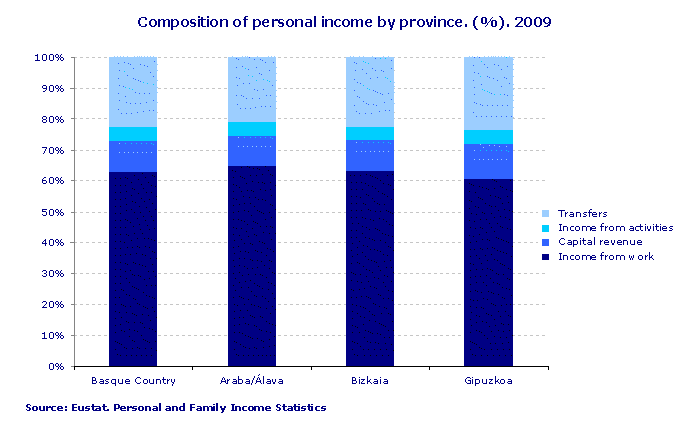
Regarding the percentage distribution of total personal income by the main income sources in the three provinces, work has the greatest relative weight, followed by transfers (pensions and social provisions).
62.6% of personal income originated from work
In this sense, regarding the composition of total personal income received by residents of the Basque Country Turing the 2009 financial year, 62.6% of it came from income resulting from work, with an average of 12,290 euros. The rest was distributed between 22.6% for transfers and social provisions, 4441 euros on average, 4.6% came from income from economic activities, with an average of 901 euros, and 10.2% came from capital gains, both moveable and immoveable, with an average of 1999 euros.
These data, when compared with those from 2006, show that transfers rose by 3 percentage points, reaching 22.6% of the total, whilst income from work fell 0.8% in the final income total, capital gains were down by 1.1 points and income from economic activity, for its part, dropped by 0.9 percentage points.
�By province, differences can be seen regarding the weight of work income and transfers in the composition of the total income, because while in Álava income represented 64.6% work and 21% transfers, Bizkaia had 63.3% of income from work and 22.5% from transfers and Gipuzkoa 60.6% from work and 23.5% from transfers.
The average income for women represented 56% of income for men
An uneven distribution can be seen between income for men and women, given that whilst men in the Basque Country obtained an average income of 25,376 euros, women received 14,242 euros, that is, the personal income of men was 11,134 euros higher than that for women.
The greatest difference between personal income of men and women was amongst those aged 60-64. In this age group the average personal income for men exceeded that for women by 20,920 euros.

For the population aged 18 and over as a whole, the highest total personal income was obtained between the ages of 55 and 59, and stood at an average of 26,563 euros. However, in the case of women the highest income was obtained between the ages of 50 and 54 (with an average income of 18,955 euros), whilst for men the maximum average income was between 55 and 59 years of age and was considerably superior (37,023 euros).
For further information:
Basque Statistics Office
C/ Donostia-San Sebastián, 1 01010 Vitoria-Gasteiz
Tel:+34-945-01 75 00 Fax:+34-945-01 75 01 E-mail: eustat@eustat.es
Contact: Pilar Martínez Rollón
Tel:+34-945-01 75 31 Fax:+34-945-01 75 01
Further press releases on Family and Personal Income of the Basque Country
Database on Family and Personal Income of the Basque Country