Press Release 30/04/2012
Added value in Basque industry grew by 3.5% in 2010
Personnel in work fell by 2.9%
Added value at factor cost, after having suffered an intense drop of 20.3% in 2009, recovered in 2010 with a growth rate estimated at 3.5%, according to Eustat data.
This positive year-on-year growth had a different sectorial evolution rate, with the Coke Plants & Oil Refinery sector obtaining growth of 60.0%, followed by the Electronic & Computer Products sector, which grew by 12.1%. In third and fourth place were Pharmaceutical Products and Water Supply & Sewage with increases of 11.6% and 9.8%, respectively.
On the other hand, on the side of the most notable drops were Extraction Industries (-20.7%), the Textile, Garments, Leather & Footwear sector (-5.4%) and Electricity, Gas & Steam (-4.8%).
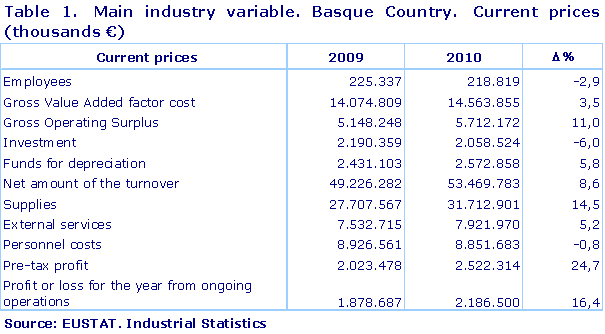
Regarding turnover of Basque industry, if in 2009 it suffered a drop of 25%, in 2010 it recovered, standing at 53,469 million euros with growth of 8.6%, but without reaching the 2008 monetary value of 65,654 million euros.
In Basque industry as a whole the loss of employment stood at over six thousand five-hundred individuals, which was a drop of 2.9% compared to the previous year. The loss of employment was more or less general across all sectors, especially affecting the Extraction Industry sector (-9.7%) and the Timber, Paper & Graphic Arts sector (-6.1%). The only sectors to see an increase in employment were Pharmaceutical Products (5.0%), Water Supply & Sewage (4.5%) and Food, Beverages & Tobacco (2.5%).
In keeping with the above, productivity in Basque industry in 2010, measured in terms of value added per employee, rose by 6.6%.
Other noteworthy aspects of the industrial evolution of the Basque Country in the 2010 financial year were:
• Personnel expenditure fell by 0.8%.
• Investment fell by 6,0%, and stood at 2059 millon euros. The sectors with the best evolution of the investment variable were Pharmaceutical Products (60.5%) and Electronic & Computer Products (35.6%).
• The Gross Operating Surplus grew by 11.0% which, together with more moderate growth in amortizations meant that the net surplus increased by 15.5%.
• In keeping with the above, the result of the financial year rose 16.4%.
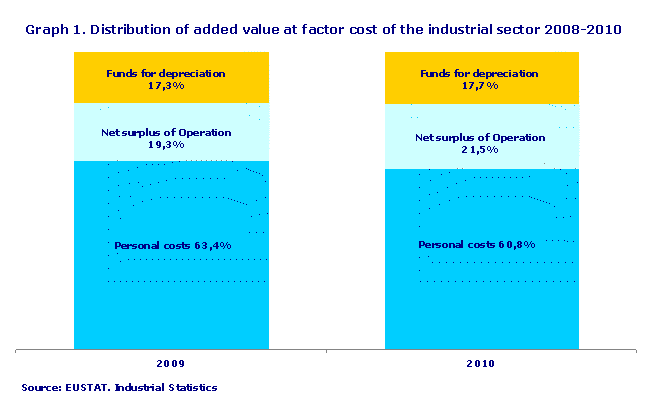
From the analysis of the distribution of added value at factor cost it can be gathered that, in 2010, 60.8% remunerated the employment factor, 21.5% represented business surplus and the remaining 17.7% the provision for the depreciation of capital represented by amortization. In relation to 2009, personnel costs were down 2.6 participation points in added value. The operating surplus posted a participation increase compared to 2009 of 2.2 points.
Provincially, the evolution was homogenous both for employment and added value. The biggest growth in added value was in Bizkaia, with 3.7%, followed by Gipuzkoa with 3.4% and Álava with 3.3%. Employment fell by 3.0 in Gipuzkoa, 2.9% in Álava and 2.7% in Bizkaia.
�
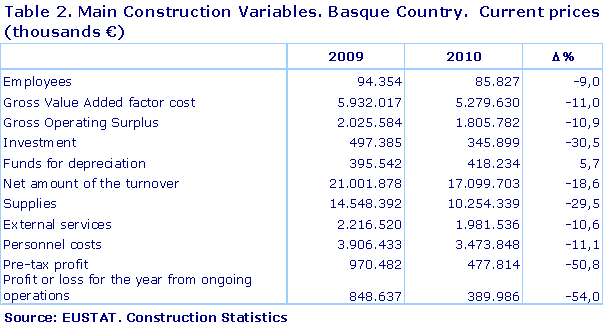
The two most important traits in the Construction sector in 2010 were a drop in employment of 9.0% and a fall of 11% in added value
At provincial level the general performance was repeated, with general falls both in employment and in added value, at a similar magnitude to the occurrences in the Basque Country.
Other aspects that stood out were:
• The percentage decrease of employment in construction of 9.0% translated into a loss of 8500 job positions compared to the previous year.
• The drop in the sum of the net turnover figure stood at 18,6% and Personnel Costs fell by 11.1%.
• The Gross Operating Surplus was down 10.9% which, together with growth in amortizations caused the net surplus to fall by 14.9%.
• Pre-tax profits fell by 50.8% and the yearly result was down by 54.0%.
For further information:
Basque Statistics Office
C/ Donostia-San Sebastián, 1 01010 Vitoria-Gasteiz
Tel:+34-945-01 75 00 Fax:+34-945-01 75 01 E-mail: eustat@eustat.eus
Contact: Iosune Azula
Tel: +34-945-01 75 06 Fax:+34-945-01 75 01
Further press releases on Industrial and Construction Statistics of the Basque Country
Industrial and Construction Statistics of the Basque Country databank