Press release 23.03.12
Births dropped 0.9% in the third quarter of 2011
Álava is the only province that saw an increase in the number of live births
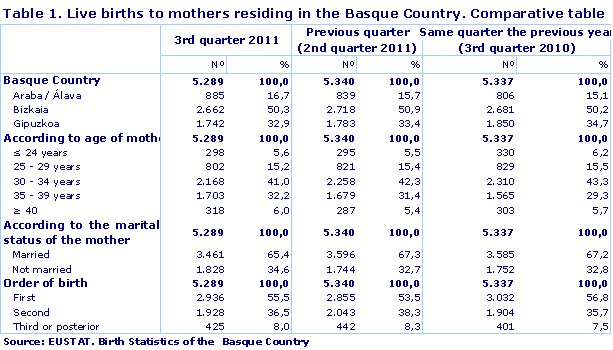
In the third quarter of 2011 the number of births in the Basque Country stood at 5289, which was a drop of 0.9% compared to the same quarter of the previous year, according to Eustat data. The only province to experience an increase was Álava where 885 boys and girls were born, up 9.8%. In Bizkaia, with 2662 births, there was a decrease of 0.7% and in Gipuzkoa, with 1736 births, the drop was 5.8%.
In 79.2% of births the mothers were over 30 years of age
Referring to the distribution of births according the age of the mother, there continued to be a clear preponderance of the 30-34 year-old age group, in which 41% of the births took place. This group was followed by the group immediately above it (mothers aged 35-39), which accounted for 32.2% of births, over double that of the 25-29 age group, with 15.2% of births. Amongst the groups at the two extremes, those under the age of 25 accounted for 5.6% of births, whilst those over 40 accounted for 6%.
Births outside of marriage accounted for 34.6% of the total, which was higher than the 32.8% of the same period of the previous year. The average age of single mothers stood at 31.6 years, whilst that for divorcees and widows stood at over 35. On average for this quarter, married women had children at the age of 33.3.
Foreign women were mothers 4 years before Spanish women
16.1% of women who became mothers in the Basque Country in the summer months of 2011 were foreign. This percentage was only higher in Álava, where it stood at 21.4%, whereas in Bizkaia and Gipuzkoa the number of non-Spanish mothers stood at 15.8% and 13.9%, respectively.
The age at which women became mothers varied according to their nationality. In fact, the average age of the foreign mothers was 29.4, compared to 33.5 for mothers with Spanish nationality.
There was an increase of 13% in second and subsequent children in Álava
According to the order of birth, more than half (2936 boys and girls) were first children in the third quarter of 2011; 1928 (36%) arrived in families that already had another son or daughter and the percentage of third or subsequent children stood at 8%.
The number of women who had their first child fell by 3% with respect to the same quarter of the previous year, whilst the number of second and subsequent children rose by 2%. This growth was produced especially in Álava, with an increase of 13%, against the 0.1% registered in Gipuzkoa and Bizkaia.
For further information:
Basque Statistics Office
C/ Donostia-San Sebastián, 1 01010 Vitoria-Gasteiz
Tel: +34-945-01 75 00 Fax:+34-945-01 75 01 E-mail: eustat@eustat.es
Contact: Martín González Hernández
Tel:+34-945-01 75 49 Fax:+34-945-01 75 01
Further press releases on BIRTH STATISTICS of the Basque Country
Database on BIRTH STATISTICS of the Basque Country