Press release 18/01/2012
The average growth in expenditure on health between 2005 and 2009 in the Basque Country stood at 9.0%
In 2009 the total expenditure per inhabitant stood at 2602 euros, up 6.9% on the previous year
In 2009 the total expenditure on healthcare in the Basque Country reached 5636 million euros, up 7.5% on 2008 according to Eustat data and following the System of Health Accounts (SHA) methodology of the OEDC.
This total expenditure on health was 8.8% of GDP in 2009, 1.8 percentage points up on 2005. In terms of how this expenditure was financed, public financing accounted for 75.1% of the total, standing at 4231 million in 2009.
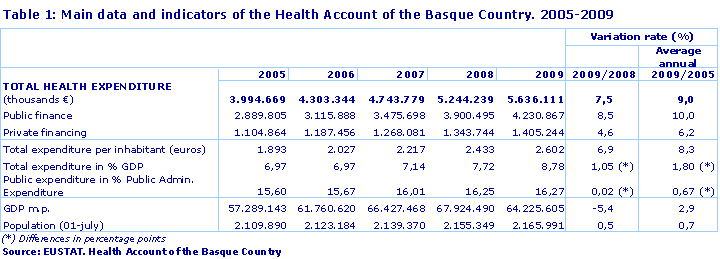
Public expenditure on healthcare compared with the total expenditure of public administrations, which is an indicator of effort placed on healthcare by the public administrations, increased across the series, and stood at 16.3% in 2009.
In the international comparison, with the data provided by the OCED for the year 2009, the expenditure on healthcare per capita in the Basque Country stood at 3658 PPC (Purchasing Power Parity in $) per inhabitant, above countries such as the United Kingdom (3487), Finland (3226) and Spain (3067) and below Norway (5352) and Switzerland (5144), amongst others.
As regards financing, public expenditure in the Basque Country was 75.1% of total health spending, in line with surrounding countries. The indicator of the effort placed on health by the public administrations in the Basque Country was 16.3, a level that was above that of countries such as the United Kingdom (16.0), Belgium (15.1), Sweden (14.8) and Spain (15.2).
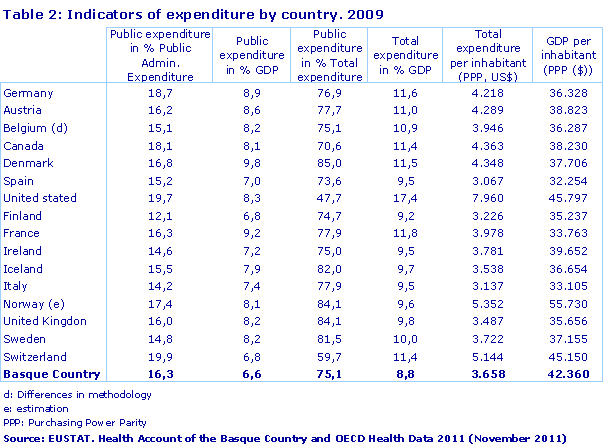
However, spending as a percentage of GDP, standing at 8.8% in the Basque Country, situated it below all countries of reference.
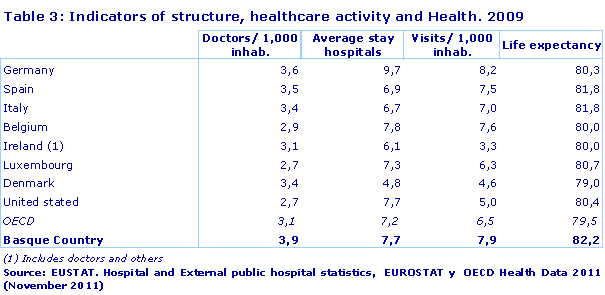
To complete the comparison of expenditure on health carried out in the Basque Country as regards other countries in the OCED, the analysis of another type of indicator of offer, such as the number of doctors per inhabitant, average length of stay or medical consultations, and of health, such as life expectancy, is necessary. If the compared data are analysed, these indicators place the Basque Country above the OCED average.
A detailed analysis of the Health Accounts of the Basque Country reveals that, out of the total spending on healthcare in 2009, 96.6% corresponded to current expenditure and the remaining 3.4% to Gross Capital Formation (investment).
In the distribution of expenditure by functions, 74.2% corresponded to individual healthcare services. The greatest growth was produced in medium and long-stay healthcare provision, which grew to an accumulative annual rate of 13.8%, with the largest part of health spending relative to dependence included in this function.
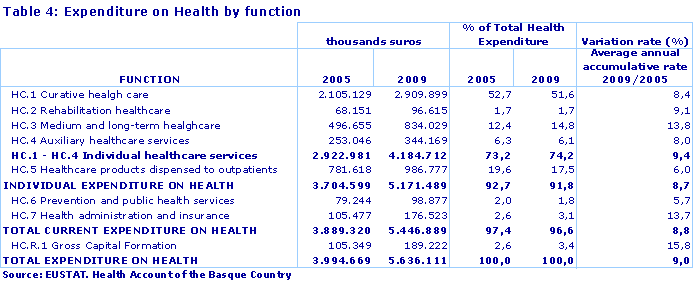
The function with the second largest expenditure was that of health products provided to outpatients, which accounted for 17.5% of expenditure. Thus, by summing these two groups the individual expenditure on health is obtained, which represented 91.8% of expenditure.
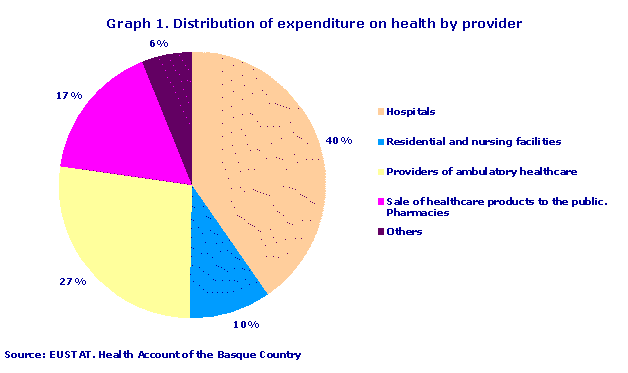
The analysis of the structure of expenditure by provider shows that the greater part of spending was on hospitals (40%) and the second biggest spending was on providers of outpatient care, with 27%. Residential and nursing facilities represented 10% of current expenditure, but was the group that experienced the greatest increase in the analysed period, with an accumulative rate of 11.4% (health expenditure relative to situations of dependency has been included in this group).
For further information:
Basque Statistics Office
C/ Donostia-San Sebastián, 1 01010 Vitoria-Gasteiz
Tel:+34-945-01 75 00 Fax:+34-945-01 75 01 E-mail: eustat@eustat.eus
Contact: Clara Ramos Hernández
Tel:+34-945-01 75 97 Fax:+34-945-01 75 01
Further press releases on the Health Account of the Basque Country
Databank on the Health Account of the Basque Country