Press release 23/11/2011
The Basque Country is one of the Autonomous Communities with the greatest number of elderly people and the greatest percentage of foreign people
In 19 municipalities of the Basque Country more than a quarter of the population is 65 or over
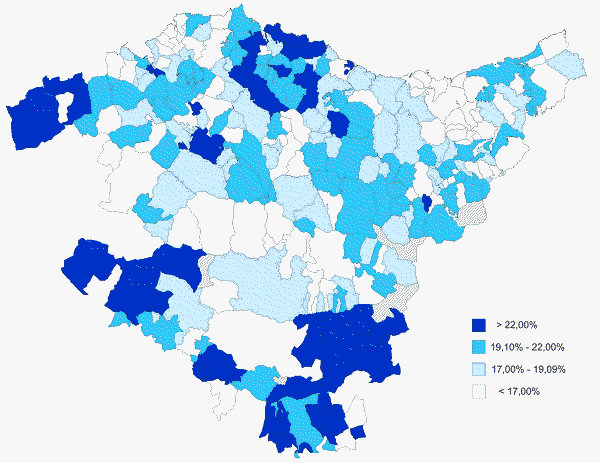
The proportion of people older than 64 in the Basque Country, at 19.1%, is more than 2 percentage points higher than that in Spain, according to Eustat data. Castilla y León, Principality of Asturias, Galicia and Aragón are the Autonomous Communities which have a higher proportion of elderly people than our own. Compared to Europe, we are only superseded by Germany and Italy.
113 municipalities exceed the average percentage of the Basque Country, whilst 138 present the same or a lower percentage. Amongst those that exceed it are Bilbao, Donostia-San Sebastián and Barakaldo, which account for 30% of the population of the Community.
Graphic 1. Percentage of people 65 years or over by municipality
Source: EUSTAT. Municipal Inhabitants Statistics of the Basque Country 1st of January 2010
There is quite a lot of disparity between the municipalities regarding the percentage of people 65 and over, where it goes from 8.4% in Elburgo/Burgelu to 37.2% in Lagrán. There are 4 municipalities in the Community that have a percentage under 10%: Altzo, Alegría-Dulantzi, Irura and the already mentioned Elburgo/Burgelu, which has a combined population of 5306 inhabitants. On the other hand, three municipalities have a percentage over 30%: Añana, Harana/Valle de Arana and Lagrán, which have a combined total of 661 residents.
Municipalities with high percentages of people 65 years and over are mainly concentrated in Álava, specifically in the districts of Montaña Alavesa, Valles Alaveses and la Rioja Alavesa, and in Bizkaia, above all in the districts of Gernika-Bermeo, Markina-Ondarroa and Encartaciones.
In the Autonomous Community of the Basque Country there is a ratio of 1.4 people 65 and over for each person below the age of 16, exceeding that of Spain as a whole, which has a ratio of 1.1. The municipalities that exceed this ratio number 100 with extreme cases such as Lagrán, which has a ratio of 11 to 1. Harana/Valle de Arana has a ratio of 6 to 1. Elantxobe, Añana and Moreda de Álava/Moreda Araba have more than 3 elderly people for each person below the age of 16. On the other hand, Irura, Alegría-Dulantzi, Altzo, Larraul, Elburgo/Burgelu, Altzaga and Iruña Oka/Iruña de Oca have 2 young people up to the age of 15 for each person 65 years and older.
Population distribution by age is most extreme in the municipalities of Álava where, due above all to its small size and the fact that any demographic phenomena, such as migration, unbalances this distribution.
Only three municipalities in the Basque Country have a percentage of the population born abroad higher than that of Spain as a whole
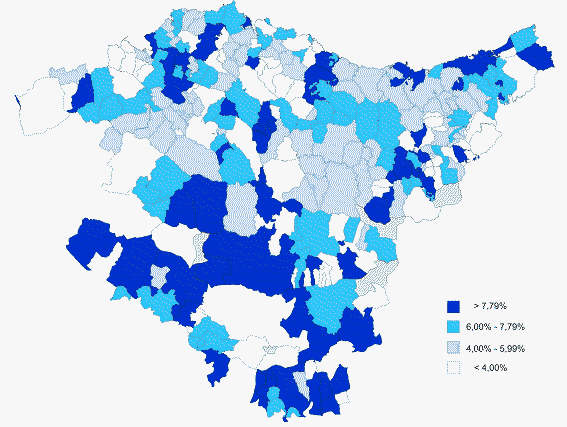
On the 1st of January 2010 in the Basque Country the population born abroad represented 7.8% of the total population, a long way from the proportion recorded in Spain, which was 14.1%. The Basque Country is aligned on this point with the Spanish Autonomous Communities with the greatest number of elderly; Asturias, Galicia and Castilla y León, where the population born abroad does not exceed 8%.
Of the 58 municipalities that have a proportion of people born abroad greater than that of the Basque Country as a whole, 22 are in Álava and, of those, 10 exceed 10%, the majority being from the district of Rioja Alavesa. The three municipalities that exceed the percentage of the State as a whole are Berriatua (16%), Leza (15.4%) and Samaniego (15%).
On the other hand, we have 15 municipalities that have a resident population born abroad lower than 2%. Of these municipalities, 11 belong to Gipuzkoa, with Gaintza and Orexa being worthy of special mention due to the fact that none of their inhabitants were born abroad as of the 1st of January 2010. Except for Berastegi and Ispaster, these municipalities have less than 500 inhabitants.
The provincial capitals have percentages of the population born abroad higher than that of the Basque Country as a whole, with Vitoria-Gasteiz being the only one to exceed 10%, with Bilbao at 9.7% and Donostia-San Sebastián scarcely reaching 8.5% compared to the total population.
Graphic 2. Percentage of people born abroad by municipality
Source: EUSTAT. Municipal Inhabitants Statistics of the Basque Country. 1st of January 2010
Contrary to what is happening in Spain as a whole, there are more residents in the Basque Country who have nationality from American countries
Residents in the Basque Country with nationality of American countries account for 45.4% of the total of foreign residents, whereas in Spain as a whole this figure scarcely exceeds 31%. Those coming from South American countries account for the majority: Columbia, Bolivia, Ecuador and Brazil make up 27.8% of the total foreigners, and 61% of Americans. On the other hand, residents from European countries in the Basque Country account for 28% of foreigners, compared to nearly 45% in Spain. In this group Romanians are worthy of special mention, where they account for 10.6% of the total number of foreigners, whilst in Spain the figure is 14%, but they make up 38% of Europeans, 6 percentage points more than Spain as a whole. The Portuguese, although lower in number than the aforementioned, have a significantly greater representation in the Basque Country than in Spain as a whole compared to the total number of Europeans, with their numbers accounting for 13.5% and 5.5%, respectively.
Nationals from African countries provide a similar proportion to the total in Spain, that is, 20.8% compared to 18.4%, but it stands out that in Spain Moroccans make up 71% of all African nationals whereas in the Basque Country this figure does not reach 50%. The second nationality of this group in terms of importance in the Basque Country is Algerian, with 16.3% compared to 5.5% in Spain.
Chinese and Pakistani nationals have a presence amongst foreigners of 4.5%, one percentage point higher than in Spain, with the fact standing out that in the Basque Country they are practically the only representatives of the Asian nations, given that they make up 80%, whilst in Spain as a whole they do not reach 68%.
If we take into account the provincial capitals, variations can be seen in the distribution of nationalities by continents. In Bilbao and Donostia-San Sebastián more than 50% of foreigners have nationality from American countries, but in Bilbao the large majority are nationals of South American countries, whilst in Donostia-San Sebastian nationals from Central American countries such as Nicaragua and Honduras make up a considerable proportion. In these two municipalities the distribution of Europeans and Africans is different, with Europeans having more weight in Donostia-San Sebastián, due to the number of French nationals, 32.4%, compared to 8% of African nationals. The difference is not so noticeable in Bilbao, with Africans making up 21.4% compared to 17.1% Europeans.
In Vitoria-Gasteiz the distribution amongst groups of nationalities by continents is not so uneven, due to the fact that, although American nationals are the most numerous, they only make up 38.1% of foreigners. Next are African residents, with a difference of 6 percentage points. In this group Algerians make up the greater number, accounting for 25.7%, whilst in the Basque Country as a whole they scarcely exceed 16%. Europeans account for 23%. Portuguese and Romanian nationals make up the most residents of this group, with 53% of the total, but the first group is more numerous, although only by 191 people.
For further information:
Basque Statistics Office
C/ Donostia-San Sebastián, 1 01010 Vitoria-Gasteiz
Tel: +34-945-01 75 00 Fax:+34-945-01 75 01 E-mail: eustat@eustat.eus
Contact: Martín González Hernández
Tel:+34-945-01 75 49 Fax:+34-945-01 75 01
Further press releases on Municipal Inhabitants Statistics of the Basque Country