Press release 29/11/2011
Half of working women dedicate 5 hours or more per day caring for their sons and daughters
One in 2 working men dedicate 2 hours or less attending to their children
Half of women in work, as well as time spent in paid work, dedicate 5 hours or more per day to caring for their sons and daughters, according to the Survey on the Reconciliation of Work, Family and Personal Life carried out by Eustat. Just over half of men in work – 52.4% - dedicate 2 hours or less attending to the care of their sons and daughters. However, one in seven – 15.2% - dedicates the same amount of time as women. As a whole, whilst men employ 2.8 hours daily to the care of young children, women dedicate 4.7. The sharing of domestic tasks by sex between working men and women in the Basque Country is even more unequal: nine out of ten men – 92.2% - dedicate 2 hours or less, whilst a third of women – 34.1% - employ 3 or more.
In turn, when it is necessary to care for dependent relatives, up to 61.2% of women in work dedicate 3 or more hours daily, with this percentage falling to 26.7% in the case of men.
The inequality of responsibilities assumed has a cost in the level of satisfaction with time available for personal life, leisure and studies, given that a fourth of women – 23.9% - say they are unsatisfied, compared to less than one in five men – 18.4% -. This low satisfaction is concentrated in the ages during which the family is being formed, from 35 to 44, diminishing after this age.
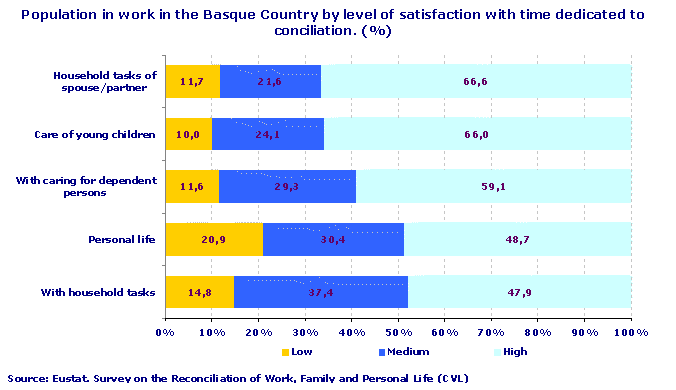
This uneven sharing of functions also shows that a significant percentage of women in work, more than one in five, are very unsatisfied with the collaboration of their spouses or partners in domestic tasks. A large majority of men in work – 85.1% - on the other hand, are very satisfied with the housework done by their partners.
However, it is worth mentioning that working women express a considerably greater satisfaction with caring for their children – a high 71% - including caring for dependent relatives – 66.2% also express high satisfaction - than employed men, which in the first case drops to 61.6% and to 51.9% in the second.
One in 3 people in work in the Basque Country states that they have a lot of difficulty combining work with caring for dependent relatives
One in 3 people in work in the Basque Country – 35.1% - states that they have a lot of difficulty combining work with caring for dependent relatives This high level of difficulty is repeated in 29.6% of people in work where it concerns attending to young children. In turn, the time that a fifth of working people dedicate to paid work makes it highly difficult for them to carry out domestic tasks and up to one in four – 24.4% - state that it is only with great difficulty that they can enjoy leisure time or other personal activities such as studying.
Employers and autonomous workers show considerably greater levels of impediments than the rest of people in work in combining work and family life. Thus, 37.7% of the first group and 43.7% of the second group confess to experiencing a lot of difficulty in caring for young children and for around a third it is also very difficult to dedicate time to merely personal activities or to help with domestic tasks.
Overall the level of difficulty that the population in work in the Basque Country has in combining paid work and personal and family life is 3.3 points, out of a maximum of 10, where 10 would indicate that conciliation is completely impossible. Bizkaia is situated within the average, Araba/Álava shows the least level of difficulty with 2.1 points, whilst Gipuzkoa shows the highest, with a level of 3.8.
One in four people in work believes that requesting extended leave or a reduction in the working day for family reasons would seriously affect their professional trajectory
The fear that requesting leave or reduced timetables would affect professional promotion has a similar bearing as regards men and women, although in a more noticeable way amongst young people. Notwithstanding, maternity could create promotion inequalities for one in five working women, whilst just 6.4% of males are of the opinion that paternity could seriously affect them. Despite this, one in seven employed males believes that it would be highly negative for them to request paternity leave.
83.6% of people in work don’t have difficulty in taking time off to solve personal issues
Within the various methods that could make the conciliation of work, family and personal life easier, short-term leave is within reach of the large majority of the population in work, followed by the possibility of requesting unpaid days, possible for 69.8% of the working collective. Also, close to 60% indicate a low difficulty in obtaining extended leaves of absence or reductions in the working day.
In general, there are no noticeable differences by sex, except that women show less difficulty in requesting reductions in the working day – 62.3% state that they can obtain it without much difficulty – than men – 57.3% - ; On the other hand, obtaining permission for sporadic absences is slightly more difficult for working women – 19% - than working men – 14.2% -. Age, likely to be associated with time spent in the job position, reduces difficulties in accessing the cited conciliation measures.
�
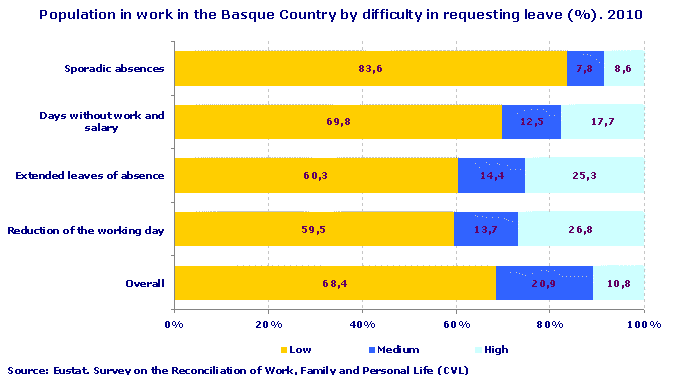
Autonomous personnel and employees access sporadic absences with less difficulty than other professionals; however, they state greater limitations as regards the rest of the measures. Out of employers, 78% respond that they have many problems in taking a day off and 64% in taking extended leaves of absence or obtaining reductions in the working day. 72.8% of autonomous workers see it as extremely problematic to stop working for one day and close to 61% consider it difficult to obtain an extended leave of absence or a reduction in the working day.
One in five people has to prolong the working day nearly every day
18.8% of people in work nearly always, and a similar percentage, sometimes, have to dedicate more hours to work than those established or planned. This situation affects nearly two-thirds of employers and autonomous workers (prolongation of working hours: always or sometimes). It is also such a case for one in three salaried workers in the private sector and 28.8% in the public sector.
The flexible timetable for leaving work, another supplementary solution for improving conciliation, is enjoyed by two in five people in work – 42.1% -, although lower for women -38.4%- than for men -45.1%-.
As regards working from home, 8.9% work sporadically from home and 5.6% at least half of the days. In overall terms, one in seven employed people works from home occasionally or more.
Half of employed people in Gipuzkoa prefer working in a small company, 43.7% in the private sector and 17.1% prefer being autonomous
Gipuzkoa shows a specific profile with respect to work preferences: Half of employed people in this province prefer working in a small company, 43.7% in the private sector and 17.1% prefer being autonomous. This profile contrasts with that of the employed population in Araba/Álava: 71.5% would choose a large company, up to 70.2% prefer the private sector and just 12% elect managing their own company.
Those from Bizkaia, although closer to the profile of Araba/Álava, are placed between both provinces: 68.5% prefer large companies, 67% prefer the public sector and something more than one in seven – 15.2% - choose having an independent business.
Clear differences can be seen in working preferences according to sex, given that 72.4% of employed women wish to work in the public sector, with this percentage being 57.2% in the case of men. In turn, only 11.8% of women in paid work prefer to be autonomous, compared to 18.2% of men.
For further information:
Basque Statistics Office
C/ Donostia-San Sebastián, 1 01010 Vitoria-Gasteiz
Tel: +34-945-01 75 00 Fax:+34-945-01 75 01 E-mail: eustat@eustat.eus
Contact: Pilar Martínez Rollón
Tel:+34-945-01 75 31 Fax:+34-945-01 75 01