Press release 13/09/2011
The GDP of the Basque Country registered 0.8% year-on-year growth in the second quarter of 2011
Growth was up 0.2% on the previous quarter
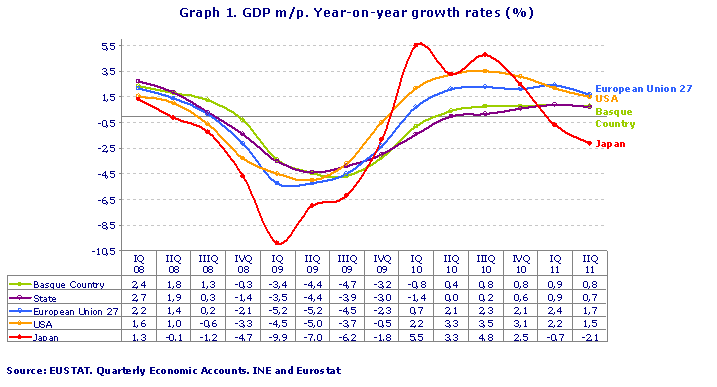
The GDP of the Basque Country registered growth of 0.8% in the second quarter of 2011, compared to the same period of 2010, according to EUSTAT data. This figure was one tenth down on the growth registered in the previous quarter.
It stood at 0.7% for the Spanish economy, 1.7% for the European-27 and 1.5% for the US economy. Japan fell by 2.1%.
With regards to the previous quarter, the GDP of the Basque Country registered positive growth of 0.2%, one tenth down on the previous quarter. This quarter-on-quarter variation was the same as that registered by the Spanish, European-27 and US economies. Japan fell by 0.5%.
From the point of view of supply, year-on-year growth in this quarter was mainly underpinned by the positive performance, although rather more slowly than in the previous quarter, by the Industrial sector. The services sector also showed a positive performance, slightly better than the previous quarter, with market and non-market services showing similar behaviour. The activity of the Construction sector, however, continued on a negative trend, which was even more noticeable than that shown in the previous quarter.
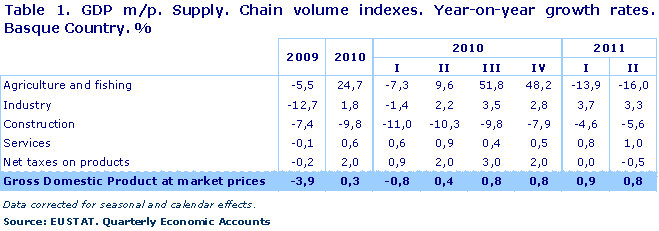
The primary sector recorded downturns in growth in year-on-year terms (-16.0%), although with respect to the previous quarter it was up by 6.6%.
The Industrial sector posted growth rates that were positive in year-on-year and month-on-month terms, but in year-on-year terms the rates were more moderate than in the previous quarter. Year-on-year growth of 3.3% was 4 tenths lower than the previous quarter, where it stood at 3.7%. Month-on-month growth in Industry was 1.3%, six tenths up on the previous quarter.
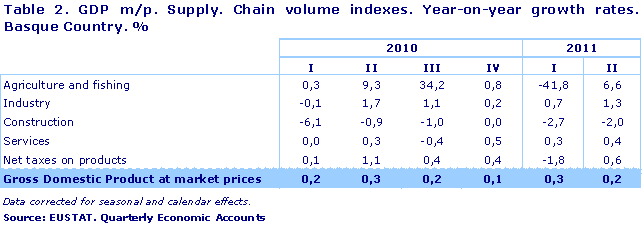
The Construction sector again failed to show signs of recuperation, and posted a negative year-on-year rate (-5.6%), one point less than the previous quarter. Once again, and following the trend in previous quarters, there was decrease in both civil works and building. Month-on-month performance again showed negative figures with a fall of 2.0%. This rate, although still negative, was not as negative as in the previous quarter (-2.7%).
Overall performance in the Service sector continued to show positive results and even slightly better than the first quarter. In month-on-month terms it grew by 1.0%, two tenths more that the growth posted in the first quarter of the year, and in quarter-on-quarter terms its performance was positive, at 0.4%, compared with growth of three tenths in the previous quarter.
In the second quarter of 2011 Market Services grew 1.0% in year-on-year terms, compared to 0.8% in the previous quarter. This improvement in year-on-year growth of two tenths is punctuated by quarter-on-quarter growth that, although positive, registering 0.2%, is six tenths lower than growth posted in the previous quarter.
Non-market services, linked to Public Administration, continued to show moderate performance, above all with regards to the start of this exercise. Year-on-year growth was 0.9%, two tenths down on the previous quarter. For the first time in the estimated figure for non-market services, the year-on-year growth rate is less than one point. The month-on-month figure, after the steep decline that was registered in the first quarter, showed growth of 1.9%.
The aggregated sectorial performance gave place to an increase of Added Value that shows positive growth rates both in year-on-year and quarter-on-quarter terms, but more moderate than in the previous quarter. Thus, year-on-year growth reached 0.9%, one tenth less than that posted in the first quarter of the year. The quarter-on-quarter figure is one tenth, compared to the four tenths posted in the first quarter of 2011.
The most positive results in terms of Demand, for another quarter, were posted by the foreign sector, which was positive for the performance of GDP despite both import and export growth figures being more moderate than in previous quarters.
Internal Demand posted year-on-year growth of 0.2%, one tenth down on the previous quarter. The quarter-on-quarter growth figure was one tenth compared to six tenths in the previous quarter.
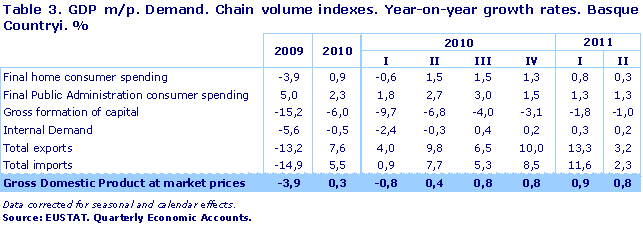
Spending on Final Household Consumption (Private Consumption) posted positive growth of 0.3% in year-on-year terms, although it was lower than in past quarters, specifically five tenths less than that posted in the previous quarter. Growth in quarter-on-quarter terms was 0.6%.
Public Consumption (Spending on Final Public Sector Consumption) continued to post a moderate performance, as in the first quarter. In the second quarter of 2011 the year-on-year rate was 1.3%, identical to the previous quarter, compared with average growth greater than 2% in all of 2010. The quarter-on-quarter rate grew 1.4% in the second quarter, after the fall posted in the first quarter of 2011 (1.6%).
There were negative figures in Gross Capital Formation (Investment) for another quarter both in year-on-year and quarter-on-quarter terms. The year-on-year fall was 1.0%, eight tenths less than the fall registered in the previous quarter. Quarter-on-quarter performance also posted a fall of 0.8%.
The performance of both Public and Private Consumption and of Gross Capital Formation, along with their relative weightings, determined the performance of Internal Demand, which posted a positive rate (0.2%) in year-on-year terms. This growth rate was one tenth less than that achieved in the previous quarter. This moderation was also seen in the quarter-on-quarter figure, which grew one tenth compared with the six tenths posted in the previous quarter.
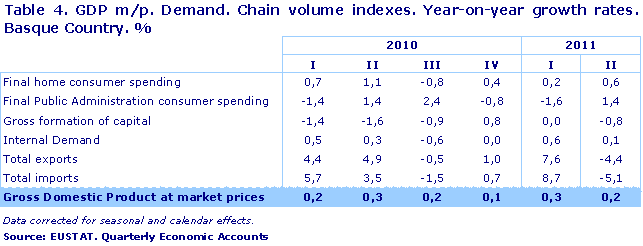
As far as the foreign sector was concerned, the dynamics of the previous quarter continued, with a positive contribution to GDP performance, although with more moderate growth rates. In year-on-year terms the performance of exports was still greater (3.2%) than that of imports (2.3%), which resulted in a stronger foreign balance, meaning that GDP performed better compared to Internal Demand.
With respect to employment, measured in job figures, it dropped by four tenths in year-on-year terms with an upturn of one tenth in the quarter-on-quarter rate. By sectors, employment continued to go down in the primary and construction sectors, both in year-on-year and quarter-on-quarter terms, whilst in the industrial sector slight quarter-on-quarter growth was recorded for the first time in fourteen quarters, although in year-on-year terms the rates continued to be negative. The service sector had the best sectorial results with year-on-year growth of 1.1% and quarter-on-quarter growth of 0.5%.
With reference to the evolution of GDP by provinces, Bizkaia posted the best performance with year-on-year growth of 0.8%, followed by Gipuzkoa with 0.7% and Araba/Álava with 0.6%. In quarter-on-quarter terms, Bizkaia achieved a rate of 0.2%, Gipuzkoa 0.1% and Araba/Álava 0.0%.
Methodological note: Definitive annual data from 2009 and advance data from 2010 from the Economic Accounts of the Basque Country have been incorporated into this publication for the second quarter of 2011, which has led to the re-estimation of the series of Quarterly Accounts from the first quarter of 2009.
For further information:
Basque Statistics Office
C/ Donostia-San Sebastián, 1 01010 Vitoria-Gasteiz
Tel: +34-945-01 75 00 Fax:+34-945-01 75 01 E-mail: eustat@eustat.eus
Contact: Javier Aramburu
Tel:+34-945-01 75 80 Fax:+34-945-01 75 01
More press releases on the CET - Quarterly Economic Accounts of the Basque Country
Quarterly Economic Accounts of the Basque Country databank