Press release dated 20/06/2011
The percentage of women with more than two sons or daughters falls
The average number of children per women fell to 1.4
According to Eustat data from the 2006 Population and Housing Census, the percentage of women aged 15 and over who have more than two sons or daughters fell to 18.3% from the 22.4% recorded in 1996. The figures show a downturn both in the number of women who have 3 children - 10.9% in 2006 compared in 12.1% in 1996 - and of those that have 4 or more children - 7.4% in 2006 compared 10.3% ten years earlier-.
While the average number of children per woman in the Basque Country in 2006 stood at 1.4 for those aged 15 and over, while it was 1.5 in 1996. In terms of women aged 40 and over, this figure stood at 2 children per woman, while it was 2.4 in 1996.
With respect to the trend in the average number of children according to the generation of their mothers, it can be seen that the average number of children was 2.48 up to the generations of women born in 1940 - they were 66 or over in 2006. However, the average number of children per woman has fallen over the generations, from 2.48 for the generations born before 1941 to 1.35 children per women for those born between 1961 and 1964.
Nearly two out of every three women aged 15 and over are mothers
The Basque Country has 954,000 women aged 15 and over, 621,000 of whom are women, in other words, nearly two out of every three.
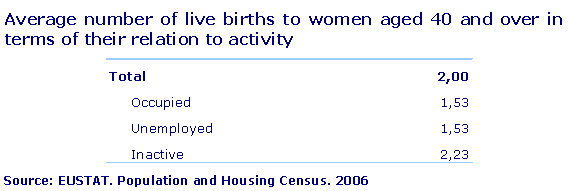
With respect to the difference in the fertility rate among women aged 40 and over in terms of their relation to activity, the average number of children is the same, both in the case of employed and unemployed women, with a significant difference being detected of 0.7 children fewer with respect to those who are inactive.
�
Given the difference between the average number of children to women aged 40 and over according to educational level, a lower fertility rate was noted among women with higher education levels.
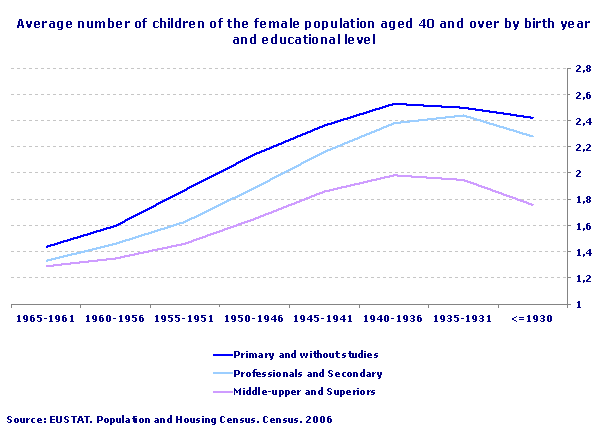
The differences found indicate that women with higher studies have had nearly 0.5 fewer children in some generations that those with a lower educational level. Likewise, in the same way that the average number of children has fallen in general, the differences between the average number of children has also decreased, with these differences being much less significant for the younger generations or women, in other words, those born between 1961 and 1965.
Even though the difference of the fertility rate according to the spatial component of the Basque Country are scarce in general terms, as the women in the three provinces have the same average number of children (2), if the figures are considered at district level, Montaña Alavesa and Goierri were clearly over the average as the average number of the women living there was 2.3 and 2.2, respectively. Plentzia-Mungia is at the opposite end as the average of children per women fell to 1.9 and is the only district under the average of the Basque Country.
�
Donostia-San Sebastián is the Basque capital with the fewest average number of children per women
If we consider it in terms of the three provincial capitals, differences can also be noted, with Vitoria-Gasteiz heading the fertility rate with two children per women aged 40 and over, followed by Bilbao with 1.9 children and, finally, Donostia-San Sebastián, with 1.8 children per women.
For further information:
Basque Statistics Office
C/ Donostia-San Sebastián, 1 01010 Vitoria-Gasteiz
Tel: +34-945-01 75 00 Fax:+34-945-01 75 01 E-mail: eustat@eustat.es
Contact: Ana Miranda Liguerzana
Tel:+34-945-01 75 34 Fax:+34-945-01 75 01
Further notes on 2006 Population and Housing Census of the Basque Country
2006 Population and Housing Census Databank of the Basque Country