Press release dated 29/06/2011
PUBLIC SECTOR BUDGETARY STATISTICS of the Basque Country 2009
Current revenue of Basque Administrations down by 12.7% in 2009
Financial debt with respect to the GDP up by 4.3% in 2008 and 7.2% in 2009
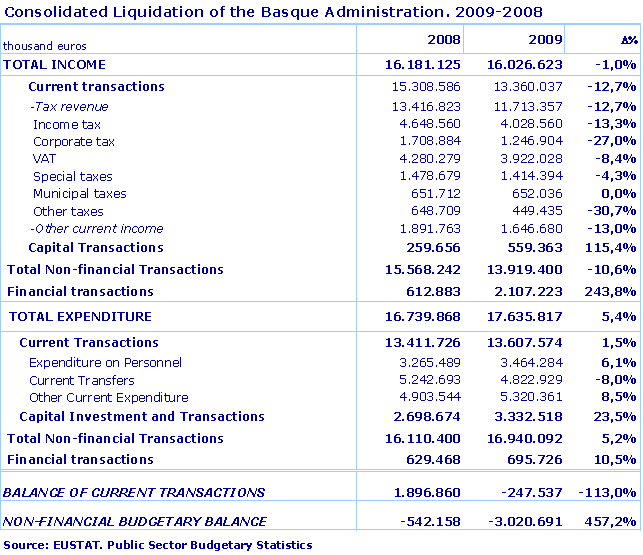
Current revenue of the Basque administration – made up of the Basque Government, Provincial Councils and Municipal Administrations, together with their corresponding Autonomous Bodies and supra-municipal Organizations- fell by 1.0% in 2009 compared to 2008, while expenditure rose by 5.4%, according to EUSTAT data.
The drop in total revenue was focused on current transactions, which represented 83% of the total, with a drop of 12.7%, but this drop could not offset the increases in both capital and financial revenue.
The 5.4% increase in the total expenditure is determined by a 5.2% rise in non-financial and 10.5% in financial transactions.
As a result of these trends, the “Current Transactions Balance” was negative (-247.5 million euros) and the “Non-financial Budgetary Balance) posted a downturn on 2008, with a deficit of 3,020.7 million euros.
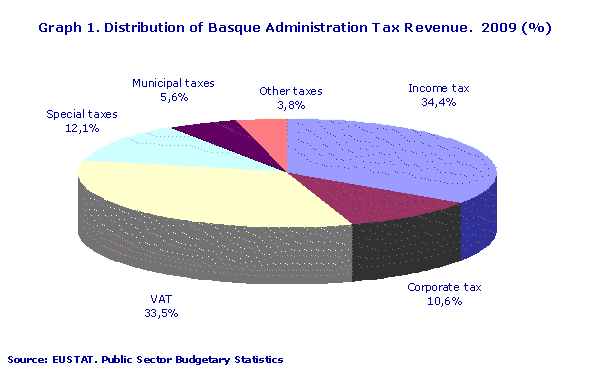
A common feature of the analysis of the evolution of tax revenue, except in the case of Municipal Taxes, was the drop in the amount of taxes collected in 2009.
When analysed in terms of the amount of taxes collected, revenue from income tax (IRPF), which accounted for 34.4% of the total of tax revenue) fell by 13.3%. VAT, which accounted for 33.5% of the total, was down by 8.4%. Special Taxes and Corporation Tax were in fourth and fifth place in terms of the amount of taxes collected, and fell by 4.3% and 27.0% respectively.
Municipal taxes, which played a much less significant quantitative role, barely fluctuated and Other Taxes fell by 30.7%. Other Current Income also fell by 13.0%.
As far as expenditure was concerned, all the non-financial chapters, except for current Transfer, posted positive variation rates. Employee costs rose by 6.1%, one point and four tenths down on the previous year. Even though its growth slowed down on the previous year, Other Current Expenditure was up by 8.5%. Current Transfers posted a change in trend with a 8.0% downturn on the previous year. The overall impact of the aforementioned trends meant that Current Expenditure posted growth of 1.5%, which together with the Capital Expenditure Transactions, resulted in Total Non-financial Transaction Expenditure increasing by 5.2%.
In addition to the negative balance for current transactions, the balance, which was also negative, of the capital transactions resulted in a negative Non-financial budgetary balance of 3020.7 million euros, which represented 4.7% of the GDP in 2009.
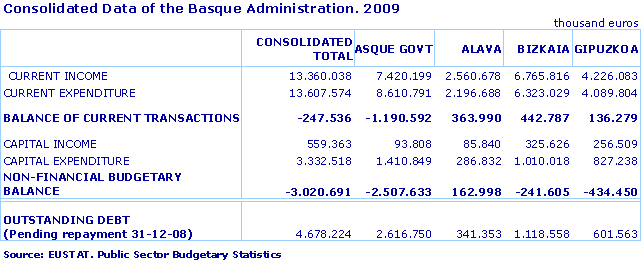
The outstanding debt of the Basque Administrations was 4678.2 million euros as of 31 December 2009. The difference between the new contracted liabilities and the amortization of pending debt stood at 1,751.9 million euros in 2009, which means net debt growth of 59.9% compared to the end of 2008.
This debt increase meant that the percentage in relation to the GDP rose from 4.3% in 2008 to 7.2% in 2009.
In 2009, the Basque Administrations overall were made up of a total of 1096 entities. The Basque Administrations employed 111,834 people, 1.2% up on 2008, 68.7% of whom worked for the public sector of the General Administration of the Autonomous Community, 9.1% for the public sector of the Provincial Administrations and the remaining 22.2% for the public sector of the Local Administrations. In terms of the employment status, 69.9% were permanent employees.
For further information:
Basque Statistics Office
C/ Donostia-San Sebastián, 1 01010 Vitoria-Gasteiz
Tel: +34-945-01 75 00 Fax:+34-945-01 75 01 E-mail: eustat@eustat.eus
Contact: Jose Javier Aramburu
Tel:+34-945-01 75 80 Fax:+34-945-01 75 01
Further press releases on Public Sector Budgetary Statistics of the Basque Country.
Databank on Public Sector Budgetary Statistics of the Basque Country.