Press release dated 22/02/2011
Eight out of every ten university students were enrolled in publicly-funded universities in the 2009/10 academic year
94% of the young people who took the University Entrance Exam passed
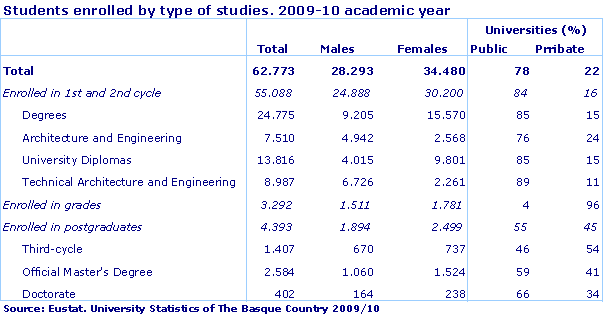
During the 2009-10 academic year, the number of students enrolled at the universities of the Basque Country stood at 62,773, according to Eustat data. With respect to the previous year, this figure was down by 1%, which was in line with the trend over the last 15 years.
As far as the distribution by province was concerned, 56% were studying in Bizkaia, 27% in Gipuzkoa and, finally, Araba/Álava had the smallest number of enrolled students, with 13%.
In terms of the ownership of the centre, eight out of every ten students opted to study at a publicly-funded university. Even though this percentage was similar for first and second cycle studies, the trend changed when it came to post-graduate studies, where there was a greater balance between the number of students at publicly-funded (55%) and private (45%) universities.
�
While 70% of students who opted for technical studies were men, 66% of students on long- or short-cycle degrees were women
The university distribution in terms of sex reflects the large number of women who enrol at university, calculated to be 10 percentage points: 55% were women, compared to 45% for men.
This higher presence of women was seen across the board: first and second cycle (55%), four-year degree (54%) and post-graduate courses (57%).
The difference, in terms of sex, was noted in the branch studied at any level. The male students opted for more technical studies, with a total of 11,668 men compared to 4,829 women on the same courses. On the other hand, female students opted for more long (leading to a five-year degrees) or short (leading to a three-year degree) cycle degrees, accounting for a total of 25,371 enrolments, compared to 13,200 men on the same courses.
On the other hand, 55,088 students completed first and second cycle, 3,292 were on four-year degrees, and, finally 4,393 studied at post-graduate levels.
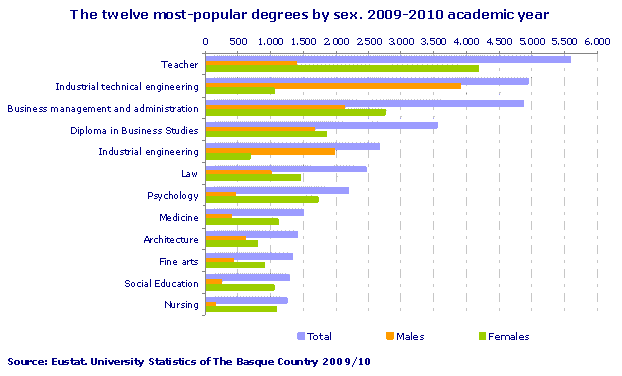
The most sought-after degrees were: Teacher Training (5,579), 3-year degree in Industrial Engineering (4.941), Business Administration and Management (5167), 3-year degree in Business Science (3,543), 5-year degree in Industrial Engineering (2,663), Law (2,454), Psychology (2,184) and Medicine (1,503).
�
The academic staff at the universities of the Basque Country totalled 5,724
7,757 people worked at the universities of the Basque Country during the 2009-10 academic year, which accounted for 1.2% of the total number of people employed in the services sector. 3,552, i.e. 46%, of them were women.
On the other hand, the university academic staff totalled 5,724, with more men (60%) than women (40%) being employed. There were also 2,033 people working as administrative and service staff.
98% of the young people who took the University Entrance Exam passed in June
A total of 9,957 young people enrolled for the University Entrance Exam in the Basque Country in 2010. A total of 9,346 students passed the exam, which meant a pass rate of 94%, with an average mark of 6.8.
A total of 8,102 students took the exam in the June Session and 7,950 passed, i.e. 98%, while 1,409 of the 1,692 enrolled for the July Session passed (83%).
The total number of students taking the exam can be broken down as follows: 4,397 were men and 5,560 women. Their results were similar: 94% passed the exam and the average mark was also very similar: 6.7 in the case of the male and 6.9 for the female students.
For further information:
Basque Statistics Office
C/ Donostia-San Sebastián, 1 01010 Vitoria-Gasteiz
Tlf +34-945-01 75 00 Fax:+34-945-01 75 01 E-mail: eustat@eustat.eus
Contact: Matxalen Plágaro
Tel:+34-945-01 75 99 Fax:+34-945-01 75 01
Further press releases on University Statistics of the Basque Country
Database on University Statistics of the Basque Country