Press release dated 27/10/2010
MIGRATORY MOVEMENT STATISTICS (EMM) 2009
In the same way as in the previous year, there was a positive migratory balance between the Basque Country and the other Autonomous Communities
This is the tenth consecutive year where a positive migratory balance for the Basque Country was registered, according to Eustat data. Specifically, 13,254 more people came to the Basque Country than left, even though this figure was 21.1% down on 2008.
By provinces, Bizkaia, which gained 7,394 people, had the highest migratory balance in absolute figures and it was down 16% compared to 2008. Gipuzkoa, which gained 2,190 people, saw its balance fall by 40% with respect to the previous year. On the other hand, Álava gained 3,670 people, which was down 16%.
With regard to the movement between the Basque Country and the other Autonomous Communities, there was a positive balance of 3,452 people in 2009. It was the second consecutive year, since Eustat started publishing this statistics, when there were more immigrations to the Basque Country from other Autonomous Communities than emigrations from it.
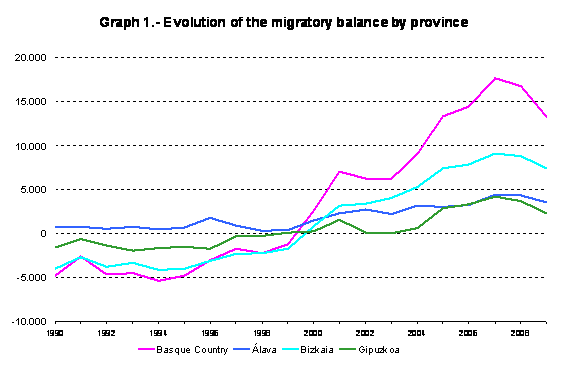
Source: Eustat. Mirgatory movement Statistics
The migratory balance for people coming from overseas was positive (14,092 people). However, it was down by 34% with respect to the previous year.
8.9% of the Basque population changed their place of residence in some way during 2009. Mobility within the Basque Country accounted for 71.14% cases, while the mobility in the other cases was extra-community.
In total, 193,084 changes in the normal place of residence were recorded in the Basque Country:
91,994 were changes in residence within the same municipality.
Intra-community mobility, which is to say movements whose origin and destination were different municipalities within the Basque Country, accounted for 45,372 movements
Likewise, 34,486 cases of extra-community or external immigration were recorded, which are those whose origin is in a municipality outside the Community and whose destination is the Basque Country.
Finally, there were 21,232 cases of external or extra-community emigration, in other words, residential variations originating in a municipality of the Autonomous Community and with the destination outside it, with 3,400 of them moving abroad.
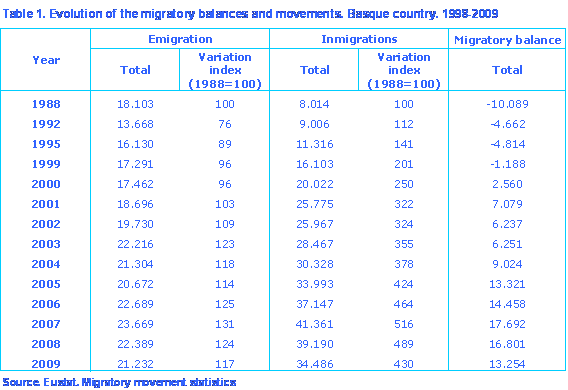
Basque geographical mobility is on a much smaller scale if compared to the other Autonomous Communities
External geographical mobility, which involved 25.8 per thousand inhabitants of the Basque Country (Álava 31.9‰, Bizkaia 26.5‰ and Gipuzkoa 21.8‰) in 2009, was relatively small if compared to the other autonomous communities, where 41 per thousand inhabitants moved on average.
Except for the Autonomous Communities of Galicia, Cantabria, Navarra, Extremadura and the Autonomous Cities of Ceuta and Melilla, the other Autonomous Communities contributed more population to the Basque Country than they received from that community.
The Autonomous Communities that were a hub of attraction for the emigrants from the Basque Country were in this order: Castilla y León, Cantabria, Madrid, Cataluña, Navarra and Andalusia. These six were the destination of 66% of the people who left our Community for other Autonomous Communities of the State.
The number of foreign immigrants came to 21,403 in 2009 (43% of whom came to the Basque Country from other Autonomous Communities) and accounted for 62% of the entries into our Community. For the second consecutive year, since 2000, there was a drop in the number of foreign immigrants moving to the Basque Country, specifically, 19% less than in 2008. In 2009, 9,291 foreign immigrants were recorded as moving to the Basque Country from other Autonomous Communities. One out of every two came from Madrid, Catalonia, Comunidad Valenciana and Andalusia.
As far as the level of education was concerned, 56% of the immigrants and 58% of the emigrants had completed primary education, while there was no difference in the percentages of immigrants and emigrants who had completed higher or further education (18% in both cases).
The average age of the emigrants (35.4 years old) was higher than that of the immigrants (31.5 years old). If the gender variable of the population in question is taken into account, 53% of immigrants were men and 47% women, while the difference between the sexes was lower in the case of emigrants (52% men and 48% women).
For further information:
Basque Statistics Office
C/ Donostia-San Sebastián, 1 01010 Vitoria-Gasteiz
Tlf:+34-945-01 75 00 Fax:+34-945-01 75 01 E-mail: eustat@eustat.es
Contact: Martín González Hernández
Tlf:+34-945-01 75 49 Fax:+34-945-01 75 01
Online press releases about migratory movements in the Basque Country
Databank about migratory movements in the Basque Country