Press release dated 29/09/2010
2009 AGRICULTURAL CENSUS
The number of agricultural holdings in the Basque Country fell but they are also smaller
Greater role of women in the Basque agricultural sector
There were 16,445 agricultural holdings in the Basque Country in 2009, which was a net drop of 8,293 farms with respect to 1999 (-33%) in homogenous terms, according to the provisional 2009 Agricultural Census prepared by EUSTAT. This downturn was in all three provinces and was headed by Bizkaia (-37%), followed by Álava (-33%) and Gipuzkoa (-30%).
The average total surface area and the Used Agricultural Surface Area (SAU) of the agricultural holdings of the Basque Country was 16.9 hectares and 12.3 hectares, respectively, which was up 18% compared to 1999. Significant differences could be observed between Álava (29.7 ha and 28.3 ha) and the other two provinces, Bizkaia (9.5 ha and 6.6 ha) and Gipuzkoa (18.4 ha and 9.5 ha).

The concentration of livestock continues on livestock farms
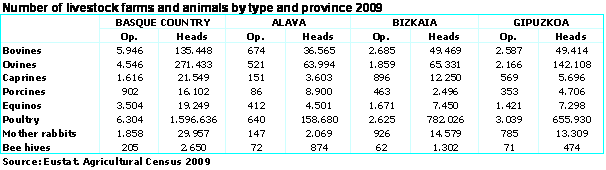
In 2009, the number of livestock farms fell for all types of livestock in the Basque Country, even though the average number of head per farm increased in all types of livestock.
The most important decreases were for milking cows and pigs. Over the last decade, the number of farms with dairy cattle and breeding sows fell by 68.5% and 68.2%, respectively. However, the number of dairy cattle per farm fell from 13 in 1999 to 26 in 2009 (+100%) and the number of breeding sows per farm rose from 9 to 10 in the same period (+11%).
Special mention should be made of the number of farms with meat cattle (-33%), while the number of head of these animals per farm rose from 8 to 11 (+30%). The rise in the number of horses (+25%) and the lack of variation in the number of laying hens are noteworthy. The number of animals per farm also increased in both cases.
Fewer young people and more women running agricultural holdings
The form adopted regarding the legal status of the agricultural holdings remained practically unchanged between 1999 and 2009, with around 95% owned by private individuals and 5% by legal entities. Slightly over 15% farms in Álava were legal entities, while they accounted for between 2 and 3% of the total holdings in Bizkaia and Gipuzkoa.
The average age of the person in charge of the agricultural holding was 57 years old in the Basque Country as a whole. The average age was 54 in Álava, 60 in Bizkaia and 59 in Gipuzkoa. Even though the average age of the person running the farm between 1999 and 2009 remained practically unchanged, the number of young people (people under 40 years old) running a farm decreased in relative importance over the last decade, as it fell by approximately 3 percentage points. The group in the 40-65 age bracket rose by nearly 5 points, while those aged over 65 years old fell slightly by around 2 percentage points.
The number of women as the person at the head of running the farm rose from 24.4% of agricultural holdings in 1999 to 30.9% in 2009. Furthermore, increases were likewise recorded in the number of women running the farms in the three provinces, in the different age brackets (under 40, between 40 and 65, and over 65 years old) and in holdings that were legal entities and owned by private individuals.

The average workload per farm rose from 0.7 AWUs in 1999 to 0.9 AWUs 2009 (1 AWU – Annual Work Unit – is equivalent at least to 228 full days or 1,826 hours). The number of farms with work loads over 1 AWU/agricultural holding fell in the last decade. Thus, 40% of the farms in the 2009 Census had work loads over 1 AWU, while they represented 42% in 1999. This trend did not only apply at the level of the Basque Country as a whole, but also in each and every one of the province (in particular in Álava), and irrespective of the legal status of the farm and the age of the person running the agricultural holding.
In 2009, around 7% of the farms in the Basque Country declared that they required labour as all the people working on the holding were overworked, either because the tasks were not properly carried out as they did not have enough time or because those tasks were not performed. Furthermore, 15% of farms that needed temporary workers found it difficult to contract (due to availability or qualification of the workers) and 12% of the farms that needed indefinite workers also faced the same difficulties.
New challenges: diversification of activities, product transformation, agro-environmental measures, organic farming,...
Other complementary activities took place in roughly 30% of the farms of the Basque Country, using the resources of the holding itself. These activities include those related to forestry (present in 24% of the agricultural holdings), transformation of agricultural products (6.4%) and those linked to tourism, accommodation and other recreational activities (1.5%).
Furthermore, 20% of Basque agricultural holdings have benefited from some rural development measure during the last three years. Mention should also be made of the number of agricultural holdings implemented agro-environmental measures (8%), modernising holdings (3%) and the measures related to the increase of the value added of forestry and agricultural products (2%).
Organic farming, even though it is still in its early stages, is growing in importance in the Basque Country. According to the 2009 Agricultural Census, the number of agricultural holdings registered in the Organic Farming Regulatory Board stood at 126 and the declared surface area is 718 ha.
Methodological note: The data refers to the agricultural campaign between 1 October 2008 and 30 September 2009, the 2009 agricultural year. The population sphere refers to agricultural holdings with at least: 1 ha of Used Agricultural Surface area (SAU); o.2 ha used for growing vegetables, flowers and ornamental plants outside and production under glass or crops in greenhouses or irrigated fruit trees (including citrus trees) or nurseries; 0.1 ha used for growing vegetables in greenhouses; 0.1 ha for growing flowers and ornamental plants in greenhouses; 0.5 ha used for growing tobacco; 0.5 ha for growing hops or cotton; the agricultural holdings that had one or more Livestock Units (LG) with a Total Gross Margin (TGM) equal or greater than 0.75 European Size Units (1 ESU = €1,200).
This operation has been carried out in conjunction with the Spanish National Statistics Institute (INE) in the Basque Country and with the Basque Government’s Department for the Environmental, Land Planning, Agriculture and Fisheries.
The data included are provisional and are for agricultural holdings whose owners reside and have the holding in the Basque Country.
The criteria established for the 2009 Agricultural Census, which has limited the population sphere with regard to the 1999 Agricultural Census, as described above, have been considered in the inter-census comparison.
For further information:
Basque Statistics Office
C/ Donostia-San Sebastián, 1 01010 Vitoria-Gasteiz
Tlf:+34-945-01 75 00 Fax:+34-945-01 75 01 E-mail: eustat@eustat.eus
Contact: Mariano González Izquierdo
Tlf:+34-945-01 75 42 Fax:+34-945-01 75 01
Online press releases:
Databank: