Press release dated 13/09/2010
The GDP for the Basque Country registered 0.5% year-on-year growth in the second quarter of 2010
Growth was positive compared to the previous quarter and stood at 0.3%
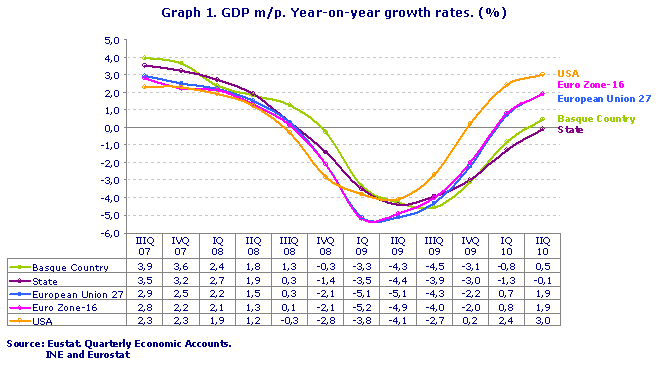
The GDP of the Basque Country registered growth of 0.5% in the second quarter of 2010, compared to the same period of 2009, according to EUSTAT data. This rate was up 1.3 points on the previous quarter.
This figure stood at -0.1% for the Spanish economy, 1.9% for European-27 overall and the Euro-16 zone, and by 3.0% for the US economy.
With respect to the previous quarter, the GDP of the Basque Country registered positive growth of 0.3%, which was the third positive quarter-on-quarter data after four consecutive quarters with negative rates. This quarter-on-quarter variation also stood at 0.2% for the Spanish economy, 1.0% both for the EU-27 and the Euro-16 Zone and 0.4% for the US economy.
From the point of view of supply, the improvement in the year-on-year and quarter-on-quarter trend was mainly due to the performance of the industrial and service sector, while the primary sector (except for the quarter-on-quarter rate) and construction performed negatively.
�
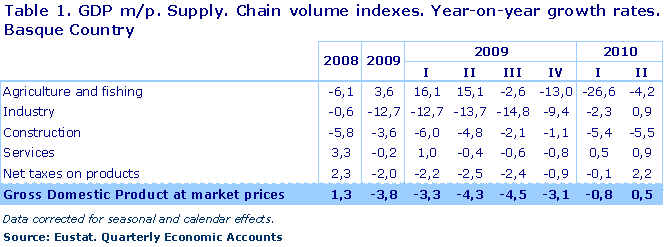
The primary sector registered a 4.2% fall with respect to the same quarter of 2009, together with a quarter-on-quarter rise of 20.5%.
The industrial sector, for the first time since the second quarter of 2008, posted a positive year-on-year rate of 0.9%, thanks to the good performance basically of Metallurgy & Metal Articles, Transport Equipment and Rubber & Plastic branches. This growth is of an identical size in terms of the quarter-on-quarter rate, after six quarters with negative rates.
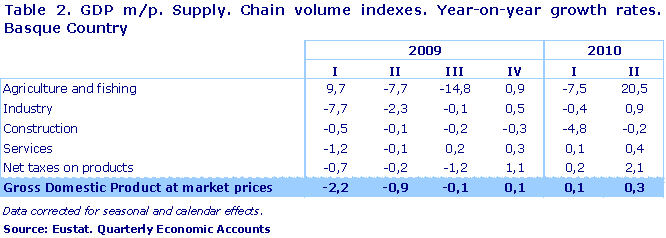
The Construction sector registered downturns in both its year-on-year (-5.5%) and quarter-on-quarter (-0.2%) performance, even though the latter was more moderate that in the first quarter of 2010 (-4.8%). This performance was reflected in the number of people employed in the sector, which fell again in terms of both rates.
The overall performance of the Services sector performed better than the other sectors, with positive year-on-year (0.9%) and quarter-on-quarter (0.4%) rates. Compared to the rates for the first quarter of 2010, the year-on-year rate was up by 0.4 percentage points and the quarter-on-quarter rate by 0.3.
�
In this second quarter of 2010, the Market Services posted positive year-on-year (1.0%) and quarter-on-quarter (0.3%) growth rates, as these rates were respectively 0.4 and 0.2 percentage points higher than those posted in the previous quarter.
After a first quarter with more moderate or even negative rates, the Non-market Services also showed signs of recovery and posted year-on-year and quarter-on-quarter rates of 0.3% and 0.9% respectively.
With regard to the performance of Demand, the most important fact was that, in addition to a relative improvement of Internal Demand, a more expansive performance was noted by the external sector and the combination of both factors explains the better year-on-year and quarter-on-quarter performance of the GDP.
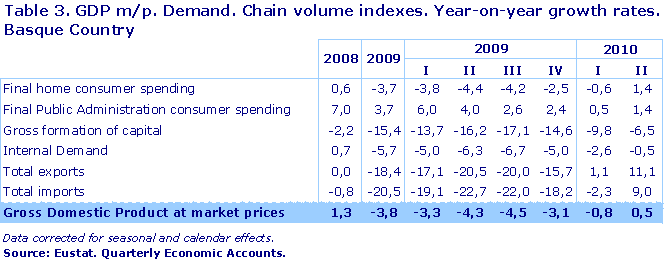
Spending of Final Household Consumption (Private Consumption) posted a positive growth rate not only in quarter-on-quarter (1.1%), but also in year-on-year (1.4%) terms, after six quarters of negative rates. This performance of private consumption is fundamental for a relative improvement to occur in the year-on-year rate of internal demand.
After a first quarter of 2010 where it clearly slowed down, Public Consumption returned to growth both in terms of the year-on-year (1.4%) and quarter-on-quarter (0.8%) rates.
The performance of the Gross Capital Formation (Investment) is determined by that of the Construction and Capital Goods sector. Even though the drop in the year-on-year and quarter-on-quarter rates was more moderate in the first quarter, demand was the variable with the weakest performance, with negative rates in the last eight quarters.
The performance of both Private and Public Consumption and of the Gross Capital Formation, along with their relative weights, determines the performance of Internal Demand, which moderated the rate of its year-on-year downturn by 2.1 points with respect to the data for the first quarter. Growth was positive and stood at 0.2% for the quarter-on-quarter rate and for the third consecutive term.
�
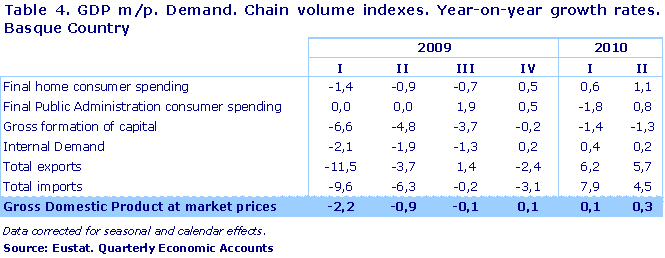
As far as the foreign sector was concerned, the most important fact was its positive contribution to the performance of the GDP. Foreign trade figures, whose year-on-year rates for exports and imports plummeted by even over 20% throughout 2009, managed to turn around in the first quarter of 2010 and even grew significantly in the second quarter.
Year-on-year growth of exports came to 11.1% and the performance of imports was also very dynamic (9.0%). The quarter-on-quarter rates were 5.7% and 4.5% respectively.
The number of people employed rose by 0.4% (4,000 more people employed) with respect to the previous quarter and was down 0.6% (6,000 fewer people employed) with respect to the same quarter of the previous year. The growth in employment was due to the service sector, as the figures fell for the primary sector, industry and construction.
With reference to the evolution of GDP by provinces, Álava posted the best performance, in quarter-on-quarter rates, with growth of 0.5%, followed by Bizkaia (0.4%) and Gipuzkoa (0.1%). In year-on-year terms, Álava posted positive growth of 1.1%, Bizkaia 0.4% and Gipuzkoa 0.2%.
Methodological note: The final annual data for 2008 and the provisional for 2009 of the Economic Accounts of the Basque Country have been included in this second quarter of 2010, which have led to changes in the series of the quarter accounts from the first quarter of 2008.
For further information:
Basque Statistics Office
C/ Donostia-San Sebastián, 1 01010 Vitoria-Gasteiz
Tlf:+34-945-01 75 00 Fax:+34-945-01 75 01 E-mail: eustat@eustat.es
Contact: Javier Aramburu
Tel:+34-945-01 75 06 Fax:+34-945-01 75 01
More press releases on the CET - Quarterly Economic Accounts of the Basque Country
Quarterly Economic Accounts of the Basque Country databank