Press release dated 28/07/2010
Spending on Social Services per inhabitant was up by 14% in the Basque Country in 2008
15% of the population aged 65 and over was cared for by specialist social services
Expenditure on social services in the Basque Country stood at 1,861 million euros in 2008, 15% up on the previous year, according to Eustat data. This expenditure represented 2.7% of the Basque GDP and average expenditure per inhabitant was 860 euros, 13.9% up on the previous year and 623 euros of which came from public funds.
By province, spending rose by 17% in Álava, by 15% in Bizkaia and by 13% in Gipuzkoa. In per capita terms, Álava, with an average of 995 euros per inhabitant, remained ahead of the 847 euros in Bizkaia and the 821 of Gipuzkoa.
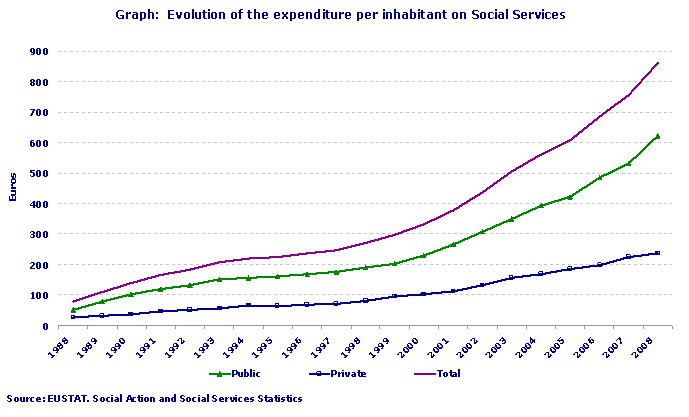
The contribution from the different public authorities came to 1,347 million euros, which represented 72% of the expenditure, while the remaining 28% came from the private sector. One out of every four euros spent was financed by user contributions and other sales. The elderly in residential homes contributed 200 million euros of this total, which accounted for 46% of the current expenditure of these centres.
�
The sector directly employed 4.1% of working women
In 2008, social services overall generated 480 new jobs and directly employed 24,683 people (2.6% of people in employment), of which 70% were women (4.1% of women in employment). This figure does not include subcontracted workers, home helpers and direct carers, whose total hours worked were the equivalent of over 5,000 full-time jobs. Furthermore, there were 18,958 volunteers, who work free of charge for the social services, in 2008 and represented an equivalent of 1,762 full-time jobs.
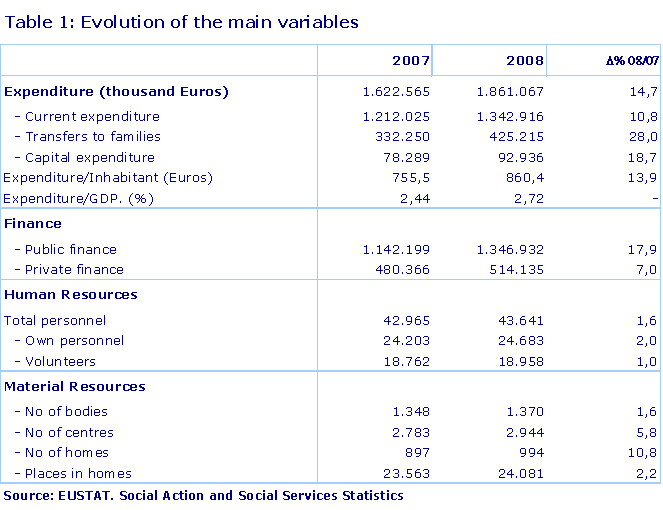
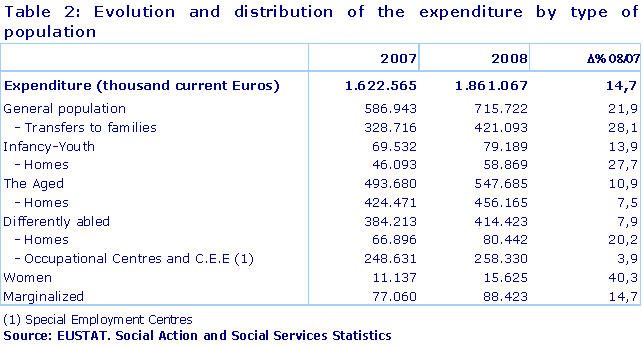
Among the diversity of the social services, the services for the population as a whole and for the elderly stand out as the areas to which the greatest amount of resources were dedicated, as they represented 68% of the expenditure between the two.
Among the resources for the population as a whole, transfers to families, particularly the Basic Income (RB), with 203 million euros (+17%) and the Social Emergency Aid (AES), with 45 million euros (+9%), were the programmes that were particularly noteworthy, due to their size and evolution. These two programmes represented spending of 115 euros per inhabitant on average in the Basque Country. Special mention should be made of their impact in Bizkaia, where 158 euros was spent per inhabitant, a figure that was much higher than the 94 euros in Álava and 53 in Gipuzkoa.
�
Specialist social services cared for 15% of the population aged 65 and over
Care for the elderly by the social services is mainly based on providing residential services, day-care centres, home care service and remote control care.
In 2008, there were 18,108 residential places, which meant a coverage of 4.4 places per 100 elderly persons, aged 65 and over. The authorities offered 34% of these places through publicly-funded centres and agreed a similar percentage (30%) with private institutions.
With respect to the day-care centres, the number of places came to 3,706 places (+7%). The public administration offered 86% of these places directly or by means of agreements with the private network.
The home-care service (SAD) looked after 23,905 old-aged people in their own homes (5.8% of the population aged 65 and over).
A total of 17,226 old-aged people had the remote care service in their home.
With respect to 2007, the number of SAD users increased by 11%, while the hours of care grew at a lower rate (+5%). The total expenditure of this service came to 85.8 million euros (11% up on the previous year), which was an annual average cost of 3,233 euros per user and was mainly financed by the public sector (91%).
For further information:
Basque Statistics Office
C/ Donostia-San Sebastián, 1 01010 Vitoria-Gasteiz
Tlf:+34-945-01 75 00 Fax:+34-945-01 75 01 E-mail: eustat@eustat.es
Contact: Matxalen Plagaro
Tlf:+34-945-01 75 99 Fax:+34-945-01 75 01
More press releases about Social Action and Social Services Statistics in the Basque Country
Social Action and Social Services Statistics in the Basque Country Databank