Press release 28/05/2010
The housing supply grew at a rate of 20,500 units per year between 2001 and 2006
Housing growth over the five years was equal to that of the previous decade
Between 2001 and 2006, the supply of housing in the Basque Country grew by 102,429 units, with an annual average of 20,486 homes, according to EUSTAT data. This figure shows the fast growth in the residential building sector, as it was practically the same in just five years as for the whole of the previous decade (1991 to 2000), where it was 104,240 units.
Bizkaia accounted for 48.4% of the growth for the Basque Country as a whole between 2001 and 2006, while 28.6% was in Gipuzkoa and the remaining 22.9% in Álava.
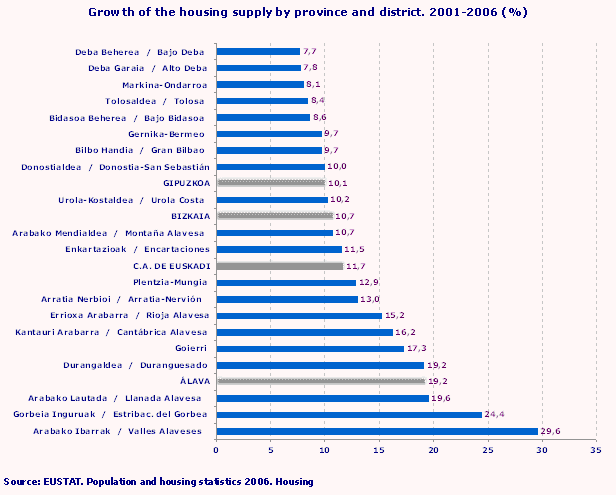
The evolution of the housing supply differed according to the province. If the evolution over these five years is considered, Álava stood out as its housing supply increased by 19.2%, followed by Bizkaia and Gipuzkoa, with similar growth of around 10%:
�
Special mention should be made of the high growth rates in the Alava districts, with increases ranging from 10.7% in the Montaña Alavesa up to 29.6% in the Valles Alaveses. In Bizkaia, the districts posting greatest growth were Duranguesado (19.2%) and Arratia-Nervión (13%), and the Goierri district (17.3%) stood out in Gipuzkoa. On the other hand, the Bajo Deba and Alto Deba were the districts with the lowest increase in the housing supply, slightly under 8% over these five years.
Vitoria-Gasteiz was the capital with the largest increase (17.6%) in its housing supply between 2001 and 2006
Vitoria-Gasteiz was the capital with the greatest growth in terms of housing, 17.6% over this five-year period (15,301 more homes), followed by Donostia-San Sebastián with 9.4% (7,250 more), and then Bilbao with the lowest percentage increase (6.9% or 10,151 more homes).
In terms of the increase in housing by municipalities, Barakaldo stood out with 7,314 more homes, Durango with 3,553, Irun with 2,835, Santurtzi with 2,403 and Basquri with 2,355.
Eight out of every ten homes were the main place of residence
If the family housing supply is analysed from the point of view of use, 82.5% was used as the main place of residence, while 17.5% of family homes were empty or used as a second home.
53.4% of all the main places of residence in the Basque Country were in Bizkaia, 32.3% in Gipuzkoa and 14.3% in Álava. By provincial capitals, Bilbao stood out with 17.2% of the main places of residence in the Basque Country (138,672 dwellings), followed by Vitoria-Gazteiz, with 86,681 dwellings (10.7%) and, finally, Donostia-San Sebastián, with 8.7% (70,118 dwellings).
Álava likewise had the highest proportion of second or empty homes, which totally 20.8% of the total family housing supply, followed by Gipuzkoa with 18.5% and Bizkaia with 15.9%.
By districts, three in Álava stood out as having the highest percentage of second or empty dwellings in relation to their respective family housing supply: Valles Alaveses (51.4%), Rioja Alavesa (48.8%) and Montaña Alavesa, (47.3%).
The average Basque home is 37 years old and with 87 square metres of useable floor area.
Between 2001 and 2006, 7,319 more buildings contained one home, which represented 7.1% of the total increase over this five-year period, and 2,846 more with two homes (2.7%). However, there was still a predominance of buildings with 3 to 10 homes, which accounted for 28.7% of the total family housing, and those of 11 to 20 homes (31%).
The average age of the housing supply was 37.3 years old, and was 32 in Álava, 27.8 in Gipuzkoa and 38.5 in Bizkaia.
The average useable floor area of Basque family housing was 86.8 square metres, which meant that there had been an increase of one square metre over the last five years. Álava had the largest houses with an average useable floor surface of 92.4 square metres, followed by Gipuzkoa (87.2 m2) and Bizkaia (85 m2)
�
In terms of the number of rooms, three-quarters of Basque family housing had 4 or 5 rooms (excluding bathrooms, shower rooms, WCs and kitchens with less than 4 square metres). The highest percentage was for homes with 5 rooms (49.2%).
61% of the total family dwellings had a lift in the building.
The Basque housing comfort index rose by two percentage points in just five years
The comfort index of the main places of residence in the Basque Country was 72.2% on average and had risen by nearly two points compared to 2001 (70.6). This indicator is based on the structure of the dwelling (surface area, age, number of rooms and bathrooms) and its amenities (mains gas, telephone landline, etc.).
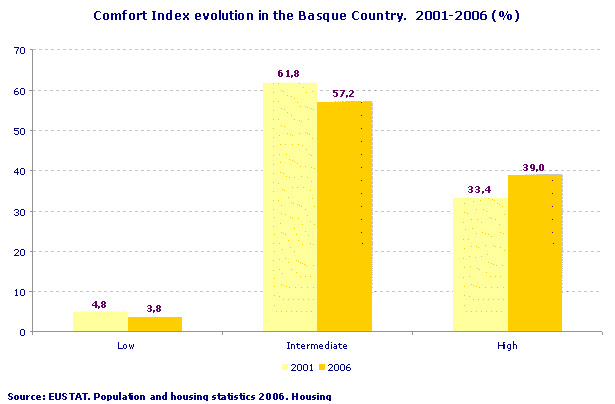
The positive evolution of the comfort index can be seen from the increase in the percentage of dwellings with a high comfort level, 39% in 2006 compared to 33.4% in 2001. At the same time, the percentage of housing with a low comfort index fell, as can be seen from the graph.
The homes in Álava (76.5%) had the highest levels of comfort, followed by those in Gipuzkoa (72.7%) and Bizkaia /70.8%). All three provinces evolved positively compared to 2001, particularly in Álava, which saw its comfort index increase by nearly two points.
Sopelana, Berango, Irura, Ziortza-Bolibar, Vitoria-Gasteiz, Durango and Getxo had the housing with the highest comfort indexes in the Basque Country
Out of the three Basque provincial capitals, Vitoria-Gasteia stood out with a housing comfort index of 78.6%, followed by Donostia-San Sebastián (75.1%) and Bilbao (71.7%).
By districts, special mention should be made of the Llanada Alavesa (77.9) as the district with the highest level of comfort index, followed by Alto Deba, Bajo Bidasoa, Plentzia-Murgia, Goierri, Duranguesado, Cantábrica Alavesa and Donostia-San Sebastián, all of which had values over the average for the Basque Country. On the other hand, the district with the lowest housing comfort index was Markina-Ondarroa (62 points).
The municipalities with the most comfortable homes were Sopelana, with a comfort index of 83.8, Berango with 82, Irura with 81.6, Ziortza-Bolibar with 80.6, and Durango and Getxo, both with 78.5 points.
For further information:
Euskal Estatistika-Erakundea / Instituto Vasco de Estadística
C/ Donostia-San Sebastián, 1 01010 Vitoria-Gasteiz
Tlf:+34-945-01 75 00 Fax:+34-945-01 75 01 E-mail: eustat@eustat.es
Contact: Pilar Martínez Rollón
Tel:+34-945-01 75 97 Fax:+34-945-01 75 01
Further press releases at EPV06
Databank on EPV06