Press release 29/04/2010
Health insurance grew in terms of premiums and number of insured in the Basque Country in 2008
The number of insured increased thanks to the collective medical insurance
Private insurance entities (ESL) that operated in the Basque Country collected nearly 220 million euros in premiums in 2008, 9.3% up on the previous year, covering a collective of 369,017 people insured, according to Eustat data. In an economic situation that was already beginning to note the downturn, the health insurance sector grew in terms of the value of the premiums and number of insured in 2008.
The premiums totalling 219.8 million euros declared by the ESLs represented 4% of the total premiums for Spain as a whole and 0.3% of the GDP of the Basque Country. The growth rate (9.3%) was also higher than the average for Spain (8.3%). Some of the reasons that explain this increase were the range of medical insurance policies adapted to specific collectives and for companies (with tax advantages), together with the wider coverage.
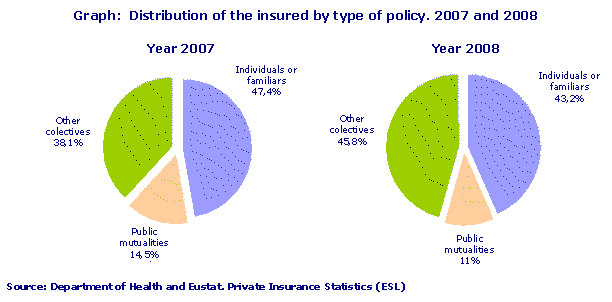
The number of people with healthcare insurance reached 369,017 (nearly 23,000 up on 2007), with that collective representing 17% of the population of the Basque Country. According to the policy type, collective insurance policies (companies or other specific collectives) accounted for 45.8% of the insured, which was ahead of individual and family insurance that covered 43.2% of the insured and the public mutual societies.
�
With respective to the previous year, the total number of insured was up by 6.6%. Despite the number of individual or family policy cancellations, the increase in collective medical insurance in 2008 meant that the number of insured increased and it also became the type of insurance with the greatest number of people covered.
The vast majority of policy holders (94%) preferred private medical insurance with general healthcare coverage, which covers primary care and hospitalisation, compared to the 6% who had opted for a specific care policy (such as dental, specialised or primary care).
A total of 1,299,156 doctor’s appointments, 52,818 hospital admissions and 154,562 stays in hospitals are figures that reveal moderate growth in the activity of the healthcare insurance sector. Doctor’s appointments were up 1.1% with respect to the previous years and most appointments were in the branches of orthopaedics, obstetrics-gynaecology and paediatrics. Hospital admissions rose by 1.2% with respect to 2007, which was an average hospital stay of nearly 3 days. The greatest number of hospital admissions involved the branches of general surgery, internal medicine and orthopaedics.

Methodological note: These statistics contain information from the private medical-pharmaceutical insurance companies with a branch in the Basque Country.
The 2006 and 2007 data have been reviewed and then updated.
For further information:
Euskal Estatistika-Erakundea / Instituto Vasco de Estadística
C/ Donostia-San Sebastián, 1 01010 Vitoria-Gasteiz
Tlf:+34-945-01 75 00 Fax:+34-945-01 75 01 E-mail: eustat@eustat.es
Contact: Marta de la Torre Fernández
Tlf:+34-945-01 75 48 Fax:+34-945-01 75 01
Further press releases on Statistics for private medical-pharmaceutical insurance companies
Databank on Statistics for private medical-pharmaceutical insurance companies