Press release 25/03/2010
Average personal income in the Basque Country rose by 27% between 2003 and 2006
Average income of Basque families in 2006 was nearly 39,000 euros
According to the Personal and Family Income Statistics prepared by Eustat, in conjunction with the Provincial Councils of Álava, Bizkaia and Gipuzkoa, the average personal income of the residents of the Basque Country in 2006 was 17,632 euros for the population aged 18 and over, 27.2% higher than three years previously. Gipuzkoa was the province with the highest personal income (17,488 euros), followed by Bizkaia (17,332 euros) and, finally, Álava with 17,190 euros. If the evolution by province since 2003 is analysed, the best performance was by Bizkaia, growing by 29.6%, followed by Gipuzkoa, which increased 25.9%. Álava posted growth of 21.7%.
If we look at disposable income, meaning total income less income tax and worker social security contributions, there were barely any differences between the three provinces. Disposable income for the Basque Country as a whole stood at 14,598 euros, for Álava it came to 14,767 euros, 14,584 for Gipuzkoa and 14,501 euros for Bizkaia
The municipality of the Basque Country with the highest average personal income was Laukiz, with 29,726 euros, located in Bizkaia. In Álava, the municipality with the highest personal income was Zigoitia, with 23,538 euros, and Zerain, with 20,115 euros, was the one with the highest personal income in Gipuzkoa. On the other hand, the municipalities with the lowest personal income were Gripan in Álava, with 9,969 euros, Errezil in Gipuzkoa, with 11,202 euros, and Lanestosa in Bizkaia, with 11,505 euros.
The average personal income of the capitals of the three provinces was higher than the average for the Basque Country as a whole. Donostia-San Sebastián was in first position with 20,056 euros, followed by Bilbao, with 18,196 euros and, finally, Vitoria-Gasteiz, with 17,597 euros.
Average personal income by type according to province and sex. (euros). 2006

One out of every nine people aged 18 or over doubled their annual average income, while one of every eight did not receive any type of income in 2006
As for the distribution of income among the population, there were almost 1,600,000 people aged 18 or over who earned some kind of income, which is to say 88%, while 12% of the population, one in eight residents, received no income at all during 2006. Additionally 60% of people received an income below the average of the Basque Country or received no income at all, while 11.5% earned an income that was twice or more the average, which is to say over 34,700 euros
The median is the indicator that establishes which income divides the population into two equal halves. In 2006, this figure stood at 13,269 euros. This means that half the population of the Basque Country aged 18 or over had an average personal income of more than 13,269 euros per year, while for the other half it was lower.
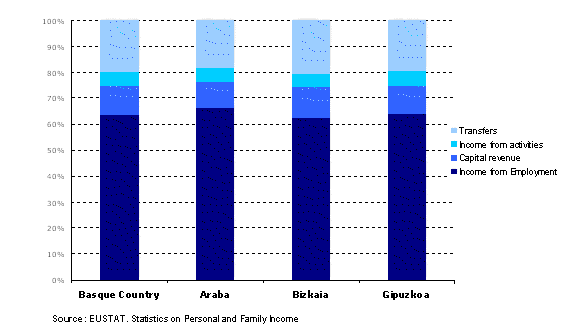
As regards the percentage distribution of total personal income� by the principal sources of income in the three provinces, work turned out to be of greater relative weight, followed by the transfers (benefits or social welfare).
Composition of personal income by provinces. (%). 2006
Source: Eustat
63.4% of the income from work
Therefore, as regards the composition of total personal income received by the residents of the Basque Country during 2006, 63.4% came from income derived from work, with an average of 11,022 euros. The remainder was divided between 19.8% from benefits or social welfare, an average of 3,433 euros, almost 5.5% was derived from income from economic activities, with an average of 966 euros, and 11.3% came from income from both financial and property capital, with an average of 1,960euros.
These figures, if compared with those from 2003, clearly show a 3 percentage point decrease for income from work in the weight of total income, while income from capital rose by 3.7%. However, income from economic activities fell by 0.8%, while benefits remained at 19.8%.
As for provinces, we can see differences as regards the weight of income from work and benefits in the composition of total income, given that while in Álava 66% of income was derived from work and 18% from benefits, in Gipuzkoa 64% income came from work and 19% from benefits and in Bizkaia 62% was from work and 20.5% from benefits.
Men earned double the average personal income of women
Income was unevenly distributed between men and women, in that while men in the Basque Country received an average total income of 23,224 euros, women had an average income of 11,857 euros, which is to say that the average income for men doubled that of women and that men received a personal income of 11,367 euros more.
The greatest difference between the personal income of men and women was between those aged between 55 and 59 years old. In that age bracket, the average income of men bettered the personal average income for women by 21,330 euros.
Differences in average personal income between sexes (men minus women) by age brackets. The Basque Country. (euros). 2006
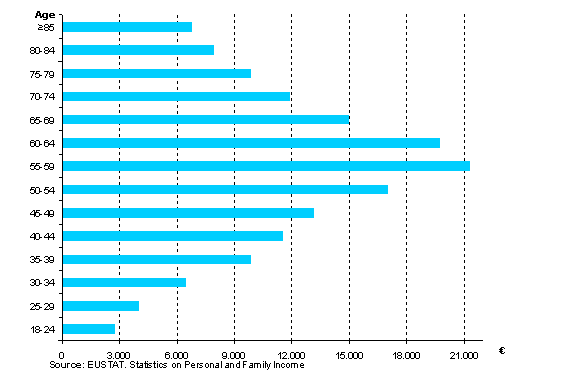
For the population aged 18 or over as a whole, the highest total personal income was obtained between the ages of 50 and 54 with an average income of 23,504 euros. In the case of women the highest average income was obtained between the ages of 45 and 49 (with an average income of 15,848 euros) while for men the maximum average income came between the ages of 55 and 59 and was substantially higher (33,568 euros),
The average income of Basque families in 2006 was nearly 39,000 euros
The average income for families in the Basque Country in 2006 came to 38,853 euros. The average income for all of the families of the Basque Country was exactly 2.23 times the average personal income.
Total family income is the result of aggregating the total personal income of all the members of the same family aged 18 or over who received some type of income. Unlike the case with personal income, Bizkaia is the province with the highest family income (39,008 euros). It was followed by Gipuzkoa with 38,704 euros and, finally, Álava with 38,610 euros.
Half of the families of the Basque Country have an average family income over 30,740 euros a year in 2006
Average family income for the Basque Country grew by 16% from 2003 to 2006. By provinces, the best performance was by Bizkais, which grew by 21.1%, followed by Gipuzkoa, where average family income increased by 18.4% in the province. Growth in Álava was 13.7%.
2.6% of the families, one of every 40, did not receive any type of income in 2006
63% of families received an income below the average for the Basque Country or received no income, three percentage points than in the case of income. At the other extreme, nearly 9% of families, specifically 70,659, had an income that was at least twice the average, which is to say, over 77,700 euros.
The median for families of the Basque Country stood at 30,740 euros, which is to say that 50% of families had an income lower than that figure and for the other 50% it was higher.
When the main earner of the family was a man, families had average earnings of 42,774 euros, mainly concentrated on the upper and middle strata, whereas if it was a woman, then the average family income stood at 30,950 euros and was concentrated on the lower income strata.
Families by stratum of family income according to the sex of the main wage earner.
The Basque Country. (%). 2006
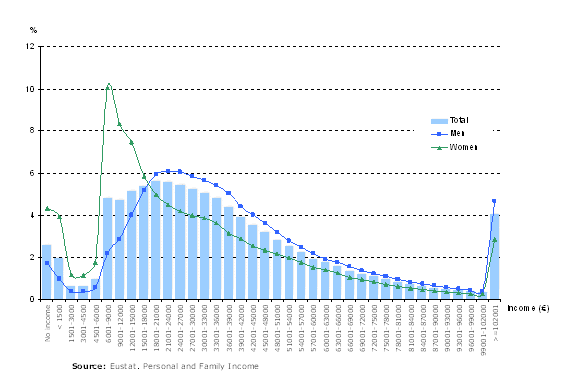
We can therefore speak of a “gender gap” in family earnings because of the inequalities that exist in family incomes depending on whether the main earner is a man or a woman. However, in general, the families where the main wage earner is a women are smaller in size than the others.
The municipality of the Basque Country with the highest average family income was the municipality of Laukiz, located in Bizkaia, with 80,338 euros. In Álava, it was Berantevilla, with 52,165 euros and Elburgo in Gipuzkoa, with 50,332 euros. On the other hand, the lowest family incomes wer Kripan in Álava, with 24,440 euros; Karrantza in Bizkaia, with 27,550 euros and Pasaia in Gipuzkoa, with 29,347 euros.
In turn, the gap between the municipalities with the highest and lowest average family income exceeded 55,890 euros. At the upper limit was Laukiz, with 17,200 euros more than the municipality with the next highest family income, and at the lower end was Kripan, with 1,200 euros less than the nearest municipality with the lowest family income
Donostia-San Sebastián was the provincial capital with the highest family income, followed by Bilbao and Vitoria-Gasteiz
Donostia-San Sebastián, with 43,893 euros, was the provincial capital with the highest family income, followed by Bilbao, with 39,679 euros, and by Vitoria-Gasteiz, with 39,506 euros. The three provincial capitals were above the average family income.
At district level, there were also important differences among the 20 districts that make up the Basque Country. Only 6 obtained family incomes that were higher than the Community average, among which, the following stood out for having an income of more than 39,000 euros: Plentzia-Mungia In Bizkaia (45,712 euros); Estribaciones del Gorbea In Álava (43,921 euros) and Donostialdea in Gipuzkoa (41,964 euros). On the other hand, the 14 remaining districts had a family income below the average and notable among these with earnings of less than 39,000 euros were: Montaña Alavesa and Rioja Alavesa, with 28,874 and 32,280 euros, respectively, and Encartaciones in Bizkaia, with 33,788 euros.
As regards the size of the family, only families of one or two people obtained family earnings which were below the Community average, 20,134 and 32,869 euros respectively.
For further information:
Basque Statistics Office
C/ Donostia-San Sebastián, 1 01010 Vitoria-Gasteiz
Tlf:+34-945-01 75 00 Fax:+34-945-01 75 01 E-mail: eustat@eustat.es
Contact: Pilar Martínez Rollón
Tel:+34-945-01 75 97 Fax:+34-945-01 75 01
Online press releases of Personal and Family Income Statistics