Press release 12/02/2010
SOCIAL CAPITAL SURVEY (ECS) 2007
Basques have a large (22 people), but highly uniform friends and family network
The social participation of the Basque population is mainly based on elections, according to the Eustat Social Capital Survey
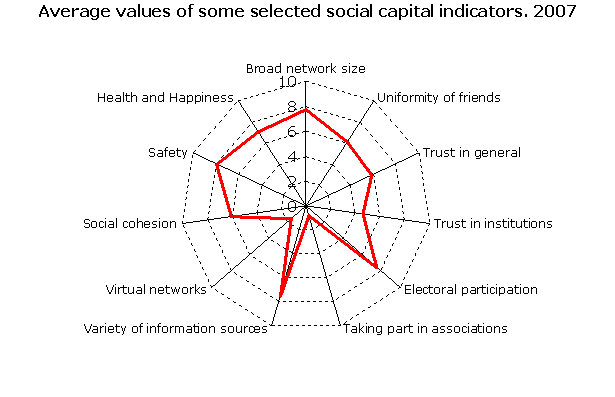
At the end of 2007, Eustat carried out the Social Capital Survey, designed as a set of social participation and relationship dimensions. Some of the indicators refer to the health and happiness of the population, size of the friends and family network, their uniformity, trust in general and in the institutions, participation in elections and association, variety of information sources, virtual networks, safety and social cohesion.
The results of the survey showed that people in the Basque Country had an average of 22.5 people around them between relatives and friends, a dozen of whom formed the closest core with whom they have the closest relationship. The type of family was particularly discriminating among the socio-economic variables, as childless couples had just over 24 relatives and friends, while single-person families had 18.7, while people who do not live with families but resided in collective establishments had barely over 14. In relation to the activity, pensioners had an average of 19.7 relatives and friends, while the number was over 24.1 in the case of students.
Now if only friends are taken into account, the uniformity or the cross-section of them were considered in the survey. For the population as a whole, the uniformity scored an average of 6.0, which means that nearly two thirds of people only had friends who were the same as them in terms of religious beliefs, nationality, social position or political trends.
On the other hand, it can be seen that mainly those people born abroad had the networks with the widest cross-section, for obvious reasons, along with university graduates, professionals and managers, the upper and upper-middle classes and entrepreneurs. At the other extreme, people with primary or lower studies, those who took care of the household chores, were aged 55 years or older, unemployed, born in other provinces or were widowed, separated or divorced had the most uniform networks.
Social participation
Social participation is based on participation in elections, with minimum presence of associations. The Basque population was thus revealed to participate highly in elections, with an average value of 7.6 which means that they had voted in 3 out of 4 of the last elections. It also expressed an interest in socio-political questions in the different spheres affecting it (5.8), but its political and social participation was low (1.2 points on average) and its participation in associations was nearly non-existent (0.8 points).
The Basque population only considered themselves to be moderately informed (5.2 points on average) about the public issues that concerned them and this was despite the abundance of provincial information sources (7.5 on average) and the wide use of the media (6.7).
�
If we look at this in greater detail, it can be seen that the population is better informed about the matters closest to them, preferably about their neighbourhood, municipality or the Autonomous Community (over a third consider that their level of information is high), which that is less true when it comes to Spain (a quarter consider themselves to be well informed) and, above all, Europe (just over 15% have a great deal of information). However, in 2007, the lack of Internet and virtual contacts could be noted (1.6 points on average).
It was barely a pass when it came to trust
The trust shown by the Basque population varied depending on whether it was about people in general (5.8), the different professions (5.1), friend and family networks (6.9) or the institutions (4.7), with the latter scoring under the pass rate. The results of the trust in each institutions is variable. They range from a minimum of 3.1 points in the case of the political parties and 3.4 in the army up to a maximum of 6.1 points in non-governmental organisations, 5.6 in the Ertzaintza (Basque Police Force) and 5.5 in charity organisations such as Cáritas, with trade unions (4.6) and the courts (4.7) falling in the middle.
When it comes to trust in the different professions, the scores showed those that doctors are clearly considered to be most (7 points on average) and politicians to be the least trustworthy (3 points). Scientists and teachers are close behind doctors and, along with politicians and sales personnel, are some of the professions who passed. Judges and civil servants scored around 5, while entrepreneurs, priests and journalists only got 4 and soldiers were at the bottom along with politicians with 3.5 points on average.
On the other hand, social cohesion, safety and the (lack of) corruption are important dimensions of the social capital. Special mention needs to be made in the Basque case of the strong feeling of safety that was close to 8 points on average Social cohesion, combining proximity, disputes and acceptance of differences, was around 6 points. However, corruption was seen negatively, with 5.9 points which reflects the majority belief in the existence of abuse of power.
The youngest population (7.3) and adults aged 25-34 (7.4) felt slightly less safe, together with the unemployed and students (7.4), even though they all scored well. The highest safety scores were among retirees (8.3), people over 65 years old (8.2) and the people in charge of household work (8.2).
It seems that personal characteristics are not problematic from the point of view of safety for the Basque citizens, given that 20% to 45% consider that none of them cause a problem. Up to 22% believe that ideological differences can be problematic, a similar percentage believe the same about ethnic origin and over 16% also refer to the social level. Religious and languages differences are considered by nearly 10% of the population to be a strong potential for conflict.
Quite happy and healthy population
From a global point of view, the Basque population felt happy and healthy to a great extent, scoring an average of 7.1 points out of a maximum of 10. The happiness section considers health, satisfaction with life and financial income.
Therefore, happiness, satisfaction with life can be, and is, related to income, which is reflected in the fact that the social class is the most important variable. The maximum difference is between the value scored by the working (6.2) and the upper and upper-middle (7.7) social classes.
�
The relationship appears to be more diluted when the relationship with activity is considered, where the happiest people, along with the students (7.5), were the people who were employed (7.3) and the least happy were the pensioners (6.4) and retirees (6.8), which reflects the importance of health in their self-assessment.
The importance of variables such as the type and size of families reveal the impact of being alone when considering satisfaction, as childless couples (7.2) or those with children (7.1) were the happiest and single-person families (6.6) and residents in collectives (6.6) were the least.
Overall results of the Social Capital Survey
Eustat conducted this social capital survey, which it is taken to be a resource that is accessed through broad personal networks by means of which a person actively participates in the different social and economic spheres in an atmosphere of trust and which can facilitate social and personal development, together with the economic development of a society.
Social capital is seen as a set of social participation and relationship dimensions, some of whose indicators are summarised in the following graph, with the average scores obtained.
For further information:
Basque Statistics Office
C/ Donostia-San Sebastián, 1 01010 Vitoria-Gasteiz
Tlf:+34-945-01 75 00 Fax:+34-945-01 75 01 E-mail: eustat@eustat.es
Contact: Enrique Morán Aláez
Tlf:+34-945-01 75 35 Fax:+34-945-01 75 01
Online press releases: www.eustat.es
Databank:fA\;www.eustat.eus/bancopx/english/indice.aspx