Press release 04/12/2009
TECHNOLOGICAL DEVELOPMENT AND SCIENTIFIC RESEARCH STATISTICS (R&D) 2008
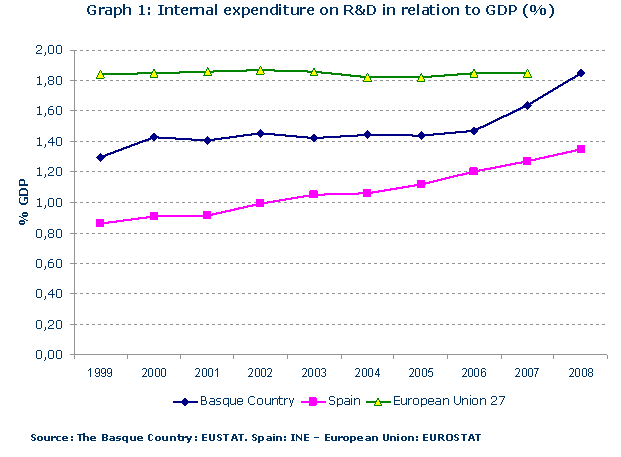
Expenditure on R&D in the Basque Country represented 1.85% of the GDP in 2008, which was in line with the average for the European Union
Expenditure was thus up 16% on the previous year.
In 2008, 1264 million euros were invested in Scientific Research and Technological Development (R&D) in the Basque Country, which was up 16% on the previous year, according to Eustat data. In current euros, internal expenditure in R&D has doubled over the last 8 years, rising from 619 million euros in 2001 to the current figure.
In 2008, expenditure on R&D in relation to the GDP of the Basque Country increased up to 1.85% of the GDP, twenty-one euro cents more than in the previous year and put it on an par with average for the European Union-27, compared to the data available for 2007. The great boost in R&D over these last two years, with growth over 15%, together with the slowing down of GDP growth in 2008, has eliminated the gap between the Basque Country and the average for the European Union, measured in terms of GDP. This ratio is also clearly above the Spanish average(1.35%).
�
It can be seen that there was a positive relation between the level of GDP per inhabitant and the percentage of GDP earmarked for R&D. The richest countries are those who make the greatest investment in R&D, which is to say those who spend over 2.5% of their GDP, which were: Sweden, Finland, Japan, Switzerland, Iceland, USA, Austria, Denmark and Germany. Those who allocated a medium amount, between 1.5% and 2.5% of their GDP, included: France, Belgium, United Kingdom, Holland, Norway, Luxembourg and the Czech Republic. The Basque Country is included in this group. The lowest investments in R&D were in Slovenia (1.45), Ireland (1.45%), Spain (1.35%), Estonia (1.29%), Portugal (1,18%), Italy (1.13%), Hungary (0 97.), Croatia (0%81), Greece (0.57), Poland (0.57%) and Rumania (0.53%).
81% of expenditure on R&D in the Basque Country was in the company sector
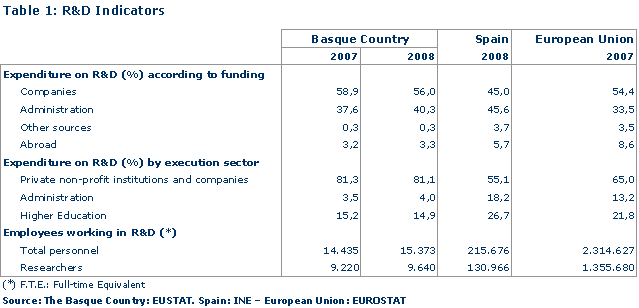
By sectors, Basque companies spent 81% on R&D, 15% was devoted to university research and the remaining 4% was by various public organisations dependent on the Administration.
The company sector of the Basque Country, therefore, made the greatest investment, comparatively, in research work. There was an important difference as regards the Spanish average, where companies accounted for 55.1% of expenditure on R&D in 2008, Higher Education 2008 and the Public Administration 26.7%.
Focusing on industrial companies, special mention should be made of the branches of Transport Material, Machinery and Metal Articles, which jointly accounted for 20% of internal expenditure by the company sector. Turning to the services companies, those whose main activity is R&D services devoted most resources, accounting for 42% of total internal business expenditure.
From the point of view of funding, the private sector, through companies, devoted 708 million euros to research, 56% of the total; public funding came to 40% and the remaining 4% of funds came from overseas. The Basque Country continued to be among the countries with the greatest private funding and above the European average.
�
Total full-time equivalent R&D personnel in the Basque Country came to 15,373 people (6.5% more than in 2007), 63% of whom were researchers (9640). The R&D of the Basque Country accounted for 15 per thousand employed workers (10.7 per thousand in Spain as a whole), while researchers made up 9.4 per thousand D 6.5 per thousand for Spain).
33.4% of R&D personnel were women
Thirty-four per cent of R&D personnel were women and the highest percentages of female participation were seen in the Public Administration and in Higher Education, with 50,5% and 46,2% respectively, whereas this percentage came to 29,3% in companies.
Methodology note: The activity has been classified using the new National Economic Activities Classification, CNAE-2009, the Spanish version of the European NACE Rev 2. This change is part of the European process to adapt to this new economic activities classification for statistics purposes.
For further information:
Basque Statistics Office
C/ Donostia-San Sebastián, 1 01010 Vitoria-Gasteiz
Tlf:+34-945-01 75 00 Fax:+34-945-01 75 01 E-mail: eustat@eustat.es
Contact: Susana Rabuñal Mol
Tlf:+34-945-01 75 48 Fax:+34-945-01 75 01
Online press releases: www.eustat.es
Databank: www.eustat.eus/bancopx/english/indice.aspx