Press Release 16/11/2009
QUARTERLY ECONOMIC ACCOUNTS (CET) 3rd QUARTER 2009
The GDP for the Basque Country fell by 4.0% in the third quarter of 2009
With respect to the previous quarter, it was down by 0.1%, nine tenths down on the second quarter of the year
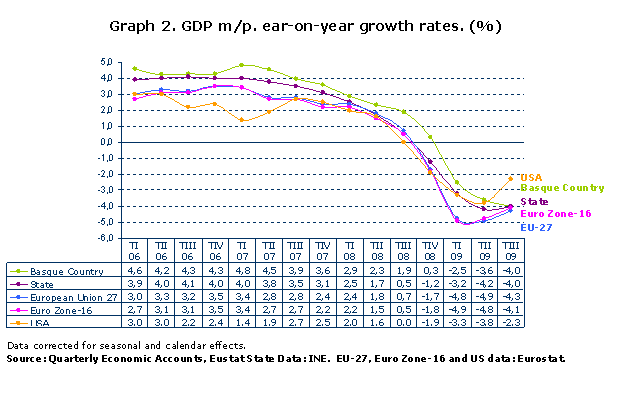
The GDP generated by economic activity in the Basque Country registered a decrease of 4.0% in the third quarter of 2009, compared to the same period of 2008, which meant 0.4 percentage points less growth than that estimated for the previous quarter, according to EUSTAT data.
The year-on-year rate registered by the Spanish economy for the same period was -4.0%, the Euro-16 Zone fell by -4.1%, the EU-27 overall by -4.3% and the US economy decreased by -2.3%.
For the fourth consecutive quarter, the performance with respect to the previous quarter was negative, with a 1.% drop, even though it was 0.9 percentage points down on the previous quarter.
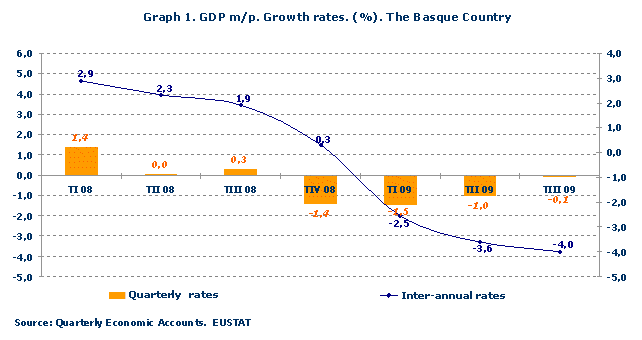
This quarter-on-quarter variation was -0.3% in the case of the Spanish economy, 0.2% for the EU-27, 0.4% for Euro-16 Zone and 0.9% for the US economy, with improvements also being registered in all cases on the previous quarter.
�
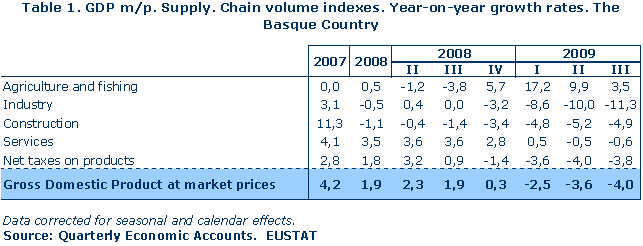
From the perspective of the supply sectors, the most intense downturns occurred in the industrial sector (-11.3%) and in the construction sector (-4.9%). The service sector recorded year-on-year negative growth for the second time (-0.6%). The primary sector was the only one that posted positive growth rates (9.8%).
For the fourth consecutive quarter, the Industrial Sector registered negative quarter-on-quarter and year-on-year rates, even though its negative quarter-on-quarter performance (-0.2%) was up 2.5 percentage points on the previous quarter (-2.7%).
�
The Construction Sector has posted six negative quarter-on-quarter and year-on-year rates, and the fall registered by this sector has been more prolonged over time than that of the industrial sector. Unlike the industrial sector, its quarter-on-quarter performance rate (-1.0%) was 0.4 percentage points down on the previous quarter.
In the Service Sector, with a year-on-year decrease of 0.6% overall, its two components performed very differently. The performance of the Market Services was negative in terms of its year-on-year comparison (-1.8%) and positive in its quarter-on-quarter variation (0.11%), while Non-Market Services continued to grow, posting a year-on-year rate of 5.2%, with its performance being determining for the level of activity achieved by the services sector.
The Primary Sector posted a positive year-on-year variation of 3.5%, even though its quarter-on-quarter performance was once again negative (-5.2%).
In terms of Demand, the contraction of Internal Demand (GDP) (-4.3%) was 0.3 points more negative than the contraction of GDP. The negative performances of its two main components, Private Consumption and Gross Capital Formation, are fundamental to explain this situation. With an Internal Demand that contracted more dramatically than the GDP, the net contribution of the foreign trade balance was positive, despite the negative performance of both exports and imports.
By we analyse it by components, Household Final Monetary Consumption Expenditure (Private Consumption) performed negatively for the fourth consecutive quarter both in year-on-year and quarter-on-quarter terms (-4.3% and -0.7%, respectively).
Final Consumption of General Government (Public Consumption), which includes public expenditure on goods and services, grew by 3.0%, in line with its growth in previous quarters.
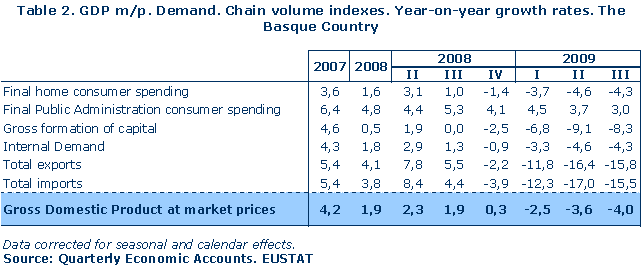
Gross Capital Formation (Investment), as the result of the downturn in Construction and investment in capital goods, was the most negative aspect of Internal Demand, with a year-on-year drop of 8.3%. Its quarter-on-quarter performance was also negative (-0,1%).
Total Exports fell by 15.8% and total Imports were down by 15.5%, which, in short, meant a net positive contribution by the Foreign Trade Balance to the GDP.
�
The number of employed personnel fell by 3.8% with respect to the third quarter of 2008 and was down by 0.6% compared to the previous quarter. With respect to the average for the previous quarter, six thousand jobs were lost and around 39,000 compared to the same quarter of the previous year. The loss of jobs in this quarter with respect to the previous one was clearly headed by Industry sector and by the Services Sector to a lesser degree.
With reference to the performance of the GDP by province, the sharpest fall was recorded in Álava (-4.6%) in this third quarter, and both Gipuzkoa and Bizkaia posted year-on-year falls of 3.9%.
For further information:
Basque Statistics Office
C/ Donostia-San Sebastián, 1 01010 Vitoria-Gasteiz
Tlf:+34-945-01 75 00 Fax:+34-945-01 75 01 E-mail: eustat@eustat.es
Contact: Jose Javier Aramburu
Tel:+34-945-01 75 06 Fax:+34-945-01 75 01
Online press releases: www.eustat.es
Databank: www.eustat.eus/bancopx/english/indice.aspx