Press Release 17/09/2009
2008 TIME BUDGET SURVEY (EPT) 2008
The average time per day dedicated to leisure increased by 23 minutes over the last five years
However, the time spent socialising decreased
According to the findings of the Fourth Time Budget Survey, conducted by Eustat in 2008, the way that the population distributes the time it dedicates daily to the different activities under study revealed certain changes that may indicate new trends in the social use of time.
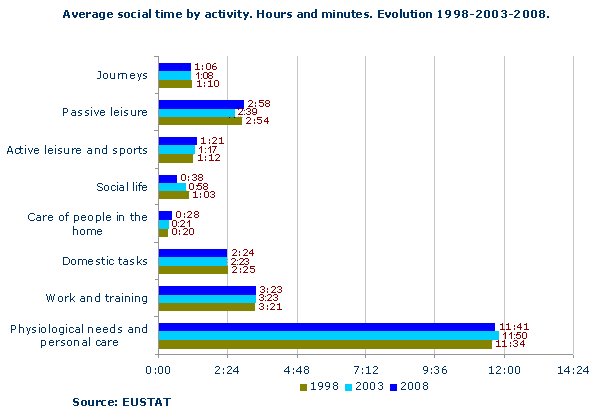
Compared to 2003, the population aged 16 and over of the Basque Country dedicated more time to leisure and looking after people and less time to socialising and meeting personal care and physiological needs. The time dedicated to work and/or training, to domestic chores and travel was similar.
Specifically, an average social time of 11 hours and 41 minutes was dedicated to meeting physiological needs and personal care, 9 minutes less than in 2003. Three hours and 23 minutes were likewise dedicated to paid work and/or training, 2 hours and 24 minutes to domestic tasks, 38 minutes to socialising (20 minutes less than in 2003), 4 hours and 19 minutes to leisure (23 minutes more than in 2003), 1 hour and 6 minutes to travel and 28 minutes daily to caring for other members of the household, 7 minutes more than in 2003.
�
The time spent on meals at home decreased while it increased in terms of meals out
The distribution of the time spent eating changed significantly: the time dedicated to meals at home fell by 21 minutes and the percentage of the population that ate at home was down by 1.1%. However, the time spent on meals out rose by 3 minutes. We can therefore conclude that the average social time spent on eating fell, although people spent more time on meals out (1 hour and 23 minutes, which was 10 minutes more than in 2003), compared to that spent on meals at home (1 hour and 13 minutes, 20 minutes less than in 2003).
Time dedicated to sleep (8 hours and 47 minutes), personal care (54 minutes), medial care (2 minutes) and receiving visitors (4 minutes), did not change significantly with respect to the previous period.
The work time of the working population increased by 12 minutes a day over the last 5 years and the participation rate of women in paid work rose
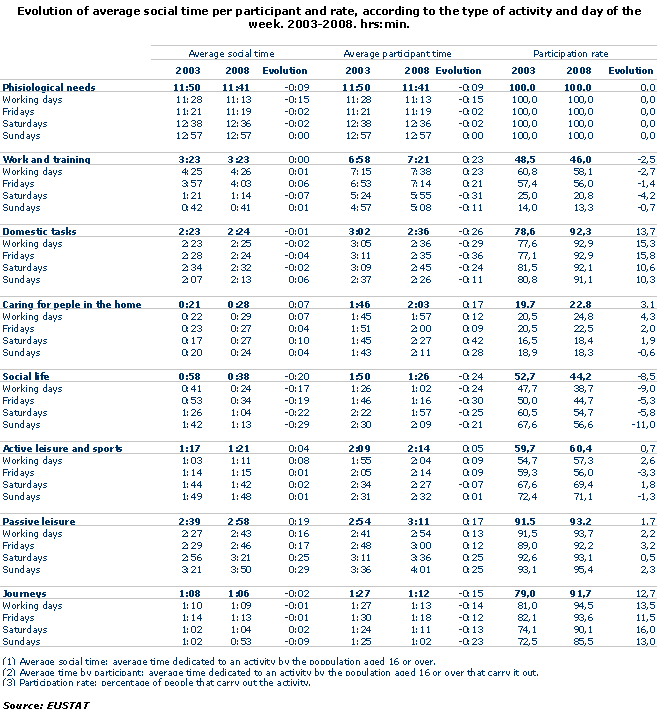
Over the last five years, and counting only Monday to Thursday, there was a 9 minute per day increase in the time that the working population devoted to paid work. On the other hand, there was an increase in the amount of time that people worked at the weekend, when they dedicated 37 and 31 minutes, respectively, more to paid work on Saturdays and Sundays.
If, in 2003, women worked 1 hour and 9 minutes less in paid employment than men, the difference increased to 1 hour and 15 minutes in 2008. Counting only Monday to Thursday, the average working day for men on those days was 7 hours and 4 minutes in 2003 and it rose to 7 hours and 58 minutes, that is 54 minutes more. On those working days, women, however, only registered an increase of 5 minutes, and went from working 6 hours and 31 minutes in 2003 to 6 hours and 36 minutes in 2008. On Fridays in 2008, men worked 23 minutes less and women up to 10 minutes less than on other working days.
A part of the variations discovered in the use of time was down to the increase in paid employment by women The male participation rate in the main professional work in 2008 was 43.5% and the female one was 32.7%, 3.3 per cent more than in 2003 for the former group and 1.9 percentage points more in the case of women
Just 7.7% of people aged 16 or over said they did not devote any time to domestic chores, while the rest spent 2 hours and 36 minutes per day.
92.3% of the population carried out these tasks in 2008, 13.7 percentage points up on five years ago, but they spent 26 minutes less on average than in 2003. However, there was a slightly different distribution depending on the day of the week: it hardly varied from Monday to Friday, while 9 minutes more time was spent on Saturdays and 10 minutes less on Sundays. On the other hand, the difference in terms of the time that the men and women dedicated to those tasks hardly changed. In 2008, women spent 3 hours and 33 minutes on domestic tasks, 2 hours and 4 minutes more than men, while they spent 2 hours and 6 minutes in 2003.
.
The participation and the average time spent on looking after children and adults increased
22.8% of people aged 16 and over (3 percentage points more than in 2003) dedicated a daily average of 2 hours and 3 minutes to looking after members of the household, either children or the elderly. There was a rise of 17 minutes in relation to 2003. In the case of men, this activity took up 1 hour and 41 minutes and it was 2 hours and 18 minutes for women. The time spent looking after children increased by 21 minutes, which meant that 1 hour and 43 minutes was spent on that task. Contrary to what had occurred in 2003, the time sent on looking after adults increased by 26 minutes in 2008, which meant that 2 hours and 9 minutes was dedicated by the carers on this activity.
On average, the population devoted 13 minutes per day to computers and the Internet, nearly double the time spent five years earlier.
93.2% of the population had time for passive leisure –press, television, entertainment, games, etc. This percentage increased 1.7 percentage points with respect to 2003, but the population as a whole also dedicated a daily average of 2 hours and 58 minutes to this type of leisure, a 19-minute increase over the last five years.
Taking the case of the broadcasting and information media –printed and audio-visual-, a 6.3 percent increase can be seen in the proportion of users of these media, representing a rate of 90.8% in 2008. These people devoted an average of 2 hours and 54 minutes to the media, 26 minutes more than in 2003. The increase in time was 30 minutes for men and 22 for women.
On the other hand, 11.5% of the population claimed to spend an average of 1 hour and 1 minutes relaxing, thinking and doing nothing, 10 minutes more than five years ago.
The average social time devoted to active leisure – doing sports, walking or going on excursions, surfing the Internet, etc. was 4 minutes more than in 2003. 60.4% of the population carried out activities included in this section, with a 1% growth in the last five years. Those activities related to the Internet and other Information Technology products accounted for an average social time of 13 minutes per day, nearly the double than in 2003. Men had a greater participation than women in these activities.
The population that spent time on activities related to socialising continued to decrease and they devoted 2 hours to these activities
Just under half of the population aged 16 or over –44.2%- spent 1 hour and 26 minutes per day to activities related to socialising: visiting friends, talking, taking part in political parties or associations, religious practises, etc. Over the last five years, the proportion of the population who carried out these activities(-8.5 percentage points) and the average time used by those who did practise them (a drop of 24 minutes) both fell.
13.3% of the population stated that they spent time visiting or receiving friends, going out for drinks or going to concerts or dances, a figure notably smaller than the 18.2% that appeared in the 2003 survey. The average daily time spent by this group came to 2 hours, five minutes less than five years ago.
The time spent in conversation, particularly face-to-face, also fell by 23 minutes per day, which meant that 52 minutes a day was spent on that activity. On Saturdays and Sundays, this average rose slightly to 1 hour and 1 minute and 1 hour and 4 minutes, respectively.
The inhabitants of Bizkaia were the residents of the Basque Country who slept the least and spent the most time on the media and information, and looking after members of the household; those of Álava the ones who worked and studied the most and spent most time socialising, and those of Gipuzkoa who dedicated most time to physiological needs, domestic chore and travelling.
The residents of Bizkaia slept 8 hours and 43 minutes a day, 12 minutes less than those of Gipuzkoa and 3 less than in Álava Of the latter group, employed individuals spent an average of 7 hours and 29 minutes per day in their job, 14 minutes more than those from Bizkaia and 19 minutes more than the residents of Gipuzkoa.
However, students from Álava –those doing regulated studies- spent 26 minutes more per day on study and attending classes than was the case of their counterparts from Bizkaia and 40 minutes more than those from Gipuzkoa, who spent a daily average of 4 hours and 43 minutes.
17.3% of the residents of the province of Álava usually visited or received friends, went out for drinks or similar activities that might come under the category of socialising, spending an average of 2 hours and 13 minutes, 15 minutes more than in Bizkaia and 16 more than in Gipuzkoa.
It was in Gipuzkoa where the greatest proportion of people stated that they usually chatted by telephone or talked with friends and family, up to 36.6%, while the percentage for Álava was 25.4% and 33.3% for Bizkaia. Furthermore, the residents of Álava spent a daily average of 1 hour and 7 minutes, 10 minutes more than in Bizkaia and 26 more than in Gipuzkoa.
The people of Álava spent 1 hours and 45 minutes playing sports, 12 minutes more than those from Gipuzkoa and 16 more than in Bizkaia.
It was also in Bizkaia where people devoted the most time per day on the broadcasting and information media: an average of 3 hours and 1 minute, 5 minutes more than in Álava and 22 more than in Gipuzkoa. The residents of Bizkaia also dedicated 2 hours and 10 minutes to looking after other members of the household, 2 minutes more than in Álava and 20 more than in Gipuzkoa.
�
For further information:
Basque Statistics Office
C/ Donostia-San Sebastián, 1 01010 Vitoria-Gasteiz
Tlf:+34-945-01 75 00 Fax:+34-945-01 75 01 E-mail: eustat@eustat.es
Contact: Enrique Morales
Tlf:+34-945-01 75 00 Fax:+34-945-01 75 01
Online press releases: www.eustat.es