Press Release 18/05/2009
QUARTERLY ECONOMIC ACCOUNTS (CET) 1st QUARTER 2009
The GDP for the Basque Country fell by 2.5% in the first quarter of 2009
In keeping with international economic trends, the quarter-on-quarter drop stood at 1.7%
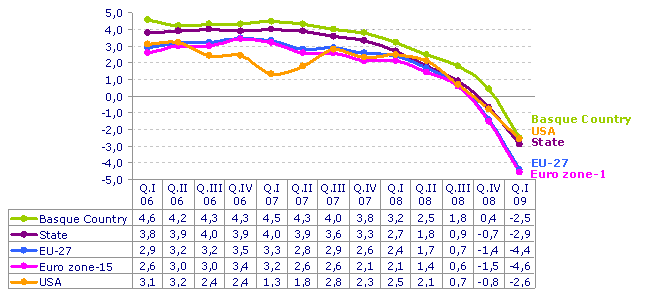
GDP created by economic activity in the Basque Country registered a real downturn of 2.5% in the first quarter of 2009, compared to the same period of 2008, according to EUSTAT data. This first quarter of the year is the first to offer a year-on-year negative growth rate, after the year-on-year growth of the four quarter of 2008 which stood at +0.4%.
Despite this negative growth rate, the rates posted by the Spanish economy (-2.9%), the Euro Zone-15 (-4,6), the EU-27 economy (-4,4%) and the US economy (-2.6%) improved.
The quarter-on-quarter fall of the Basque GDP for the first quarter compared to the fourth quarter of 2008 was 1.7% and it was the second consecutive quarter of negative interquarterly rates. This quarter-on-quarter fluctuation was 1.8 negative percentage points for the Spanish economy, the 2,5 negative percentaje for the EU-27 and Euro Zone-15, and 1.6 negative percentage points for the US economy.
Graph 1. GDP m/p. Year-on-year growth rates. (%)
Data corrected for seasonal and calendar effects.
Source: Quarterly Economic Accounts, Eustat State Data: INE. EU-27, Euro Zone-15 and US data: Eurostat.
�
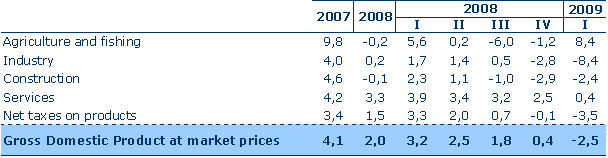
From the perspective of the supply sectors, the service sector (+0.4%) and the primary sector(+8.4%) posted positive growth, while industry and construction recorded an 8.4% and 2.4% year-on-year downturn, respectively. The industry downturn in this quarter was the deciding factor to explain the negative performance of the GDP.
The Construction Sector posted a negative year-on-year growth rate of 2.4%, conditioned by the negative evolution of the building sub-sector that could not be offset by the relatively better performance of the civil works.
The Services Sector posted a slightly positive overall growth rate, but with two completely contrasting trends between non-market and market services. Market Services, linked to industry and private consumption, recorded year-on-year and quarter-on-quarter negative growth rates of 1.0% and 2.7%, respectively. On the other hand, the Non- Market Services continued to grow at the steady rate of previous quarters, with year-on-year growth of 6.9% .
Table 1. GDP m/p. Supply. Chain volume indexes. Year-on-year growth rates (*). The Basque Country
(*) Data corrected for seasonal and calendar effects.
Source: Quarterly Economic Accounts. EUSTAT
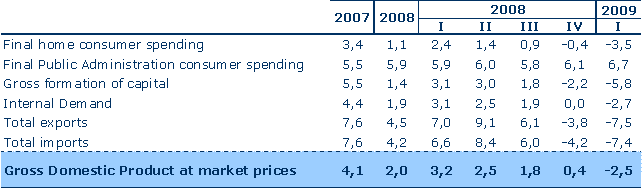
From the point of view of Demand, the most significant trends were the notable reduction in Internal Demand to a year-on-year rate of 2.7%, together with the positive contribution of the growth of the foreign trade balance.
When broken down by components, Expenditure on Household Final Consumption (Private Consumption), decreased at a year-on-year rate of 3.5%. three percentage points down on the previous quarter. Therefore, along with Investment, Internal Demand was slowing down at an even faster rate.
Final Consumption of General Government (Public consumption), grew by 6.7%, as in previous quarters.
Gross Capital Formation (Investment), due to the performance of the construction sector and the Capital Goods sub-sector, shrank by over 3.5 percentage points with respect to the previous quarter and posted a negative rate of 5.8%.
�Table 2. GDP m/p. Demand. Chain volume indexes. Year-on-year growth rates (*). The Basque Country
(*) Data corrected for seasonal and calendar effects.
Source: Quarterly Economic Accounts. EUSTAT
Exports fell by 7.5% and Imports by 7.4%, which meant that our Foreign Trade Balance played a small positive role in the growth of the economy.
With regard to employment figures, over twenty-one thousand jobs were lost during the first quarter of 2009, with a 2.5% fall in the year-on-year employment rate. Every sector posted negative year-on-year trends, which were greatest in the case of construction (-8.5%) and industry (-4.8%) and more moderate in the case of the services (-0.6%) and primary (-3.0%) sectors.
With reference to the evolution of the GDP by province, relative differences could be seen between the provinces during this first quarter of 2009, with the sharpest fall being recorded in Álava (-3.5%), compared to the more moderate downward trends in Gipuzkoa (-2.5%) and Bizkaia (-2.2%).
For further information:
Basque Statistics Office
C/ Donostia-San Sebastián, 1 01010 Vitoria-Gasteiz
Tlf:+34-945-01 75 00 Fax:+34-945-01 75 01 E-mail: eustat@eustat.es
Contact: Jose Javier Aramburu
Tel:+34-945-01 75 06 Fax:+34-945-01 75 01
Online press releases: www.eustat.es
Databank: www.eustat.eus/bancopx/english/indice.aspx