Press Release 22/04/2009
ENVIRONMENTAL SURVEY – FAMILIES –EMAF 2008
Basque households have a high level of environmental awareness and appliances
Water savings habits are very widespread
97.1% of Basque families regularly do something aimed at reducing water consumption, with the most common being “waiting to fill the washing machine or dishwasher” (82.6%) and “thawing food in advance in order to avoid doing so under the tap" (86.8%), according to data provided by Eustat.
However, barely 13.3% of families regularly recycle water, such as “collecting shower water while you are waiting for the hot water to come out". In the same way, only 10.8% have water saving appliances, such as flow reducers, infrared sensors or timers to limit how long the taps are running. On the other hand, 28.6% have discharge limiters in the tanks.
With respect to the average for the rest of Spain, the differences are small overall; practically a similar percentage (96.9%) claim to regularly save water in Spain as a whole, but the percentage of families that use the shower water is higher (22.9%) and the percentage of people with water saving devices is seven points higher.
All the houses have energy sources and over half have mains gas
All the occupied houses have electricity energy. In addition, 59.9% have main gas and a lower percentage used liquid petroleum gases (14.9%), liquid fuels (12.2%) and even wood (3.4%). In Spain has a whole, the percentage of families that have mains gas is 40.5%, while the use of liquid petroleum gases is much higher (42.1%). By provinces, the highest percentage of houses with main gases is in Álava (67.8%) and in Gipuzkoa (62.5), and in the provincial capitals (66.2%), in contrast to Bizkaia (56%) and municipalities with less than 10,000 inhabitants (49%).
Nearly all houses have with some heating system
Just under 90% of main places of residence have some type of heating, with gas (57.2%), electrical (22%) and oil (11.9%) heating being the main types. Álava (96.2%) and Gipuzkoa (94.3%) is 10 percentage points ahead of Bizkaia (85.5%) in heating installations. The availability of heating in Spain as a whole is lower and 70.3% of families have heating in their houses. Gas heating is where the main difference lies as 32.3% of Spanish families have it at home, which is twenty-five points less than in the Basque Country.
In terms of systems, gas (67.9%) and oil (21.88%) heating predominates in Álava and electrical heating in Gipuzkoa (31.9%), the majority of which comes from radiators and accumulators.
When the heating is adjusted by means of a thermostat, the Basque families select on average a temperature of 20.1º, which is more than a degree under Spain as a whole, with less than 30% setting a temperature of 21º or over.
Recycling of ordinary waste is widespread in the Basque Country
The habit of waste recycling is more common in the Basque Country compared to Spain as a whole. A high percentage of Basque families recycle paper and cardboard (92.3%), glass (91.6%) and plastic and metal (90.2%), while the separation of organic waste is much less widespread (32.2%). Collecting exclusively organic waste is implanted to a certain extent only in Bizkaia (43.1%), in medium-sized (50.8%) and small (45.3%) municipalities, and it is lagging rather behind in Álava (27.9%) and, above all, in Gipuzkoa (16.8%). In Spain as a whole, the recycling of paper, glass, plastics and metal is between 70 and 75% less than in the Basque Country, while the habit of separating organic waste is higher (60%).
The main household appliances are present in the majority of homes
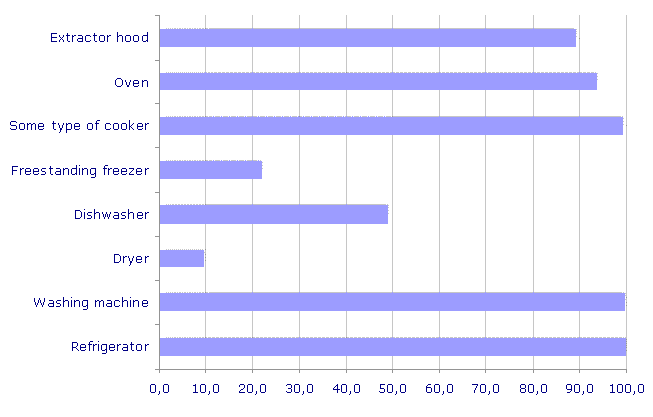
All the main places of residence have a large household appliance: a fridge, washing machine and a type of cooking hob are always present. Most homes have an oven (93.7%) and extractor hood (89.1%), while barely half have a dishwasher (49%). These percentages are slightly higher than for Spain as a whole in terms of all household appliances, differences that range between four points in the case of the microwave and seven points for the extractor hood.
Graph 1. Main places of residence by large household appliances. 2008. %
Source: EUSTAT
The distributions of dishwashers is quite uniform throughout the Basque Country, but they are more common in households consisting of large families (62.7% of families with 4 members), those with small children (64.6% of couples with children under 25 years old), where the family earns more than €2,700 a month (71.5%) and when the head of the household is at least a university graduate (71.9%).
With regard to “small” household appliances, microwaves (89.5%), food processor (87.5%), hairdryer (87%) and the vacuum cleaner (84.5%) are immediately behind the iron (97.5%) as the favourite or necessary home accessories.
Most homes have basic audiovisual equipment
The television is an appliance that is in all Basque homes. The other main appliances include the DVD (70.8%), the sound system (62.8%) and computer (62.5%). More than a firth of homes also have game console (22.3%). But that is mainly the case in large families (44.3%), with small children (43.5%) and, to a lesser extent), with high income (34.1%).
Compared to the rest of Spain in the case of audiovisual equipment, however, the Basque Country figures are under the average for the country as a whole, except for the television set, with similar percentages, and the computer. These differences range between two points in the percentage of families that have a sound system and four and a half points in the case of a game console. As far as a computer being available is concerned, the percentage of Basque families is slightly more than three points higher than the state average.
A fourth of the families have to put up with noise and 15% bad smells
A fourth of Basque families have to put up with noise (26%) and 15.1% bad smells in their home. The main sources of nose are traffic (11.9%), building works (10.4%) and neighbours (7.6%). Pipes and plumbing (6.6%) and industrial activities (2.5%) are the source of the bad smells. In Spain as a whole, the percentage of families with noise is very similar (25.1%), while 20.3% claim to suffer from bad smells.
Whether or not these problems are serious, it is true that less than 30% of Basque families affected take any measure against them, which usually involves complaining to the person responsible and, more rarely, making a formal complaint.
Over 70% of families have a vehicle.
72.3% of families have at least one vehicle, whether it is a car, motorbike or van, for their personal use. On average, there are 1.4 vehicles per home and nearly 5% of houses have 3 or more. The presence of vehicles is clearly associated with the size of the family, as families with 5 or more members have an average of 2 vehicles. Apart from this obvious correlation, the families earning higher incomes have more vehicles: 1.6 is the average for those that earn more than €2,700 a month.
The figures for Spain as a whole are similar, with 74.7% of families having at least one vehicle and an average of 1.6 vehicles per household.
The mobility of the population is based on private transport
In keeping with the abundance of vehicles owned, private transport (41.2%) and, mainly, the car (40.3%), are clearly the main standard means of transport. Travelling on foot or by bicycle (30.8%) is the second way of travelling, followed closely by public transport (28%), where the most popular means is the bus (16.2%).
The figures for Spain as a whole are even slightly higher with regard to the use of private transport (45.3%). The percentage of journeys of foot or by bicycle is also three percentage points higher, while public transport is used to a greater extent in the Basque Country (28%) than in the rest of Spain (21.7%).
By provinces, private transport predominates in Gipuzkoa (48.6%). In Álava, private transport (42.5%) is on a par with the number of people travelling on foot or by bicycle (41.2%), while the three means of transport are more balanced in Bizkaia: private (36.5%), public (32%) and on foot or by bicycle (31.5%).
It may seem surprising to know that it is in the three provincial capitals where more journeys are on foot or by bicycle (43.9%) and it is in small towns where private transport is most used (55.1%), but that is undoubtedly due to the fact that the residents of small towns need to travel to other towns for their day-to-day activities, (working, studying, shopping or leisure), and that these needs can not be meet by the insufficient public transport (24.8%), in minimum values.
For various reasons, pensioners and people in charge of house work travel in the most ecologically-friendly way, as most of them travel on foot. However, nearly two thirds of fulltime workers use private transport (60.6%).
There is widespread concern about the environment among the population
Nearly all people aged 16 and over say that they are concerned about the environment, mainly to a great extent (81.2%) and know about the awareness campaigns regarding water and energy saving or recycling (80.8%). This environmental awareness is slightly higher than in the rest of Spain (76.9%), particularly in terms of knowing about the awareness campaigns (59.2%).
Just under a quarter of people have detected ecological problems in their immediate environment (23.2%) and less than a fifth have taken part in some environment-related activity (17.5%), mainly in the form of signing petitions against harmful situations (11.9%).
Finally, there is massive support (94.3%) among the population for adopting specific environmentally-friendly measures, such as reducing traffic noise (86.2%), restricting the abusive consumption of water (71.3%) and, even, the introduction of an environmental tax on the most polluting fuels (63.8%). This support is, even, three points higher in the rest of Spain and ten points more in the case of restricting water consumption, as this measure is supported by 81.3% of families.
Methodology note:
Eustat conducted this Environmental Survey - Families in conjunction with the Spanish National Statistics Institute (INE) and the institutes of Andalusia (IEA), Catalonia (IDESCAT) and Galicia (IGE), as part of the 2008 Environment and Households Survey, which aims to establish the appliances, habits and attitudes of families towards the environment.
For further information:
Basque Statistics Office
C/ Donostia-San Sebastián, 1 01010 Vitoria-Gasteiz
Tlf:+34-945-01 75 00 Fax:+34-945-01 75 01 E-mail: eustat@eustat.es
Contact: Enrique Morán Aláez
Tlf:+34-945-01 75 35 Fax:+34-945-01 75 01
Online press releases: www.eustat.es
Databank: www.eustat.eus/bancopx/spanish/indice.asp