Press Release 11/03/2009
POPULATION AND HOUSING STATISTICS 2006. Migratory Movements
The number of residents born abroad increased to 115,000
The percentage of people born outside the Basque Country remained steady over the last ten years, but their place of origin has changed
Over the last 5 years, the number of people born abroad increased significantly, rising from 50,000 to 115,000 people, according to Eustat data. A total of 601,541 residents in the Basque Country were not born in one of the three provinces, which accounts for 28.2% of the population.
However, it is noteworthy that while the percentage of people born outside the Basque Country remained stable over the last ten years, changes in their origin did occur. Therefore, with respect to 1996, there was a drop of 73,365 people born in other Autonomous Communities and an increase of 95,767 of people who were born abroad.
The main Autonomous Communities of birth were Castilla y León (9.6%), Extremadura (2.4%) and Galicia (1.7%), in that order. Among the people born abroad, there were people from 161 countries on the 5 continents, even though the largest group consisted of people from South America, who accounted for 42% of this total.
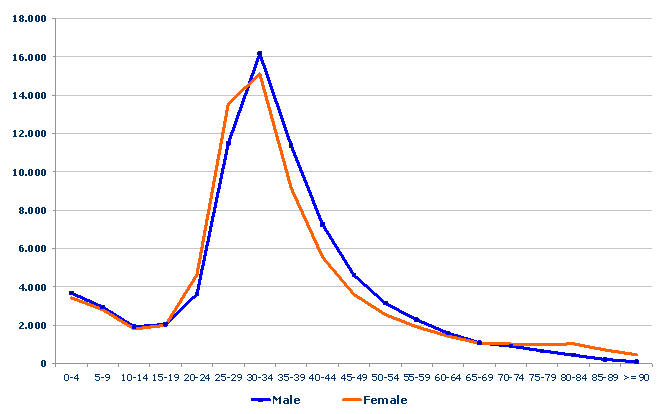
Graph 1. Population who changed municipality in the Basque Country between 2001 and 2006, according to age and sex. Number.
Source: EUSTAT
�
Around 45% of the population continued to live in the municipality where they were born
45% population of the Basque Country lived in their municipality of birth (sedentary), 23.5% came from another Autonomous Community or from abroad and 32% had changed into another town within the Basque Country at some point in their lives (internal migrants).
The greatest number of people changed municipality within the Basque Country between the ages of 25 and 30, even though in the case of men, this could be up to 40 years old.
There were some differences between the three provinces in terms of mobility in the Basque Country. Bizkaia had a less sedentary population (42.9%) and the population was divided between internal migrants (33.7%) or those born outside the Basque Country (23.4%). In Gipuzkoa, the population was more sedentary (47.7%) and Álava was the province with more people born outside the Basque Country (32.2%) and where there were fewer internal migrations (24.2%).
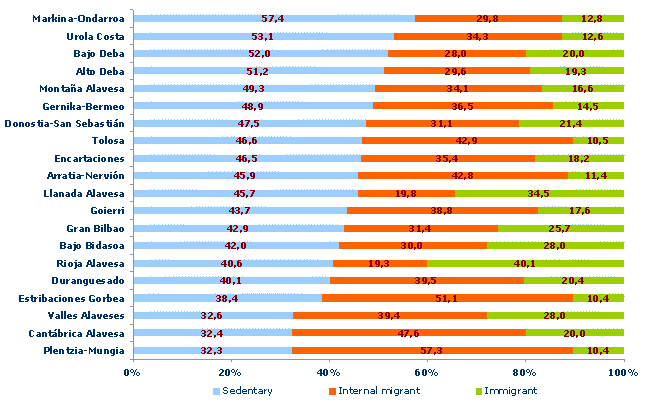
Graph 2.- Population according in terms of migration by district. 2006 (%)
Source: EUSTAT
By districts, Markina-Ondarroa (57.4%) and Urola Costa (53,1%) were the districts with the largest sedentary populations. On the other hand, the districts with the greatest number of immigrants were the Rioja Alavesa (40.1%) and the Llanada Alavesa (34.5%).
�
Special mention should be made of some districts where the population from other municipalities of the Basque Country was greater than the number of people native to the district, such as Plentzia-Mungia (57.3%), where 28,989 of the current 50,628 inhabitants came from other municipalities of the Basque Country, 16,390 were sedentary and 5,263 were immigrants. This same phenomenon was repeated in three districts of Álava: Estribaciones del Gorbea (51.1%), Cantábrica Alavesa (47.6%) and Valles Alaveses (39.4%).
For further information:
Basque Statistics Office
C/ Donostia-San Sebastián, 1 01010 Vitoria-Gasteiz
Tlf:+34-945-01 75 00 Fax:+34-945-01 75 01 E-mail: eustat@eustat.es
Contact: Pilar Vázquez Sancho
Tel:+34-945-01 75 34 Fax:+34-945-01 75 01
Online press releases: www.eustat.es