Press Release 13/03/2009
DEMOGRAPHIC PROJECTIONS (PD) 2020
Migration will be the main growth factor of the population of the Basque Country
The population of the Basque Country will increase by 117,000 people between 2005 and 2020
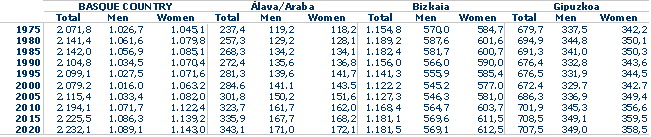
By 2020, the Basque Country will have 2,232.1 thousand inhabitants, 1,089.1 thousand of whom will be men (48.8%) and the remaining 1,143 thousand (51.2%) women, according to the 2020 Demographic Projections prepared by Eustat. Therefore, there will be nearly 117,000 people more in 2005, with an average annual growth rate of +0.37%, which will not be uniform, as growth is concentrated in the initial part of the period, while deceleration is predicted in the medium term ending in zero population growth at the end of the projected period.
Graph 1. Population pyramids of the Basque Country 2005-2020.

Source: EUSTAT
The provincial forecast predicts that Álava will be the only one to maintain its positive growth rates throughout the projection period, with an average rate of 0.88%, and will increase by slightly over 41,000 inhabitants, an increase that, given its population volume, is significant. The populations of Bizkaia and Gipuzkoa will also increase (by around 54,000 and 21,000 people, respectively), but at a notably lower rate: 0.32% for Bizkaia and 0.21% for Gipuzkoa. But the most outstanding point is that growth will be negative in these two provinces at the end of that period.
�
Table 1. Yearly Population Changes by Province and Sex. 1975-2020 (in thousands).
Source: EUSTAT
During the first 8 years of the projection period, both the natural balance, births less deaths, and the migratory balance, immigrations less emigrations, will be positive and, therefore, the population will increase by 102,000 persons. During the following years, the population will only increase by 15,000 people due to the fact that the natural population growth will be negative and migratory balance, even though it will continue to be positive, will decrease until it is equal to the natural population in the last year of the projection period.
The population continues to age
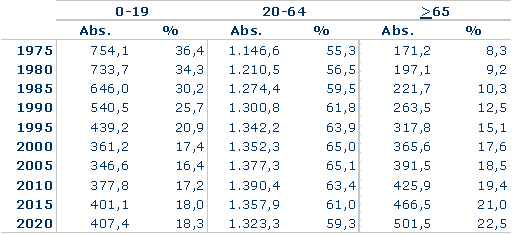
The population under 20, which accounted for 16.4% of the total of the Basque Country in 2005, will rise to 18.3% by 2020, which will mean that there are nearly 61,000 more young people, in contrast with the previous trend of continuous falls in this segment of the population.
However, this change is not enough to counteract the considerable increase in the population aged 65 or above: 110,000 people more, representing a proportional increase among the total population for this age group, from 18.5% in 2005 to 222.5% in 2020. But the biggest increase occurs in the proportion of people aged 85 or over, increasing from 2% of the total population in 2005 to 4.1% in 2020, as a result of the consequence of a higher growth rate of the very elderly segment of the population (+5.31% annual) compared to the elderly (+1.66% annual). This rate of growth represents an absolute increase of more than 50,000 personas aged 85 or above, from 42,800 to 93,000 in 15 years.
On the other hand, the “adult” population, that is those aged between 20 and 64, drop in number by 54,000 within the period 2000-2015, falling in their share of representation of the total population by almost 6 percentage points during that period (from 65.1% to 59.3%).
�
Table 2. Yearly Population Changes (in thousands) by Broad-age Groups. Basque Country 1975-2020.
Source: EUSTAT
Fertility recovers, but the number of births falls
The evolution of the annual birth rate reflects the impacts of past demographic dynamics on the future. Even though a recovery of fertility rates in women to values near to 1.4 children per women in 2020, which is a 50% increase on the level given in 2005, the birth rate in the Basque Country will be significantly reduced from the second decade of the century onwards. The reason for this decrease is the progressive fall in the number of women aged between 25 to 39, an age group where nearly 90% of the totally fertility is concentrated, which will be reduced by over 27%: from 251,000 in 2006 to 181,000 in 2020, despite the initial population contributions to those age groups due to immigration.
The impact on the birth rate will be very important, as, in the last years of the projected period, the number of births will again be under the figure of 18,000 per year, that is, similar to those registered for the 2001-2002 two-year period when fertility was 25% under than that predicted for 2020.
Life expectancy continues to increase
Between 2005 and 2020, the mortality rate will fall more among men than women and this will be particularly so among the younger age groups. The mortality rate for male children aged between 1 to 14 will fall by over 51%, while the fall for female children will be 42%. The population aged 15 to 29 will also see notable decreases in their mortality rate, more in the case of men (47%) than women (nearly 40%). However, the mortality rate for women aged 60 to 90 in that period will fall by 25%, while the one for men will be just over 22%. The infant mortality rate for girls in 2020 will be 6 times lower than it was 45 years ago in 1975, while for boys it will be 7 times lower.
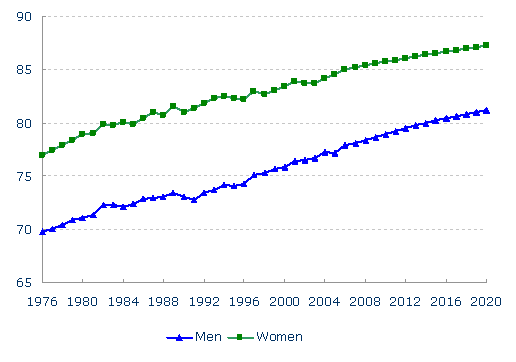
Life expectancy at birth will reach 81.2 for men and 87.3 for women in 2020, figures which were 77.1 and 84.6, respectively, in 2005. However, in these years the gap between male and female mortality rates will diminish, something that had been witnessed since the last five years of the previous century The difference between life expectancy for women and for men will fall from 7.4 in 2005 to 6 in the final period considered in this projection, that is the year 2020. This will be due to the greater reduction of the mortality rate of men, particularly among young people and adults, in women.
�
Graph 2. Changes in life expectancy by sex. Basque Country 1975-2020.
Source: EUSTAT
The migratory balance will be the most important factor determining population growth
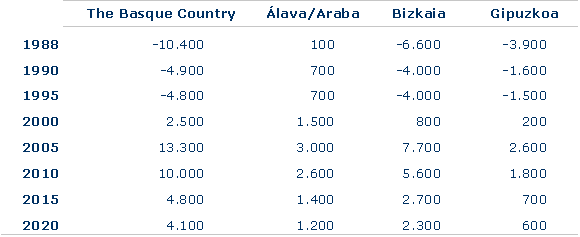
The population growth during the projection period will be, nearly exclusively, due to the migratory balance, as the natural population growth will be negative from 2013 onwards. The migratory balance, even though it will always be positive, will play an increasingly less important role: from over 18,000 net migrants in 2007 to just over 4,000 in 2020.
The determining element in the downturn in the migratory balance will be the predicted reduction in the annual number of entries to the Basque Country, particularly those from abroad, as the emigrant figure will remain more stable, even though there will a slight downward trend. Therefore, the figure of just over 41,000 immigrants in 2007 will fall to just over 26,000 in 2020, which is 37% fewer entries, while emigrants will stabilise at slightly over 22,000 a year, that is, there will be a 5% reduction.
In recent years, Álava has had positive migratory balances, but the negative balances of the other two provinces were so high, that even with a positive natural balance the total population fell. This situation changed suddenly in 2000 when a significant increase in immigration was registered producing positive balances for Bizkaia and Gipuzkoa, a situation which, with greater or lesser balances will be maintained until 2020. The drop in the migratory balance will affect Gipuzkoa more with a 76% fall between 2005 and 2020, down to just 600 people. Bizkaia will fall by 70%, while it will be 60% in Álava.
�
Table 3. Annual changes of the migratory balance by province. 1988-2020.
Source: EUSTAT
In the most recent period, in addition to the exterior migratory flows intensifying, the inter-provincial migratory balances increased. During the Nineties, the number of those migrations ranged between 3,200 and 3,500 a year, while it stood at around 4,500 a year during the 2005-2006 two-year period. The greater presence of foreigners, characterised by a higher residential mobility, played a basic role in that process, as can be seen from the fact that one out of every five internal movements involve a foreigner. As far as the future is concerned, there will be reduction in internal mobility, on the one hand, partly due to the reduction envisaged in the entries of foreigners and, on the other hand, geographical differences will remain, with an internal mobility of the residents in Álava that will double that of the inhabitants of the other provinces.
For further information:
Basque Statistics Office
C/ Donostia-San Sebastián, 1 01010 Vitoria-Gasteiz
Tlf:+34-945-01 75 00 Fax:+34-945-01 75 01 E-mail: eustat@eustat.es
Contact: Martín González Hernández
Tlf:+34-945-01 75 49 Fax:+34-945-01 75 01
Online press releases: www.eustat.es