Absence of wellfare and maintence poverty: Leyden method or SPL
Applied research has shown the contradictions in the European statistical meted and that, in reality, this is mainly an indicator of inequality in the distribution of income in a determined society. Another criticised aspect is that the determination of the threshhold of poverty is totally arbitrary, both with regard to the percentage set of the indicator (average or median) and the system of equivalence scales, being defined exclusively according to the criteria of the researcher.
In order to obviate these problems, a series of innovative methodologies have been developed that, in general, attempt in common to associate the calculation of poverty threshholds to society's own perception of basic needs. One of the most coherent approaches to this concept is associated to the work by researchers based at the Uiversity of Leyden. Internationally, the calculation is in accordance with the meted consolidated by these researhers known as the SPL method.
The SPL method is based on Kapteyn's theory of preference formation. This researcher is, in fact, the one who formulated the simplified meted to calculate the SPL method, this approach being used normally in studies that apply this methodology.
The method is based on the study of the relation existing between responses in households analysed in the reference statistical operation with regard to a series of questions related to measuring poverty or other forms of absence of wellfare (necessary income to meet basic needs and minimum income need to reach the end of the month, fundamentally) and real present income for the households considered.
In accordance with SPL methodology, if the amount of individuals that consider their minimum income mínimos "ymin" is an increasing function of the income "y", with an elasticity between 0 and 1, then the higher the present income is, the higher the income considered minimum. If we analyse graphically the 45º line that represents the line on which minimum individual income is the same as present income, and it is compared with the line of minimum income defined from household responses, then it is possible to find a "natural solution" to the aggregation problem: there is an intersection in the line at y = y*min.
To the right of y*min, households dispose of present income higher than that considered minimally necessary; to the left of y*min however households dispoe of present income below the level of income considered minimally necessary. The intersection point divides, therefore, households that have sufficient resources to reach the end of the month or meet their basic needs and those that do not, according to their own standards. In this way, y*min becomes the poverty line that divides the poor from the not poor.
The simplified meted of calculation for the SPL method acts on three variables:
| · ymin: |
minimum necessary income |
| · y: |
househod effective available income |
| · fs: |
size of houshold |
The positive relation between ymin and y makes it posible to determine a value y*min that constitutes the threshhold under which effective income is below y*min and above which effective income is above y*min. (Kapteyn)
The calculation of this threshhold is formed from the following equation, worked with logarythms:
y*min = âo + â1fs + â2y
From which the following solution is derived for value y*min= y (defined as the balance point at which minimum theoretical income and real income coincide, i.e. the poverty threshold):
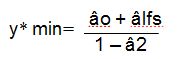
This equation may be applied both to the indicator referring to the minimum hended to reach the end of the month and to that relating to the minimum required to cover basic needs (the first linked to the absence of welfare and the second to serious poverty), giving the following poverty thresholds and absence of welfare for the Autonomous Community of Euskadi:
Serious poverty thresholds for maintenance and absence of
welfare
according to SPL method
(Data in euros)
| Size of household |
Poverty
|
Absence of welfare
|
| 1 person |
414,99
|
646,47
|
| 2 persons |
507,99
|
782,17
|
| 3 persons |
571,77
|
874,39
|
| 4 persons |
621,83
|
946,35
|
| 5 persons |
663,65
|
1006,22
|
Source: Survey on Poverty and Social Inequalities 2000