Units of measurement (Survey on the structure of agricultural farms)
Units of measurement for area
The unit of measurement used for the area of the agricultural holding and crops is the hectare (10,000 m2), except in the case of cultivated mushrooms, where it is the square metre (m2).
Units of measurement for livestock
Data related to livestock holdings can be expressed in:
Heads of animals
Livestock data can be expressed in the number of heads of animals of the different types of livestock.
Heads of animals are given on a reference day within the reference period (for the survey 30 September 2023 was used), since the number of livestock in a year may fluctuate.
For some types of animals (e.g. poultry), there may be a period between production cycles in which the livestock housing is empty, due to temporary breaks in the production cycle (e.g. regular sanitary cleaning of animal housing, disease outbreaks or similar reasons) or fewer animals being kept on the holding. The number of livestock on these holdings shall correspond to the number of animals present immediately before sanitary cleaning (provided that they are no longer kept on any other holding).
Livestock units
- Bovine animals:
. Less than 1 year old: 0,4;
. 1 to less than 2 years old: 0,7;
. Male, 2 years old and over: 1,0;
. Heifers, 2 years old and over: 0,8;
. Dairy cows : 1,0;
. Non-dairy cows : 0,8;
- Sheep and goats: 0,1;
- Pigs:
. Piglets with a live weight of less than 20 kg: 0,027;
. Breeding sows with a live weight of 50 kg or over: 0,500;
. Other pigs: 0,300;
- Poultry:
. Broilers: 0,007;
. Laying hens: 0,014;
- Other poultry:
. Turkeys: 0,030;
. Ducks: 0,01;
. Geese: 0,02;
. Ostriches: 0,35;
. Other poultry not included elsewhere: 0,001;
- Rabbits, breeding females: 0,02.
A livestock unit (LU) is a standard unit of measurement that enables the aggregation of various categories of livestock of various species and ages according to convention, via the use of specific coefficients established on the basis of the nutritional or feed requirements of each type of animal, in order to allow for comparison.
The coefficients used are adopted in accordance with Annex I of Regulation (EU) 2018/1091:
Livestock units table in accordance with Annex I of Regulation (EU) 2018/1091
Number of beehives
For bees, the unit adopted is the number of beehives.
Units of measurement for work
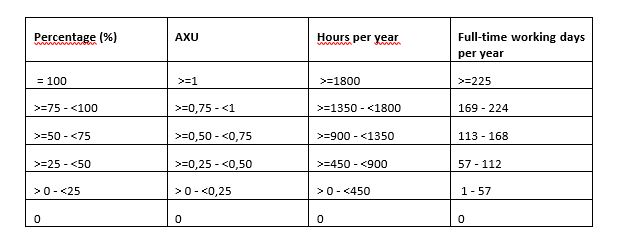
Data on work on the holding are expressed in number of working days, in percentage of time spent working or in annual work units (AWUs); one AWU is equivalent to the work performed by one person on a full-time basis over the course of one year.
One annual work unit (AWU) is equivalent to the work performed by one person on a full-time basis over the course of one year, i.e. the total hours worked divided by the average annual hours worked in full-time jobs in the country.
For census purposes, full-time is defined as working 1,800 hours (8 hours a day for 225 working days).
The table below shows the equivalences between AWU bands, hours worked per year and full-time working days:
Volume of water used
The measure used to account for the volume of water used in the exploitation for irrigation is the cubic meter (m3).
Date and Time
The date and time shall follow ISO standard 8601. The main characteristic of the standard is that date/time information is ordered so that the largest temporal term (the year) is placed to the left and successive smaller terms are placed to the right of the previous term (date elements can be separated by "-" and time elements by ":" to improve human readability).
The standard also sets the Gregorian calendar as a reference calendar.
The standard also prescribes a four-digit year (YYYY) as a minimum.
Bear in mind that the YYYYMM format cannot be used to represent a month and YYYY-MM should be used instead.
Other conventional units of measurement
The following conventional units are also used:
Standard Output (SO)
The output of an agricultural characteristic is the monetary value of gross output at farm gate price.
The standard output (SO) means the value of output corresponding to the average situation in a given region for each agricultural characteristic.
Output is the sum of the value of the principal product(s) and of the secondary product(s). The values are calculated by multiplying the output per unit by the farm gate price. VAT, taxes on products and direct payments are not included.
The standard outputs correspond to a production period of 12 months (agricultural year from 1 October 2022 to 30 September 2023). For crop and livestock products with a production period of less or more than 12 months, a SO shall be calculated which reflects the increase or the annual output for a 12-month period.
The SOs are provided by the Ministry of Agriculture, Fisheries and Food.
The standard outputs shall be determined using average basic data calculated over a reference period of five years. They are updated every so often in line with economic trends.
The total standard output (TSO) of the holding shall correspond to the sum of the values obtained for each characteristic by multiplying the standard outputs per unit by the number of corresponding units.