Methodological note. Human development index
The Human Development Index (HDI) is a summary measure of the average achievements made in the basic dimensions of human development:
- A long and healthy life, as measured b life expectancy at birth.
- Education as measured by expected years of schooling for children at school age and by the mean years of schooling that adults aged 25 and above have undertaken.
- A decent standard of living as measured by Gross National Income (GNI) per capita in terms of purchasing power parity (PPP) in US dollars in 2017.
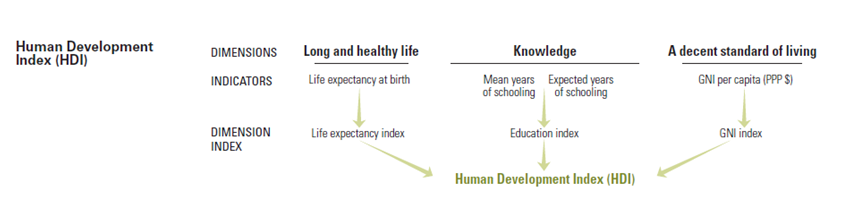
It is worked out for the Basque Country using the methodology of the United Nations Development Programme (UNDP)
SOURCES FOR THE INDICATORS
- Life expectancy at birth: Demographic indicators. Eustat
- Expected years of schooling: School activity statistics and Municipal Inhabitants Statistics. Eustat
- Mean years of schooling: Survey on population in relation to activity (PRA). Eustat
- GNI per capita: Economic accounts. Eustat
STEPS FOR CALCULATING THE HDI
Step 1. Create indices for the dimensions
In its most recent report, the UNDP established minimum and maximum values in order to convert the indicators, expressed as different units, into indicators between 0 and 1. These limits act as “natural zeros” and “targets” respectively:

By using these minimum and maximum values, we can calculate the dimension indices using the following formula:

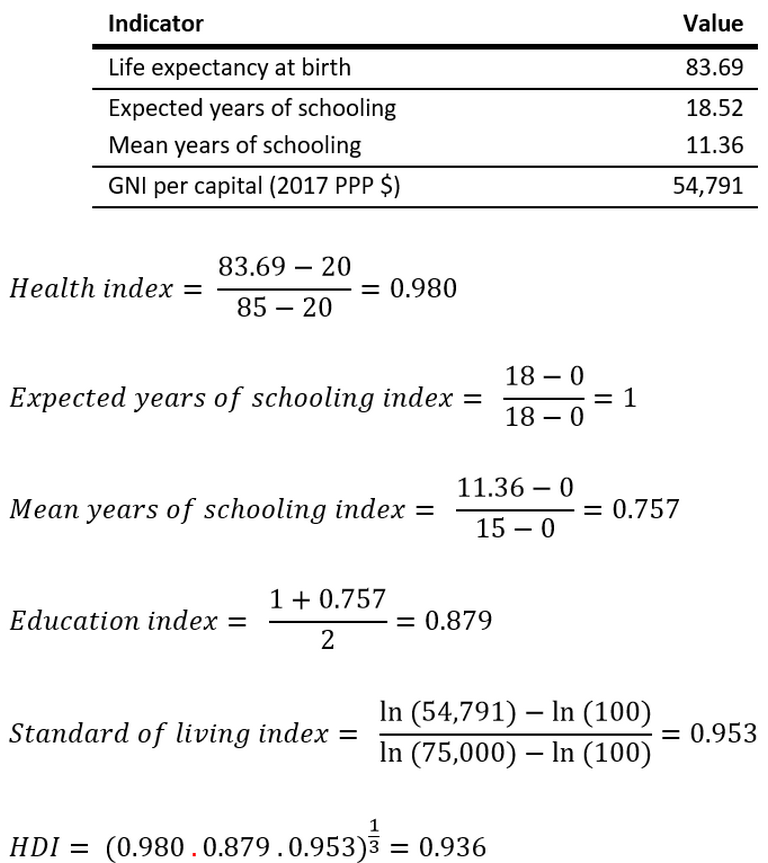
In the dimension of Education, the previous equation is first applied to both the indicators, and we then work out the arithmetic mean for the indices we obtain.
Even though income is crucial to human development, its contribution to human development decreases as income increases. An increase in GNI per capita of 100 dollars in a country where the average income is only 500 dollars has a significantly greater effect on standard of living than an increase in GNI per capita of 100 dollars in a country where average income is 5,000 or 50,000 dollars. This means that, for the Standard of Living dimension, we use the natural logarithms of current, minimum and maximum values.
Step 2. We aggregate the dimension indices to work out the HDI
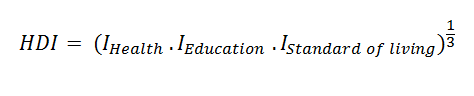
The HDI is calculated as the geometric mean of the three dimensional indices:
Example: Basque Country